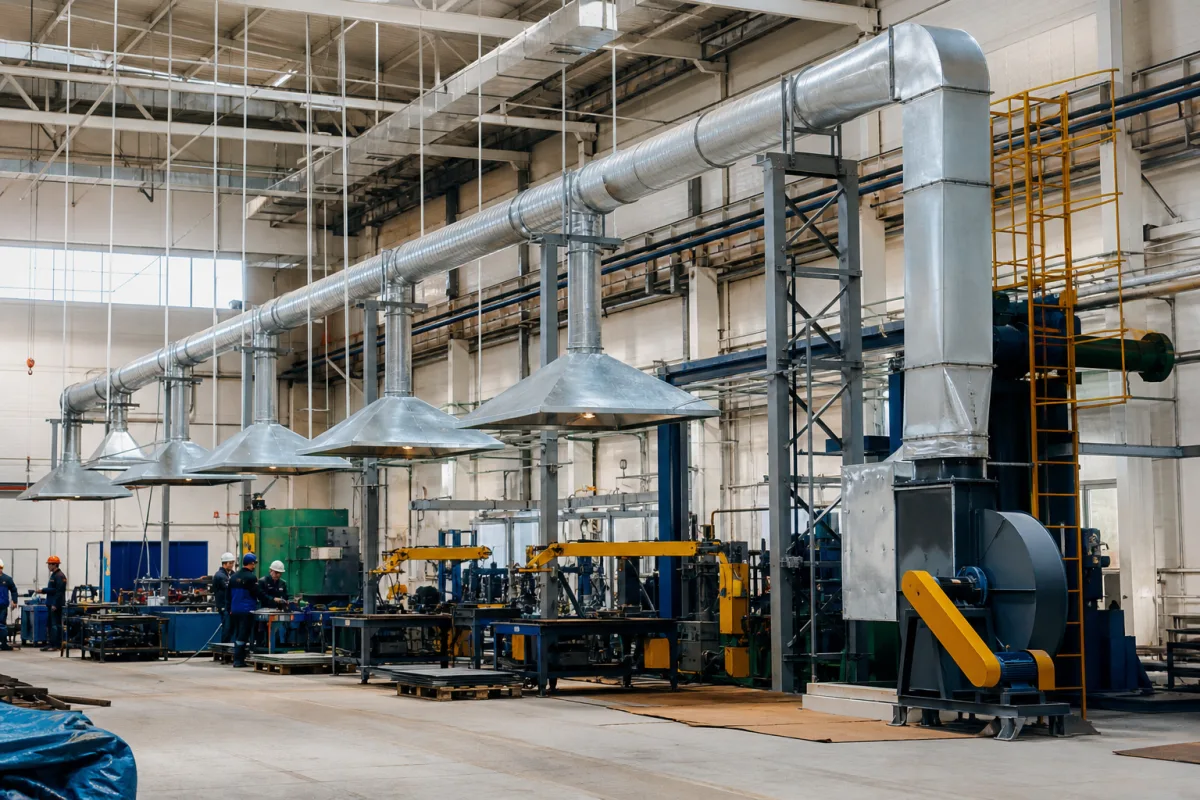
Industrial exhaust system (local exhaust ventilation and process exhaust)
Industrial exhaust ventilation · Hoods, ductwork, fan and air cleaner for workshops and process machines: capture velocity, duct velocity, canopy sizing, fan duty
An industrial exhaust system takes contaminated air from where it is released, through a hood or a machine connection, along ductwork and through an air cleaner, and discharges it using a fan. Three design choices decide whether it protects anyone: the type of hood for each source and what face or capture velocity it needs, what duct velocity keeps the contaminant moving to the fan, and the volume and pressure the fan must deliver when every hood is open.
Local exhaust ventilation and process exhaust systems for workshops and process machines: capturing, receiving and enclosing hoods, ductwork and dampers, exhaust fans, filters and stacks, including the exhaust air handling attached to tablet coaters, dryers and similar equipment. The coating machine itself is covered on the Pharmaceutical tablet coating machine (pan coater) page. Vehicle exhaust pipes, mufflers and catalytic converters, and kitchen range hoods, are outside this page. Extraction arms, on-torch extraction and filter units for welding and cutting fume are dealt with on the Welding fume extraction systems page.
CNFX editorial research · Sources checked October 12, 2026 · 3 sources
Choose the hood and the velocity that captures the source
HSE's guide to local exhaust ventilation, HSG258, groups hoods as enclosing, receiving and capturing. For partial enclosures it asks for a face velocity of at least 0.4 m/s unless a lower one is shown to work. For capturing hoods its Table 9 gives capture velocities of 0.25–0.5 m/s for release into still air with little energy (evaporation, plating mist), 0.5–1.0 m/s for welding, soldering and liquid transfer, 1.0–2.5 m/s for crushing and spraying, and 2.5 to over 10 m/s for cutting, abrasive blasting and grinding, which it says are difficult to control with capturing hoods. [1]
For canopy hoods, HSG258 gives a rule of thumb of an extract rate 1.2 times the volume flow of the rising plume at the hood face, and an overlap over the source of 0.4 times the hood's height above it. It warns that canopy hoods are ineffective over cold processes with no thermal uplift and do not protect an operator who has to work above a hot process. [1]
OSHA 29 CFR 1910.94 requires portable grinding, whenever the work permits, to be done in a partial enclosure with an average face velocity of at least 200 ft/min, and at least 150 ft/min over the whole opening where large partial enclosures house a complete grinding, polishing or buffing operation on cradles. [2]
Editorial calculation: with HSG258's conversion of 1 m/s = 197 ft/min, OSHA's 200 ft/min is about 1.0 m/s and 150 ft/min about 0.76 m/s, both above HSG258's 0.4 m/s minimum for partial enclosures. [1][2]
Give the supplier a list of every source: the process, the contaminant and its form (gas, vapour, fume, dust, mist), its temperature, the hood type you expect, the opening size, the number of hoods used at once, the building layout and the discharge point.
02
Size ducts to keep the contaminant moving
HSG258's Table 12 recommends minimum duct velocities of 5 m/s for gases and non-condensing vapours, 10 m/s for condensing vapours, fume and smoke, 15 m/s for low or medium density, low moisture dusts, fine dusts and mists, around 20 m/s for process dust such as grinding dust, and around 25 m/s for large, aggregating or damp particles. It lists a variable-speed fan, pulley changes or dampers as ways to cope with hoods being isolated, noting that dampers are not energy efficient. [1]
For grinding, polishing and buffing exhaust, OSHA 1910.94 recommends a minimum duct velocity of 4,500 ft/min in branches and 3,500 ft/min in mains, and takes hood entry losses as 0.65 velocity pressure for a straight takeoff and 0.45 for a tapered takeoff. [2]
Editorial calculation: 4,500 ft/min ÷ 197 ≈ 22.8 m/s and 3,500 ft/min ÷ 197 ≈ 17.8 m/s, close to HSG258's around 20 m/s for process dust. For a duct carrying 6,000 m³/h of air with fine dust or mist at 15 m/s: 6,000 ÷ 3,600 = 1.67 m³/s; 1.67 ÷ 15 = 0.111 m², a round duct of about 376 mm diameter. The 6,000 m³/h is an example volume taken from the inlet air of Canaan's largest listed coater; the exhaust volume of a real installation should come from the supplier. [1][2][3]
03
Match process exhaust to the machine it serves
Process machines carry their own exhaust units. Canaan's BGX tablet coater table lists inlet air volumes of 2,000–6,000 m³/h with inlet fans of 2.2–5.5 kW, and exhaust fans of 4 kW (BGX75), 5.5 kW (BGX150), 7.5 kW (BGX250 and BGX350) and 15 kW (BGX600), with exhaust cabinets weighing 650–1,200 kg. [3]
On every model in that table the exhaust fan is rated higher than the inlet fan, so the exhaust side, its filters and its ducting should be specified as part of the coater installation rather than added later. Ask for the exhaust volume and static pressure at the cabinet outlet so the building duct and any shared fan can be sized to it. [3]
04
Enclosing, receiving and capturing hoods, and balancing the branches
HSG258 separates enclosing hoods (the process inside a booth or cabinet), receiving hoods that catch a cloud with a strong direction, such as a canopy over a hot process or a hood around a grinding wheel, and capturing hoods that draw air from a source outside the hood. It notes that a grinding wheel acts as a crude fan and that the receiving hood must be close and large enough to intercept both the fine cloud and the jet of large particles. [1]
Multi-branch systems need balancing so that each hood still draws its design flow with the maximum number of hoods in use; HSG258 describes balancing as highly skilled work and advises against giving operators control of dampers where possible. [1]
05
Add up hood, duct, cleaner and fan as one airflow path
The fan delivers its design volume only at the static pressure that the hoods, ducts and air cleaner add up to; OSHA's hood entry losses of 0.45–0.65 velocity pressure are one part of that sum. [2]
Part
Role
Fix in the order
Hood or machine connection
Contains, receives or captures the contaminant. [1]
Type, opening size, face or capture velocity.
Ductwork
Carries air at transport velocity, 5–25 m/s by contaminant. [1]
Moves the design volume; 4–15 kW on Canaan coater exhausts. [3]
Volume, static pressure, speed control.
Stack and discharge
Releases cleaned air away from intakes.
Height and position.
06
Airflow, pressure and fan data the exhaust order must state
Canaan's coater table gives air volumes, fan powers and cabinet weights; filter efficiency, noise and duct pressure class are not on it and depend on the installation. [3]
Field
What it means and published values
Ask the supplier for
Airflow rate (m³/h)
Total volume with all hoods open; Canaan coater inlet air 2,000–6,000 m³/h. [3]
Volume per hood and in total.
Static pressure (Pa)
Fan pressure to overcome hoods, ducts and filters; entry loss 0.45–0.65 VP per OSHA. [2]
Pressure-drop calculation.
Filter efficiency (%)
Air cleaner performance.
Efficiency, test method, clean and dirty pressure drop.
Noise level (dB(A))
Fan and duct noise.
Value and measuring point.
Operating temperature (°C)
Temperature of the extracted air.
Range for fan and filters.
Operating pressure (MPa)
Duct pressure class.
Design pressure.
Motor power (kW)
Fan motor; Canaan coater exhaust fans 4–15 kW. [3]
kW at the duty point.
Power supply (V AC)
Fan supply.
Voltage, frequency, drive.
Ingress protection
Motor and controls rating.
IP code.
Material (SS)
Duct and housing material.
Grade and finish.
Weight (kg)
Fan, cleaner and cabinet mass; Canaan exhaust cabinets 650–1,200 kg. [3]
Weights for supports.
07
Send the source list, building and discharge data together
Paste it into your enquiry below or into an email to a maker, then replace every bracket.
Sources: [process; contaminant and form; temperature; hood type; opening size]
Use: [hoods open at once; hours per day]
Ducts: [route; lengths; material]
Air cleaner: [filter or scrubber; efficiency]
Fan: [volume; static pressure; speed control; supply]
Discharge: [stack height; position]
Explore company information and manufacturing capabilities, then discuss the scope of your project with a relevant supplier.
Share this page
Compiled and source-reviewed by the CNFX editorial team.
Each manufacturer above links to the page on that company's own website where the product is listed, with the date we checked it. How we source and review
· Page last updated 13 October 2026
Buyer questions
What capture velocity does a hood need?
HSE's HSG258 gives 0.25–0.5 m/s for low-energy release into still air up to 2.5 to over 10 m/s for cutting, blasting and grinding. [1]
How fast should air move in the duct?
HSG258 recommends 5 m/s for gases up to around 25 m/s for heavy or damp dusts; OSHA 1910.94 recommends 4,500 ft/min in grinding exhaust branches. [1][2]
How big is the exhaust fan on a tablet coater?
Canaan's BGX coater table lists exhaust fans of 4 kW to 15 kW across its 75–600 L drums. [3]
Sources and what still needs a direct check
Sources checked 2026-10-12. HSG258 is the UK Health and Safety Executive's guidance on local exhaust ventilation; 29 CFR 1910.94 is a US OSHA regulation. Canaan is a coater maker and its figures are for its BGX models.