Abrasive Recycling System
View system integration details
This page explains how Air Wash Separator is classified within Machinery and Equipment Manufacturing. Technical values and manufacturer relationships are research references; confirm the current specification and supplier evidence for each order.
A component in abrasive recycling systems that uses air flow to separate fine abrasive particles from reusable media.
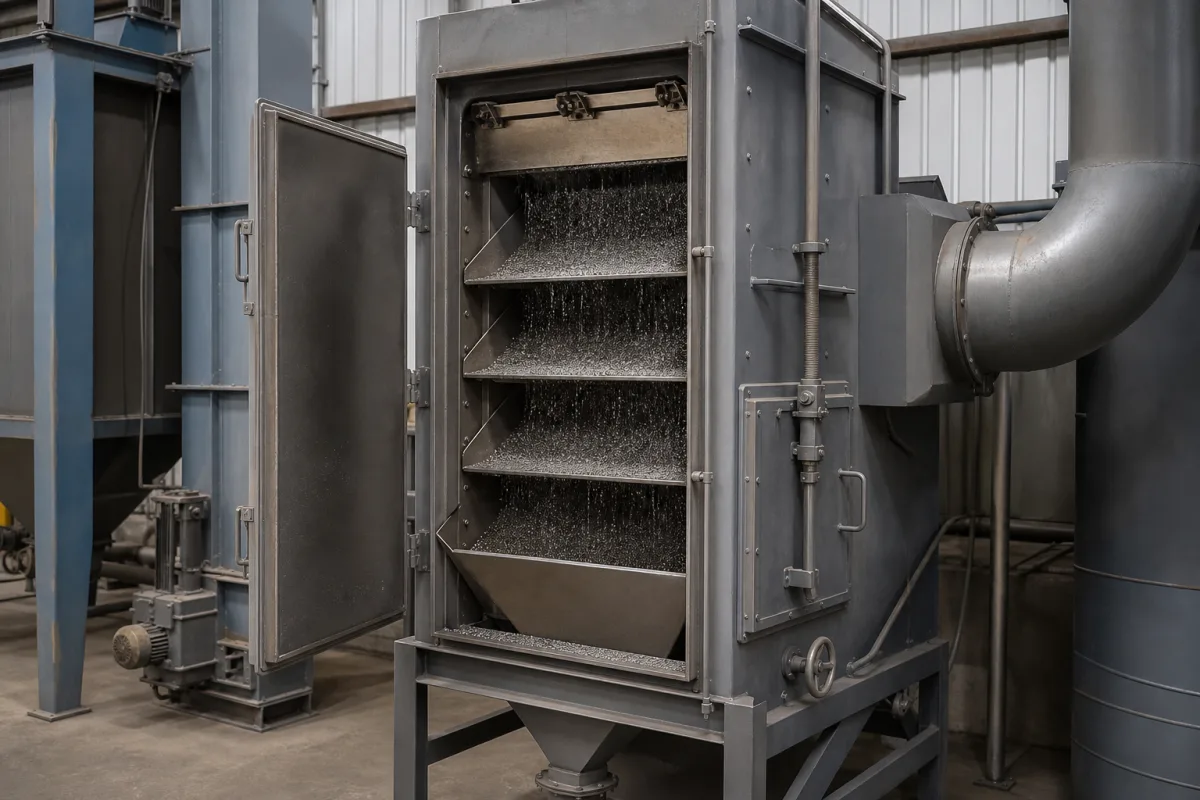
Technical details and manufacturing context for Air Wash Separator
| Parameter | Typical range | Notes & selection driver |
|---|---|---|
| Air Flow Rate | 5–20 m³/min | Determines separation efficiency and capacity |
| Separation Efficiency | 95–99 % | For particles > 50 μm |
| Operating Pressure | 0.4–0.8 MPa | Below 0.4 MPa separation drops |
| Operating Temperature | -20–80 °C | Seals degrade above 80°C |
| Inlet Diameter | 100–300 mm | Matches upstream piping |
| Outlet Diameter | 100–300 mm | Matches downstream piping |
| Body Material | Q235B | Carbon steel standardGB/T 700 |
| Liner Material | NM400 | Wear-resistant steelGB/T 24186 |
| Weight | 150–800 kg | Depends on size and material |
| Dimensions (L×W×H) | 800×600×1200–2000×1500×2500 mm | Varies with capacity |
| Noise Level | 75–85 dB(A) | At 1 m distanceISO 3744 |
| Pressure Drop | 1–3 kPa | Affects system efficiency |
Ranges are indicative industry figures for RFQ preparation, not a supplier commitment. Confirm every value and standard with the legal manufacturer before ordering.
This component is essential for the following industrial systems and equipment:
| pressure: | Max 2 bar (29 psi) |
| flow rate: | 10-500 m³/h (air volume) |
| temperature: | -20°C to 120°C |
| slurry concentration: | Up to 30% solids by weight |
Indicative industry ranges for design and RFQ preparation. Confirm the exact figures and applicable standard with the manufacturer before specifying.
Quoted from the published standard.
Manufacturer profiles associated with Air Wash Separator.
Manufacturer listings support early research and capability understanding. They are not certification, ranking, or transaction guarantees.
A practical evidence checklist for RFQ preparation and supplier evaluation.
CNFX does not score or rank suppliers. Buyers must verify all claims and documents with the legal manufacturer before ordering.
For particles larger than 50 μm, the separation efficiency is typically 95–99%. This is a reference range; actual efficiency depends on the specific model, operating conditions, and media characteristics. Verify with the manufacturer for your application.
The operating pressure range is 0.4–0.8 MPa, with separation efficiency dropping below 0.4 MPa. The operating temperature range is -20 to 80°C; seals may degrade above 80°C. Always confirm these values for your specific model.
The body is typically made of Q235B carbon steel (per GB/T 700), and the liner is NM400 wear-resistant steel (per GB/T 24186). Polyurethane seals are used. These are reference materials; confirm with the supplier.
Abrasive media enters a chamber where controlled air currents create a fluidized bed. Lighter fine particles and dust are carried upward and out through exhaust ports, while heavier reusable abrasive particles fall to collection points below. Air velocity and flow patterns are adjusted to control separation efficiency.
Editorial classification, named public sources where available, and source-reviewed manufacturer records.
Ask for use case, specification boundaries, supplier type, and RFQ preparation information for this product.
Compare manufacturer profiles with relevant product and process capability.