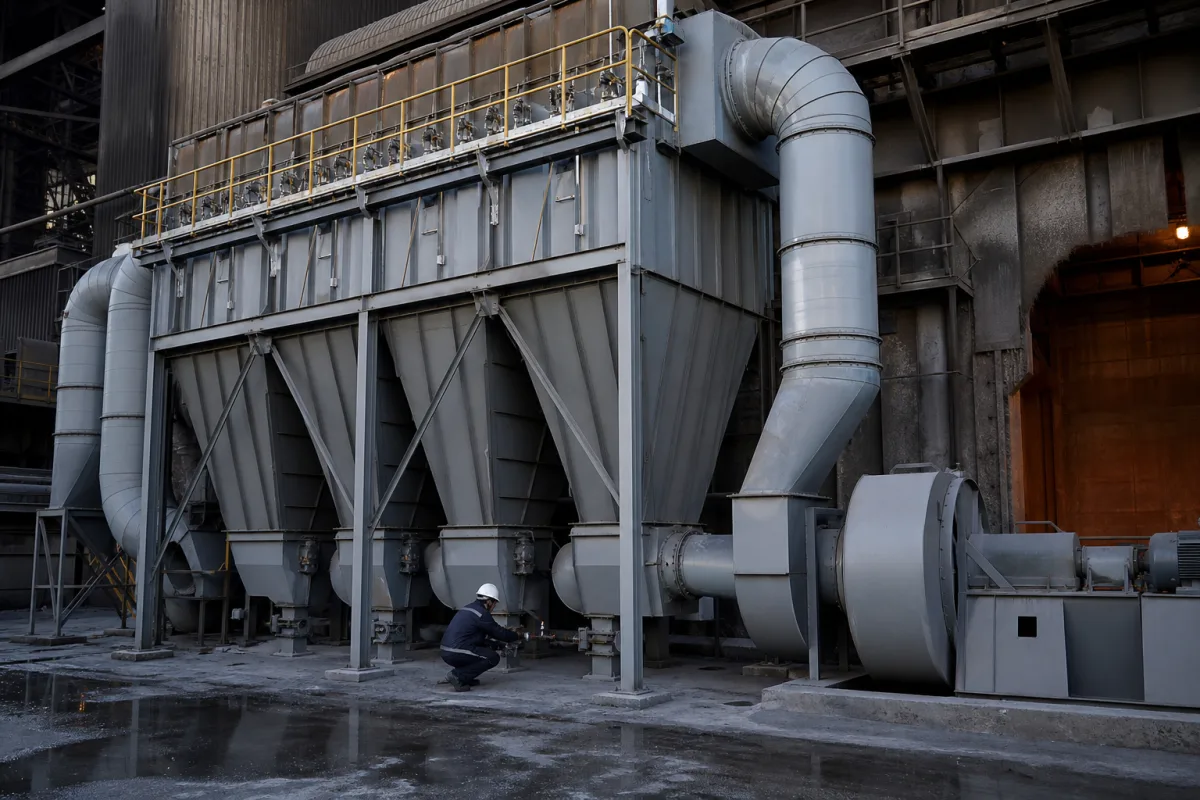
Dust collection system for a steel melt shop: capturing electric arc furnace fume and cleaning it in a baghouse plant to stack limits
Fume and dust collection systems for steel melt shops · Electric arc furnace direct extraction with hoods, doghouses or building evacuation, baghouse plants, >98% capture, <5 mg/Nm³ and 12 mg/dscm limits, and capture and bag leak monitoring
This page covers fume and dust collection systems for steel melt shops: direct extraction from the electric arc furnace, hoods, doghouses or whole-building evacuation for secondary emissions, the ducting and fans, and the baghouse plant with its dust handling and monitoring. Ask three things first: which capture arrangement reaches the collection efficiency you need, which emission limits apply at the stack, roof and dust handling, and how capture flow and bag leaks will be monitored.
Fume and dust collection systems for steel melt shops, including electric arc furnace and AOD direct extraction, canopy hoods, doghouses or building evacuation, ducting, fans, baghouse plants, dust handling and monitoring. Dust collector units on their own are covered on the Dust collector page, general local exhaust ventilation networks on the Dust extraction system page, woodworking central extraction on the Integrated dust collection system for woodworking page, and pulse-jet cleaning systems on their own page. Sinter plant and blast furnace gas cleaning are outside this page.
CNFX editorial research · Sources checked October 12, 2026 · 4 sources
Direct extraction through the furnace roof combined with hoods, a doghouse or building evacuation
The EU Best Available Techniques reference document for iron and steel production states, as BAT 89, that electric arc furnace primary and secondary dedusting, covering scrap preheating, charging, melting, tapping, ladle furnace and secondary metallurgy, should extract all emission sources efficiently by one of three arrangements followed by a bag filter: direct off-gas extraction through the fourth or second roof hole combined with hood systems, direct extraction with a doghouse, or direct extraction with total building evacuation; low-capacity furnaces may not need direct extraction to reach the same efficiency. The associated overall average collection efficiency is above 98%, with dust below 5 mg/Nm³ as a daily mean and mercury below 0.05 mg/Nm³. [1]
The BREF names German plants with doghouses, or doghouses combined with direct hole extraction, and ArcelorMittal's Schifflange, Differdange and Belval works in Luxembourg with total building evacuation, and notes that collection systems need energy, above all for the fans. [1]
Give the supplier the furnace type and tapping weight, tap-to-tap time, scrap preheating or charging method, ladle furnace and secondary metallurgy stations, building layout and roof height, applicable emission limits, dust disposal route and the space available for the baghouse and fans.
02
US NSPS limits at the control device, the shop roof and the dust handling
Under 40 CFR 60.272a, gases from an electric arc furnace or AOD vessel that exit the control device may not contain particulate matter above 12 mg/dscm (0.0052 gr/dscf) or show 3% opacity or more; gases leaving the shop due to the furnace may not show 6% opacity or more; and the dust-handling system may not discharge gases of 10% opacity or more, opacity being read by EPA Method 9 or ASTM D7520-16. [2]
Editorial note: the US limit is in milligrams per dry standard cubic metre and the EU level in milligrams per normal cubic metre as a daily mean; the reference conditions and averaging differ, so convert both to the same basis before comparing a supplier's guarantee against either.
Monitoring capture flow and bag leaks on the baghouse
40 CFR 60.274a requires capture systems to be monitored by continuously recording fan motor amperes and damper positions, by recording the volumetric flow through each separately ducted hood as 15-minute block averages, or by continuously recording the flow at the control device inlet with damper positions; flow monitors must be accurate to ±10% over their normal range, and where direct-shell evacuation is used the furnace static pressure is recorded each shift. [4] Under 40 CFR 60.273a, a single-stack fabric filter without a continuous opacity monitor must have a bag leak detection system with an alarm that activates when relative particulate loading rises above the set point, operated to a site-specific plan; triboelectric systems follow EPA guidance EPA-454/R-98-015. [3]
Editorial note: ask the supplier which monitoring option the design supports, where flow or amperage signals and damper positions are recorded, and how bag leak alarms lead to locating and replacing the failed bags compartment by compartment.
04
Send the furnaces, shop layout and emission limits together
Paste it into your enquiry below or into an email to a maker, then replace every bracket.
Furnaces: [EAF; AOD; ladle furnace; tap weight; cycle]
Capture: [4th-hole extraction; hoods; doghouse; building evacuation]
Limits: [EU BAT; US NSPS; local permit]
Baghouse: [flow; temperature; filter cloth; compartments]
Dust: [handling; storage; disposal]
Monitoring: [fan amps and dampers or flow; bag leak detection; opacity]
Compare melt shop dust collection system suppliers
2 companies list this product among what they make. Company figures are quoted from each
company's own website; every card states where the relationship came from.
Peakvac
Manufacturing site to be confirmed for the order
Lists custom industrial dust collection systems built around its baghouse dust collectors.
Explore company information and manufacturing capabilities, then discuss the scope of your project with a relevant supplier.
Share this page
Compiled and source-reviewed by the CNFX editorial team.
Each manufacturer above links to the page on that company's own website where the product is listed, with the date we checked it. How we source and review
· Page last updated 13 October 2026
Buyer questions
What dust level is BAT for an electric arc furnace?
The EU iron and steel BREF gives below 5 mg/Nm³ as a daily mean, with over 98% average collection, using direct extraction plus hoods, a doghouse or building evacuation and a bag filter. [1]
What are the US limits for EAF melt shop dust?
40 CFR 60.272a sets 12 mg/dscm and under 3% opacity at the control device, under 6% opacity at the shop exit and under 10% from the dust-handling system. [2]
Is bag leak detection required on an EAF baghouse?
Under 40 CFR 60.273a, a single-stack fabric filter without a continuous opacity monitor needs a bag leak detection system with an alarm. [3]
Sources and what still needs a direct check
Sources checked 2026-10-12. The EU iron and steel BREF and US federal rules set capture, emission and monitoring requirements for EAF melt shops; makers list their own dust collection systems.