Industry-Verified Manufacturing Data (2026)

Exhaust Duct

Based on aggregated insights from multiple verified factory profiles within the CNFX directory, the standard Exhaust Duct used in the Machinery and Equipment Manufacturing sector typically supports operational capacities ranging from standard industrial configurations to heavy-duty production requirements.

Technical Definition & Core Assembly

A canonical Exhaust Duct is characterized by the integration of Duct Section and Flange. In industrial production environments, manufacturers listed on CNFX commonly emphasize Galvanized Steel construction to support stable, high-cycle operation across diverse manufacturing scenarios.

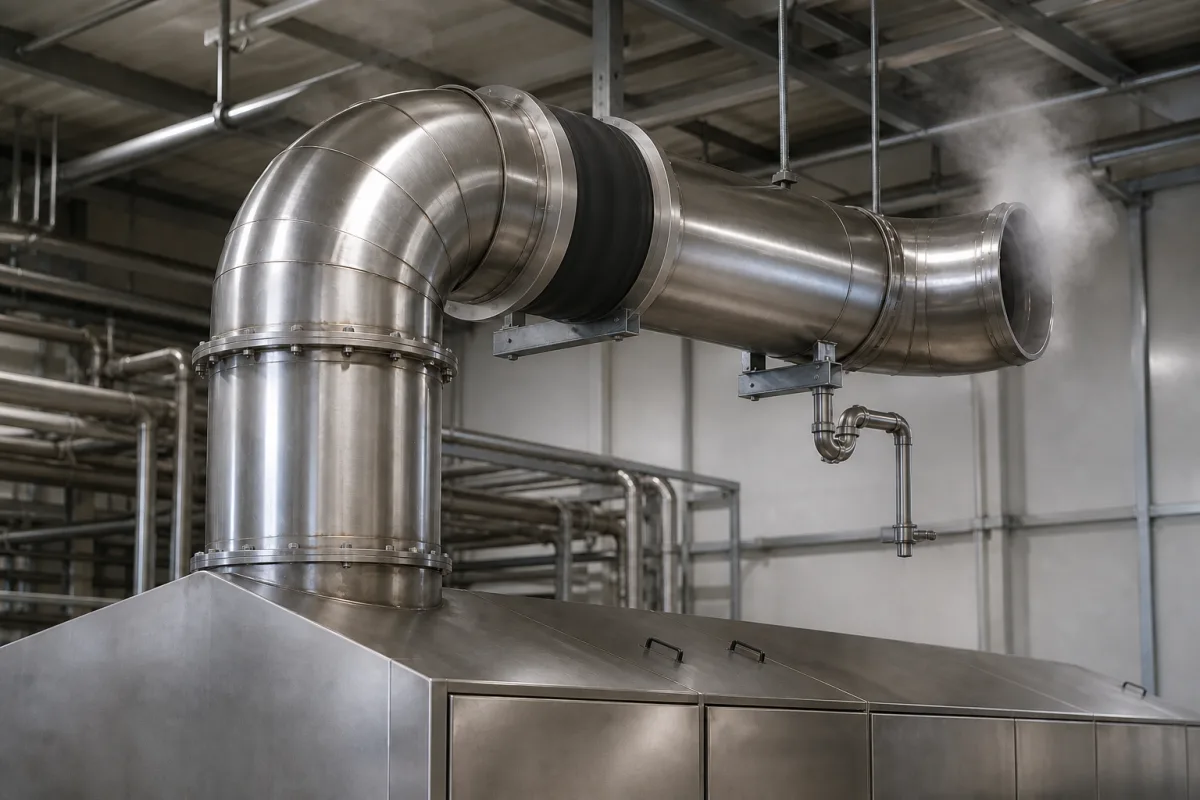
A duct component designed to transport humid air and exhaust gases away from industrial processes.
Product Specifications

Technical details and manufacturing context for Exhaust Duct

Definition
The exhaust duct is a critical component of the Humidity Exhaust System, responsible for channeling moisture-laden air, vapors, and exhaust gases from industrial equipment or processes to the exterior environment or a treatment unit. It ensures proper ventilation, controls humidity levels, and removes contaminants to maintain safe and efficient operations.
Working Principle
The duct operates by creating a contained pathway for air flow. A pressure differential, typically generated by an exhaust fan or blower within the system, draws humid air into the duct inlet. The air travels through the sealed ductwork, which is designed to minimize resistance and leakage, and is expelled at the outlet, effectively removing moisture and exhaust from the designated area.
Common Materials
Galvanized Steel, Stainless Steel, Aluminum
Technical Parameters
  • Diameter or cross-sectional dimensions (e.g., 200mm diameter, 300x400mm rectangular) (mm) Standard Spec
Components / BOM
  • Duct Section
    The primary straight or curved segment that forms the airflow pathway.
    Material: Galvanized Steel
  • Flange
    A rim or collar at the end of a duct section for connecting to other sections or system components.
    Material: Steel
  • Gasket
    A sealing element placed between flanges to prevent air leakage at joints.
    Material: Rubber or Silicone
  • Support Bracket
    A structural component used to mount and secure the duct in place.
    Material: Steel
Engineering Reasoning
0-150°C temperature, 0-2.5 kPa pressure differential, 0-15 m/s flow velocity
Condensate accumulation exceeding 0.5 L/m length, wall temperature exceeding 200°C, pressure differential exceeding 5 kPa
Design Rationale: Corrosion from sulfuric acid formation (H₂SO₄) when exhaust gas dew point (60-80°C) intersects duct wall temperature, leading to wall thinning below 1.5 mm minimum thickness
Risk Mitigation (FMEA)
Trigger Insufficient slope (below 1.5° gradient) causing condensate pooling
Mode: Localized corrosion penetration at 0.2 mm/year rate
Strategy: Install continuous slope of 2° minimum with drain traps at 3 m intervals
Trigger Thermal cycling between 20-150°C exceeding 5 cycles/hour
Mode: Fatigue cracking at welded joints due to 350 MPa stress concentration
Strategy: Implement expansion joints with 25 mm movement capacity at 10 m intervals

Industry Taxonomies & Aliases

Commonly used trade names and technical identifiers for Exhaust Duct.

Applied To / Applications

This component is essential for the following industrial systems and equipment:

Industrial Ecosystem & Supply Chain DNA

Complementary Systems
Downstream Applications
Specialized Tooling

Application Fit & Sizing Matrix

Operational Limits
humidity: Up to 100% relative humidity (non-condensing), with condensate drainage provisions
pressure: -500 Pa to +2000 Pa (operating range), up to 5000 Pa (burst pressure)
flow rate: Up to 15 m/s air velocity (recommended), 25 m/s (maximum)
temperature: -20°C to 200°C (continuous), up to 250°C (short-term)
Media Compatibility
✓ Humid process air (textile dyeing) ✓ Kitchen exhaust with grease particles ✓ Chemical fume extraction (non-corrosive gases)
Unsuitable: Highly corrosive acidic environments (e.g., hydrochloric acid fumes at >50°C)
Sizing Data Required
  • Required volumetric flow rate (m³/h)
  • System static pressure (Pa)
  • Maximum operating temperature (°C)

Reliability & Engineering Risk Analysis

Failure Mode & Root Cause
Corrosion-induced perforation
Cause: Condensation of acidic combustion byproducts (e.g., sulfuric acid) on duct walls, accelerated by temperature cycling and moisture ingress
Fatigue cracking at joints/welds
Cause: Thermal expansion/contraction cycles, vibration from connected equipment (fans, blowers), and inadequate support/flexibility in duct design
Maintenance Indicators
  • Visible rust streaks or weeping liquid at seams/joints indicating active corrosion
  • Audible rattling, banging, or increased vibration during operation signaling loose components or structural fatigue
Engineering Tips
  • Install condensate drains at low points and apply corrosion-resistant lining (e.g., fluoropolymer) in areas prone to acid condensation
  • Implement expansion joints at critical connections, ensure proper hanger spacing/support, and conduct periodic thermographic inspections to detect hot spots or thermal stress

Compliance & Manufacturing Standards

Reference Standards
ISO 13349:2014 - Fans and ducting systems ANSI/AMCA 260-07 - Laboratory Methods of Testing Induced Flow Fans for Rating DIN 24163-1 - Ductwork; circular sheet metal ducts; dimensions
Manufacturing Precision
  • Diameter: +/- 0.5% of nominal diameter
  • Wall thickness: +/- 10% of specified thickness
Quality Inspection
  • Leakage test (pressure differential method)
  • Ultrasonic thickness measurement

Factories Producing Exhaust Duct

Verified manufacturers with capability to produce this product in China

✓ 94% Supplier Capability Match Found

P Procurement Specialist from United Arab Emirates Jan 23, 2026
★★★★★
"The technical documentation for this Exhaust Duct is very thorough, especially regarding technical reliability."
Technical Specifications Verified
T Technical Director from Australia Jan 20, 2026
★★★★★
"Reliable performance in harsh Machinery and Equipment Manufacturing environments. No issues with the Exhaust Duct so far."
Technical Specifications Verified
P Project Engineer from Singapore Jan 17, 2026
★★★★★
"Testing the Exhaust Duct now; the technical reliability results are within 1% of the laboratory datasheet."
Technical Specifications Verified
Verification Protocol

“Feedback is collected from verified sourcing managers during RFQ (Request for Quote) and factory evaluation processes on CNFX. These reports represent historical performance data and technical audit summaries from our B2B manufacturing network.”

18 sourcing managers are analyzing this specification now. Last inquiry for Exhaust Duct from Turkey (1h ago).

Supply Chain Compatible Machinery & Devices

Heavy-Duty CNC Plasma Cutting Machine

Industrial machine for precision metal cutting using plasma arc technology

Explore Specs →
Automated Assembly Line System

Integrated production system for sequential component assembly operations

Explore Specs →
Automated Powder Coating System

Integrated industrial system for applying dry powder coatings to metal substrates.

Explore Specs →
Centrifugal Pump Impeller

Rotating component that transfers energy to fluid in centrifugal pumps.

Explore Specs →

Frequently Asked Questions

What materials are best for corrosive exhaust applications?

Stainless steel offers superior corrosion resistance for harsh exhaust gases, while galvanized steel provides cost-effective durability for moderate conditions, and aluminum is lightweight for non-corrosive applications.

How do I select the right exhaust duct for my machinery?

Consider gas temperature, humidity levels, corrosion potential, and space constraints. Stainless steel handles high heat/corrosion, galvanized steel suits general industrial exhaust, and aluminum works for lightweight needs.

What maintenance do industrial exhaust ducts require?

Regular inspection for corrosion, cleaning to prevent buildup, checking gasket seals at flanges, and ensuring support brackets remain secure. Material choice significantly impacts maintenance frequency.

Can I contact factories directly on CNFX?

CNFX is an open directory, not a transaction platform. Each factory profile provides direct contact information and production details to help you initiate direct inquiries with Chinese suppliers.

Get Quote for Exhaust Duct

Request technical pricing, lead times, or customized specifications for Exhaust Duct directly from verified manufacturing units.

Your business information is encrypted and only shared with verified Exhaust Duct suppliers.

Thank you! Your message has been sent. We'll respond within 1–3 business days.

Need to Manufacture Exhaust Duct?

Connect with verified factories specializing in this product category

Add Your Factory Contact Us
Previous Product
Exhaust Dampers
Next Product
Exhaust Ductwork