Industry-Verified Manufacturing Data (2026)

Airflow Control Dampers

Based on aggregated insights from multiple verified factory profiles within the CNFX directory, the standard Airflow Control Dampers used in the Machinery and Equipment Manufacturing sector typically supports operational capacities ranging from standard industrial configurations to heavy-duty production requirements.

Technical Definition & Core Assembly

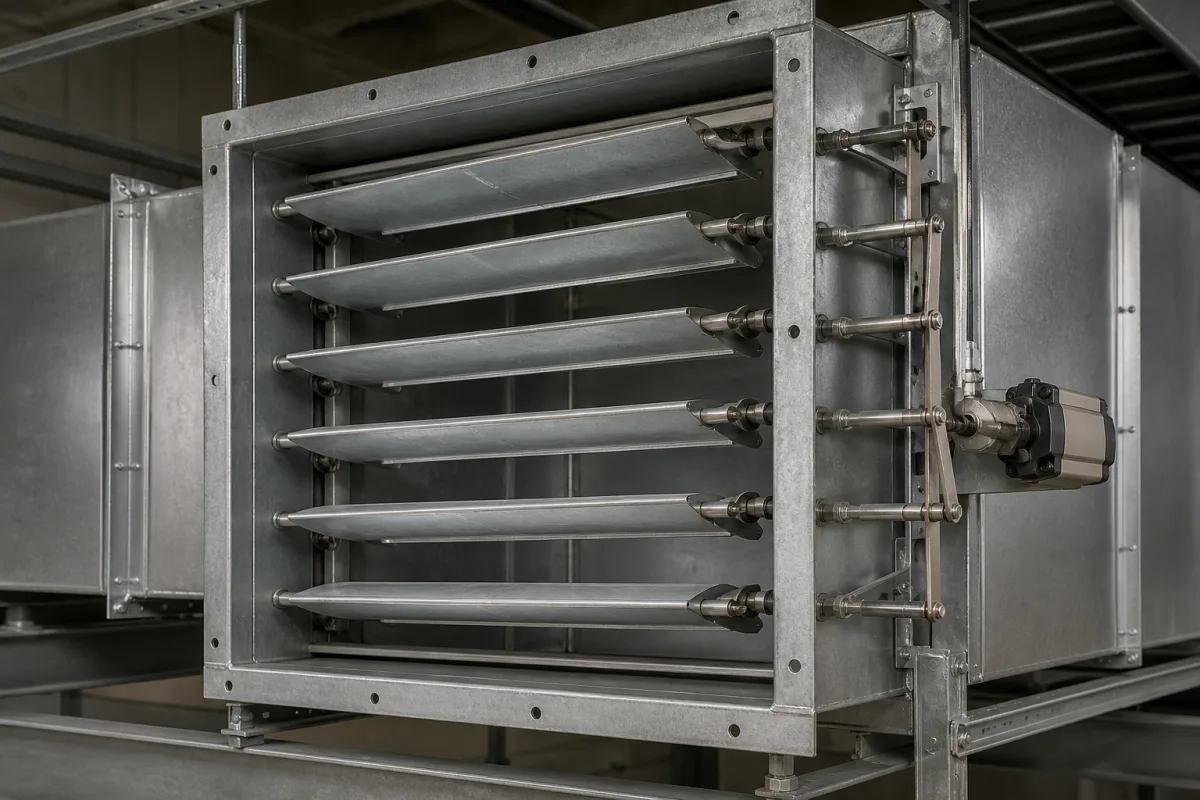
A canonical Airflow Control Dampers is characterized by the integration of Damper Frame and Blades/Louvers. In industrial production environments, manufacturers listed on CNFX commonly emphasize Galvanized Steel construction to support stable, high-cycle operation across diverse manufacturing scenarios.

Mechanical devices that regulate, direct, or shut off airflow within ventilation and air circulation systems.
Product Specifications

Technical details and manufacturing context for Airflow Control Dampers

Definition
Airflow control dampers are essential components within air circulation systems that precisely manage the volume, direction, and distribution of air. They function as adjustable valves or louvers installed in ductwork, allowing for the balancing of air pressure, isolation of specific zones, and control of environmental conditions such as temperature, humidity, and air quality. Their operation is critical for system efficiency, safety, and meeting specific process requirements in industrial settings.
Working Principle
Airflow control dampers operate by physically obstructing the duct's cross-sectional area. An actuator (manual, electric, or pneumatic) adjusts the position of blades, louvers, or a guillotine plate. As the damper modulates from fully open to fully closed, it increases resistance to airflow, thereby reducing the volume of air passing through that section of the system. This allows for precise control over air distribution to different zones or processes.
Common Materials
Galvanized Steel, Stainless Steel, Aluminum
Technical Parameters
  • The nominal size of the damper, corresponding to the duct dimensions it is designed to fit (e.g., 300x300mm, 600mm diameter). (mm) Per Request
Components / BOM
  • Damper Frame
    Provides the structural housing that connects to the ductwork and supports the blades and shaft.
    Material: Galvanized Steel
  • Blades/Louvers
    The adjustable elements that rotate to modulate airflow; their angle determines the restriction.
    Material: Galvanized Steel
  • Shaft
    A rod that connects multiple blades, ensuring they rotate in unison when actuated.
    Material: Steel
  • Linkage & Bearings
    Mechanical connections and low-friction points that transfer motion from the actuator to the blades.
    Material: Steel, Bronze
  • Actuator (Mounting Interface)
    The connection point for an external actuator (manual lever, electric, or pneumatic motor) that provides the force to position the blades.
    Material: Aluminum, Steel
  • Seals/Gaskets
    Create an airtight seal around the blade edges and frame joints to minimize leakage when closed.
    Material: Neoprene, Silicone
Engineering Reasoning
0-25 m/s airflow velocity, -40°C to 120°C temperature, 0-100% open position
Blade deflection exceeding 5 mm at 25 m/s airflow, bearing temperature exceeding 150°C, actuator torque exceeding 15 Nm at 100% open position
Design Rationale: Aerodynamic flutter at Reynolds numbers >10^5 causing harmonic blade vibration, thermal expansion coefficient mismatch (steel: 12×10^-6/°C, aluminum: 23×10^-6/°C) inducing mechanical stress, bearing lubrication failure at temperatures exceeding 150°C
Risk Mitigation (FMEA)
Trigger Corrosion-induced material thinning below 1.5 mm thickness in carbon steel blades
Mode: Blade structural failure at 20 m/s airflow velocity
Strategy: 316L stainless steel construction with 2.0 mm minimum thickness, epoxy-polyamide coating with 150 μm dry film thickness
Trigger Actuator position sensor calibration drift exceeding ±2° angular error
Mode: Damper position control error causing 15% airflow deviation from setpoint
Strategy: Absolute optical encoder with 0.1° resolution, quarterly calibration schedule with NIST-traceable standards

Industry Taxonomies & Aliases

Commonly used trade names and technical identifiers for Airflow Control Dampers.

Applied To / Applications

This component is essential for the following industrial systems and equipment:

Industrial Ecosystem & Supply Chain DNA

Complementary Systems
Downstream Applications
Specialized Tooling

Application Fit & Sizing Matrix

Operational Limits
pressure: Up to 10,000 Pa (1.45 psi)
flow rate: 0.1 to 50 m³/s
temperature: -40°C to 400°C
slurry concentration: Not applicable (air/gas only)
Media Compatibility
✓ HVAC air handling systems ✓ Industrial exhaust gases ✓ Cleanroom ventilation
Unsuitable: Corrosive chemical fume environments without special coatings
Sizing Data Required
  • Required airflow rate (m³/s or CFM)
  • System static pressure (Pa or in. w.g.)
  • Duct dimensions (width x height or diameter)

Reliability & Engineering Risk Analysis

Failure Mode & Root Cause
Seal degradation and leakage
Cause: Exposure to high temperatures, corrosive atmospheres, or particulate abrasion leading to seal material breakdown and loss of airtight integrity
Actuator/mechanical linkage failure
Cause: Wear from repeated cycling, misalignment causing binding, or corrosion of moving components resulting in loss of precise airflow control
Maintenance Indicators
  • Audible air whistling or hissing indicating seal failure and uncontrolled airflow
  • Visible damper blade misalignment or irregular movement during operation suggesting mechanical wear or actuator issues
Engineering Tips
  • Implement regular seal integrity testing and replacement schedules using materials compatible with process conditions (temperature, chemical exposure)
  • Establish preventive maintenance for actuator calibration and linkage lubrication to ensure smooth operation and precise positioning

Compliance & Manufacturing Standards

Reference Standards
ISO 5211:2017 Industrial valves - Part-turn actuator attachments ANSI/AMCA 500-D Laboratory Methods of Testing Dampers for Rating DIN 24194 Air control dampers - Dimensions and requirements
Manufacturing Precision
  • Blade alignment: +/- 0.5°
  • Frame squareness: 1.5 mm per meter
Quality Inspection
  • Leakage test per AMCA 500-D
  • Operational torque verification

Factories Producing Airflow Control Dampers

Verified manufacturers with capability to produce this product in China

✓ 92% Supplier Capability Match Found

P Project Engineer from United States Jan 25, 2026
★★★★★
"Found 15+ suppliers for Airflow Control Dampers on CNFX, but this spec remains the most cost-effective."
Technical Specifications Verified
S Sourcing Manager from United Arab Emirates Jan 22, 2026
★★★★★
"The technical documentation for this Airflow Control Dampers is very thorough, especially regarding technical reliability."
Technical Specifications Verified
P Procurement Specialist from Australia Jan 19, 2026
★★★★★
"Reliable performance in harsh Machinery and Equipment Manufacturing environments. No issues with the Airflow Control Dampers so far."
Technical Specifications Verified
Verification Protocol

“Feedback is collected from verified sourcing managers during RFQ (Request for Quote) and factory evaluation processes on CNFX. These reports represent historical performance data and technical audit summaries from our B2B manufacturing network.”

13 sourcing managers are analyzing this specification now. Last inquiry for Airflow Control Dampers from Brazil (57m ago).

Supply Chain Compatible Machinery & Devices

Automated Assembly Line System

Integrated production system for sequential component assembly operations

Explore Specs →
Automated Powder Coating System

Integrated industrial system for applying dry powder coatings to metal substrates.

Explore Specs →
Centrifugal Pump Impeller

Rotating component that transfers energy to fluid in centrifugal pumps.

Explore Specs →
High-Precision CNC Laser Cutting Machine

Computer-controlled industrial machine using focused laser beams to cut sheet metal with micron-level accuracy.

Explore Specs →

Frequently Asked Questions

What materials are best for airflow control dampers in corrosive environments?

Stainless steel dampers offer superior corrosion resistance for harsh industrial environments, while galvanized steel provides good protection at lower cost for moderate conditions.

How do actuator mounting interfaces affect damper performance?

Proper actuator mounting ensures precise blade control, reduces mechanical stress on linkages and bearings, and maintains consistent airflow regulation throughout the damper's operational life.

What maintenance is required for industrial airflow control dampers?

Regular inspection of seals/gaskets for wear, lubrication of bearings and linkages, and verification of blade alignment and actuator calibration ensure optimal performance and longevity.

Can I contact factories directly on CNFX?

CNFX is an open directory, not a transaction platform. Each factory profile provides direct contact information and production details to help you initiate direct inquiries with Chinese suppliers.

Get Quote for Airflow Control Dampers

Request technical pricing, lead times, or customized specifications for Airflow Control Dampers directly from verified manufacturing units.

Your business information is encrypted and only shared with verified Airflow Control Dampers suppliers.

Thank you! Your message has been sent. We'll respond within 1–3 business days.

Need to Manufacture Airflow Control Dampers?

Connect with verified factories specializing in this product category

Add Your Factory Contact Us
Previous Product
Air Wash Separator
Next Product
Alarm Logic Engine