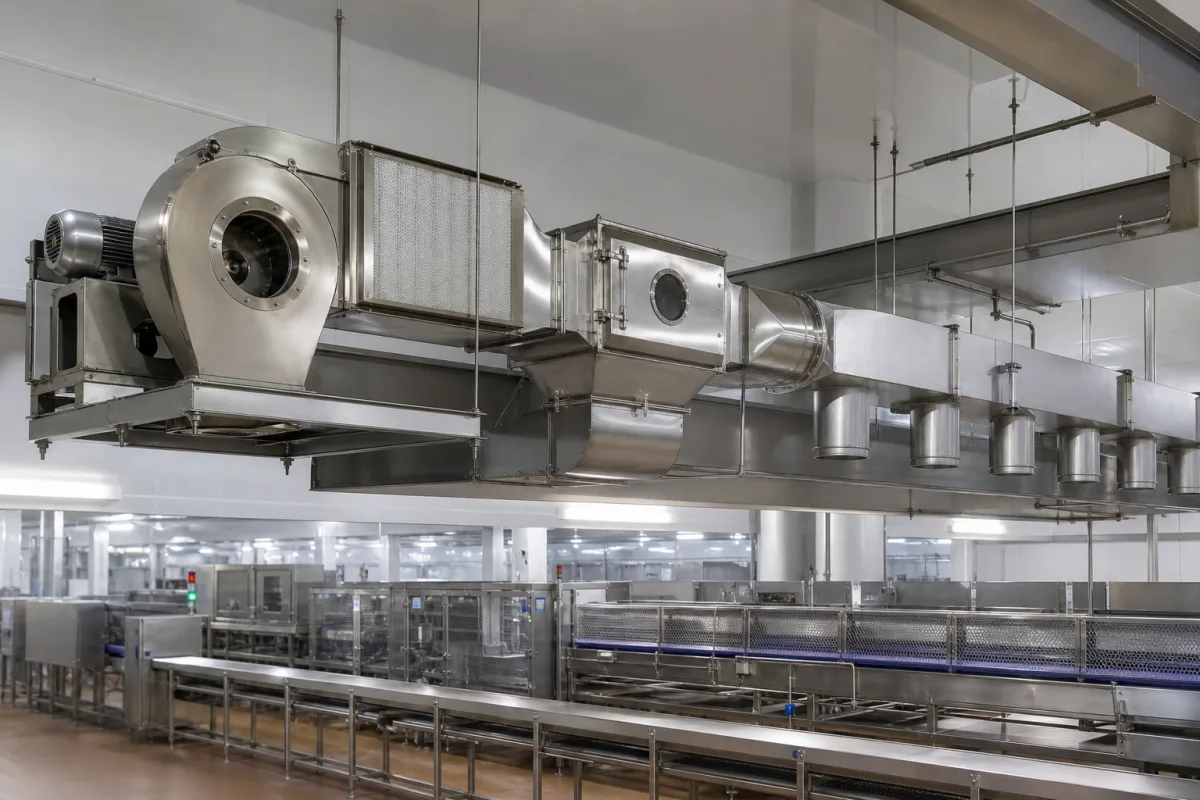
Air circulation system for industrial food dehydrators
Food dehydrators · Fan, plenum, ducts and dampers that move heated air across trays: exhaust recirculation rate, damper type, air speed over the product, inlet and outlet placement
In a food dehydrator the air circulation system is everything that moves the drying air: the fan, the heater plenum, the ducts that lead air into and across the trays, and the dampers that decide how much exhaust air goes back to the fan and how much fresh air comes in. Two numbers shape it more than any other: the share of exhaust air that is recirculated, and the air speed the product actually sees.
Forced-air circulation assemblies for batch cabinet, tray and tunnel dehydrators that dry fruit, vegetables, meat snacks and similar foods: fans, plenums, distribution ducts, recirculation and fresh-air dampers and their controls. This differs from building and cleanroom air handling: packaged, modular and cleanroom air handling units are covered on the Air handling unit page. Fan-and-drive modules for air handling units and ventilation plant have their own Fan assembly page; this page covers fans only as part of a dehydrator's drying-air loop. The complete belt and tray dryer — drying stages, belt or tray sizing, feed rate and final moisture — is the subject of the Industrial food dehydrator (belt and tray dryers for fruit and vegetables) page; here only the air loop inside it is specified. Greenhouse circulation fans, spray dryers and freeze dryers are outside this page.
CNFX editorial research · Sources checked October 12, 2026 · 3 sources
How much dehydrator exhaust to send back to the fan
Oklahoma State University's food process engineers explain that warm, moist exhaust air mixed with fresh air gives a mixture warmer than fresh air alone, so less heat is needed to bring it to the set point, while the evaporative capacity of the mix falls only moderately. They cite one study suggesting recirculation of up to 75% with energy savings of 45 to 50%, and another recommending 60 to 85% with savings of 30 to 60%. [1]
Both studies dried fruit. In the first, fruit dried to 24–27% moisture showed no change in drying time with recirculation; the fact sheet adds that reaching a lower final moisture, for example 10 to 15%, may require reduced recirculation, and that the studies used fixed rates where variable rates may be needed for the best result. Savings are offset by a partial reduction in drying capacity. [1]
Recirculated air also adds moisture, which the same sheet links to avoiding case hardening, the hard surface layer formed when a food dries too fast at the start; for products prone to it, recirculation shortens overall drying time, and where case hardening is not an issue researchers found little quality difference with or without it. [1]
Editorial calculation: at 75% recirculation only a quarter of the fan's flow is fresh air; a fan moving 2,250 m³/h would draw about 560 m³/h from outside and exhaust the same. [1]
Give the supplier the product and its target final moisture, batch or continuous operation, the drying temperature, whether case hardening has been a problem, and the recirculation range and control (manual or automatic, on humidity, wet-bulb or dry-bulb temperature) you want the dampers to cover.
02
Where the fresh-air inlet, exhaust and dampers sit relative to the fan
In the recirculating layout Oklahoma State shows, the fresh-air inlet is on the suction side of the fan and the exhaust outlet on the pressure side, with two flow-control damper valves setting the split. The authors note that butterfly dampers are hard to control because airflow is not linear with valve position, and suggest louver or knife dampers for a more linear response. [1]
They report that in one test dehydrator the exit air temperature rose with increasing recirculation, and suggest a control approach of starting at a maximum recirculation rate and reducing it until exhaust temperature begins to drop. Existing cabinet dehydrators can be retrofitted with ducts and valves, or with an enclosure built around them. The sheet also points to air leaks and heat transfer from the dehydrator and ductwork as the main energy losses, found with talcum powder or a smoke stick and then sealed and insulated. [1]
03
What a carrot tray dryer showed at 2 and 3 m/s
Putri and co-authors at Universitas Andalas modelled a tray dryer of 104 × 65.01 × 143.56 cm with five trays of 97.40 × 43 cm spaced 26 cm apart, drying 2 mm carrot slices at 50, 60 and 70 °C and 2 or 3 m/s measured at the outlet. In every case temperature and airflow were unevenly distributed, particularly in the middle and upper sections, with vortices formed by the dryer's internal structure. [2]
At 50 °C and 2 m/s the streamlines reached up to 7.3 m/s locally, and air accelerated upward toward the outlet. At 70 °C and 3 m/s the upper section was reasonably supplied but airflow to the lower trays stayed limited. The authors cite earlier work observing that raising air speed in a tray dryer does not always improve heat distribution, because of recirculation and obstructions. [2]
The study's 0.5–2.41% velocity deviation measures how well the model matched the measurements, not how uniform the air was; the authors say uniformity needs a statistic such as standard deviation or coefficient of variation, which they did not calculate. [2]
Editorial calculation: the five trays give 5 × 0.974 × 0.43 ≈ 2.09 m² of drying area. [2]
Set temperature and outlet air speed
Measured temperature
Measured air speed
50 °C, 2 m/s
46.75 °C
1.95 m/s
50 °C, 3 m/s
48.59 °C
2.92 m/s
60 °C, 2 m/s
56.66 °C
2.00 m/s
60 °C, 3 m/s
57.68 °C
3.01 m/s
70 °C, 2 m/s
65.17 °C
2.07 m/s
70 °C, 3 m/s
67.06 °C
2.92 m/s
Ask the supplier how air speed is measured (at the outlet, between trays, or across the tray face) and for a velocity or temperature map of the loaded chamber with a spread statistic, not only an average.
04
Inlet and outlet placement and dead zones in a continuous tray dryer
Welsh, Kumar and Karim at Queensland University of Technology simulated an empty U-shaped continuous tray dryer, a 500 × 500 mm channel with an overall footprint of 2590 × 2180 mm, at inlet speeds of 0.5, 2.5 and 5 m/s; the flow was turbulent in all three cases. [3]
With one inlet and one outlet at opposite ends of the U, air hit the inside wall and accelerated through the bend, leaving two dead zones, and the faster the inlet air the larger the dead spot or the effect of the bend. With an inlet at each end and one outlet at the top centre of the bend, a single dead zone remained below the outlet, in a region without trays. The authors note the trays and holders were not yet modelled and will change the distribution. [3]
Editorial calculation: the 0.25 m² channel at 2.5 m/s carries 0.25 × 2.5 = 0.625 m³/s, about 2,250 m³/h of air. [3]
05
Send the product, drying and airflow data together
Paste it into your enquiry below or into an email to a maker, then replace every bracket.
Product: [food; slice size; loading per tray; target final moisture]
Dryer: [batch cabinet, tray or tunnel; chamber size; number of trays and spacing]
Air: [temperature; airflow m³/h; air speed and where it is measured]
Recirculation: [range %; damper type; manual or automatic; control signal]
Fan: [motor power; supply voltage and frequency; static pressure]
Hygiene: [materials in the air path; filters; cleaning access]
Tests: [velocity or temperature map of the loaded chamber]
Explore company information and manufacturing capabilities, then discuss the scope of your project with a relevant supplier.
Share this page
Compiled and source-reviewed by the CNFX editorial team.
Each manufacturer above links to the page on that company's own website where the product is listed, with the date we checked it. How we source and review
· Page last updated 13 October 2026
Buyer questions
How much exhaust air can a food dehydrator recirculate?
Oklahoma State University cites studies recommending 60–85% (30–60% energy savings) and up to 75% (45–50% savings), and notes lower final moisture may need less recirculation. [1]
Which dampers suit a recirculating dehydrator?
The same fact sheet says butterfly dampers are hard to control because flow is not linear with position, and suggests louver or knife dampers. [1]
Does faster air make drying more even?
Not necessarily: a 2025 tray-dryer study found uneven airflow at both 2 and 3 m/s, and a QUT simulation found dead zones grew with inlet speed in one layout. [2][3]
Sources and what still needs a direct check
Sources checked 2026-10-12. The Oklahoma State fact sheet summarises recirculation studies on fruit; the Andalas University paper measured and modelled one laboratory tray dryer; the QUT paper is a simulation of an empty dryer without trays.