Editorial Technical Reference

Assembly Station

This page explains how Assembly Station is classified within Machinery and Equipment Manufacturing. Technical values and manufacturer relationships are research references; confirm the current specification and supplier evidence for each order.

Technical Definition & Core Assembly

A dedicated workstation within the Primer Assembly and Insertion Module where primer components are precisely assembled and prepared for insertion.
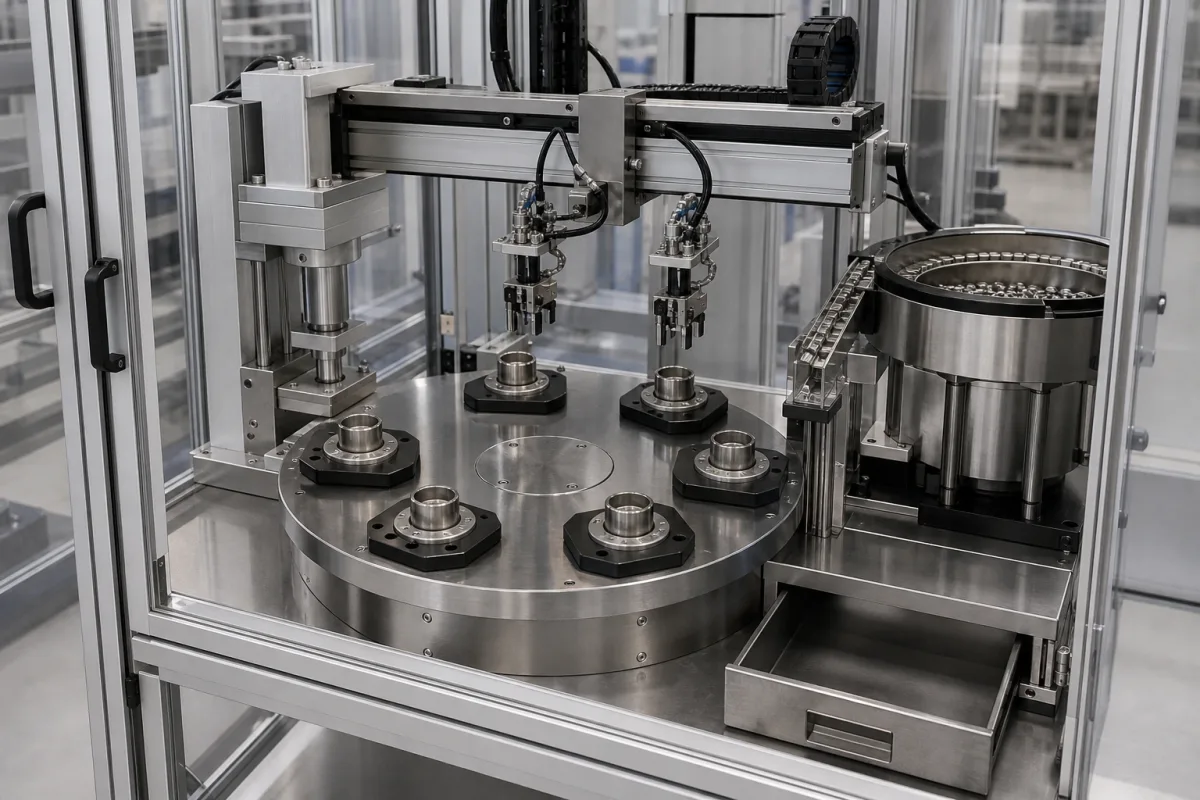
Representative product image. Confirm appearance and specifications with the manufacturer.

Product Specifications

Technical details and manufacturing context for Assembly Station

Definition
The Assembly Station is a critical component of the Primer Assembly and Insertion Module, serving as the designated location where individual primer elements are methodically brought together, aligned, and secured according to precise specifications. It functions as the final preparation stage before the assembled primer is transferred for insertion into the target system, ensuring all components meet quality and dimensional tolerances. The station is designed to support a controlled assembly process, with a worktable dimension of 1200×800 mm and a maximum load capacity of 500 kg, including fixture and workpiece weight. The assembly precision is ±0.05 mm, ensuring repeatable positioning of tooling. Cycle time ranges from 15 to 60 seconds, depending on component complexity and operator skill. The station operates within a pressure range of 1.0–1.6 MPa, with an air consumption of 0.3–0.8 m³/min at operating pressure. It requires a single-phase power supply of 220 V AC ±10% (50/60 Hz). The operating temperature range is 5–40 °C, and relative humidity must not exceed 85% (non-condensing). The ingress protection rating is IP54 (IEC 60529), indicating dust protection and splash-proofing. The frame is made of carbon steel Q235 (GB/T 700) with powder coating, while the worktable is stainless steel SUS304 (ASTM A240) with anti-static properties. The approximate weight is 350 kg, excluding tooling, and the overall footprint is 1500×1000 mm. These specifications are reference values; model-specific data must be verified with the manufacturer. The station is intended for use in machinery and equipment manufacturing, specifically within primer assembly processes. It is not a standalone product but a component of a larger module. For procurement, verify all parameters and standards with the legal manufacturer or supplier.
Working Principle
The station typically employs a combination of mechanical fixtures, alignment guides, and sometimes automated or manual tooling to hold primer sub-components in position. An operator or robotic system then performs the assembly sequence—which may involve fastening, bonding, or mechanical interlocking—based on programmed instructions or standard operating procedures. Sensors may verify component presence and correct orientation before the assembled unit is released to the next stage. The station's design ensures that all assembly operations occur within a controlled environment, maintaining the required precision and quality. The working principle relies on the integration of mechanical, pneumatic, and electrical systems, with the operating pressure and air consumption providing the necessary force and actuation. The power supply supports control systems and any automated features. The station's performance is influenced by environmental conditions, such as temperature and humidity, which must be kept within specified ranges to avoid degradation. Regular maintenance of fixtures and sensors is essential to sustain accuracy. Failure to maintain these conditions may lead to assembly errors or reduced throughput.
Common Materials
Stainless Steel, Aluminum Alloy
Technical Parameters
ParameterTypical rangeNotes & selection driver
Worktable Dimensions1200×800 mmStandard size; custom sizes available on request.
Max Load Capacity500 kgIncludes fixture and workpiece weight.
Assembly Precision±0.05 mmPositioning repeatability of the assembly tooling.
Cycle Time15–60 sDepends on component complexity and operator skill.
Operating Pressure1.0–1.6 MPa
Power Supply220 ±10% V ACSingle phase, 50/60 Hz.
Air Consumption0.3–0.8 m³/minAt operating pressure.
Operating Temperature5–40 °COutside this range, performance may degrade.
Relative Humidity≤85 %Non-condensing.
Ingress ProtectionIP54Dust-protected and splash-proof.IEC 60529
Frame MaterialQ235Carbon steel, powder coated.GB/T 700
Worktable MaterialSUS304Stainless steel, anti-static.ASTM A240
Weight350 kgApproximate, excluding tooling.
Footprint1500×1000 mmOverall dimensions including frame.

Ranges are indicative industry figures for RFQ preparation, not a supplier commitment. Confirm every value and standard with the legal manufacturer before ordering.

Components / BOM
  • Base Frame Part
    Provides structural support and mounting points for all other station components.
    Material: Steel
  • Work Fixture / Jig
    Holds and precisely locates primer sub-components during the assembly process.
    Material: Aluminum Alloy or Tool Steel
  • Tooling Mounting Plate Part
    Interface for attaching assembly tools (e.g., screwdrivers, presses, adhesive dispensers).
    Material: Steel

Applied To / Applications

This component is essential for the following industrial systems and equipment:

Industrial Ecosystem & Supply Chain Structure

Complementary Systems
Downstream Applications
Specialized Tooling

Application Fit & Sizing Matrix

Operational Limits
pressure: Atmospheric pressure operation only
other spec: Cleanroom Class ISO 7 (10,000) or better required, max particulate size < 100 μm
temperature: 15-30°C (59-86°F) ambient operating range
Media Compatibility
✓ Primer cartridges and casings ✓ Small metallic primer components ✓ Non-reactive polymer primer elements
Unsuitable: High-viscosity adhesives or sealants requiring pressure application
Sizing Data Required
  • Daily production volume (units/hour)
  • Primer component dimensions and tolerances
  • Required automation level (manual/semi-auto/full-auto)

Reliability & Engineering Risk Analysis

Failure Mode & Root Cause
Mechanical wear of linear guides and bearings
Cause: Inadequate lubrication, contamination from metal debris or dust, and misalignment from improper installation or foundation settling
Electrical/control system failure
Cause: Voltage spikes, moisture ingress, overheating due to poor ventilation, or PLC/program logic errors from software bugs or corrupted memory
Maintenance Indicators
  • Unusual grinding or knocking sounds from moving parts, indicating mechanical wear or misalignment
  • Inconsistent cycle times, frequent stoppages, or error codes on the HMI/control panel, signaling electrical or control system issues
Engineering Tips
  • Implement a precision alignment program using laser alignment tools for all rotating and linear components, and establish a strict lubrication schedule with condition-monitoring (e.g., oil analysis)
  • Install surge protectors and uninterruptible power supplies (UPS) for electrical components, and perform regular backups and updates of PLC programs with documented change management

Indicative industry ranges for design and RFQ preparation. Confirm the exact figures and applicable standard with the manufacturer before specifying.

Compliance & Manufacturing Standards

Applicable Standards
ANSI/ASME Y14.5 - Dimensioning and Tolerancing CE Marking - Machinery Directive 2006/42/EC

Quoted from the published standard.

Manufacturing Precision
  • Positional Tolerance: +/-0.05mm for mounting holes
  • Surface Flatness: 0.08mm across work surface
Quality Inspection
  • Dimensional Verification using CMM (Coordinate Measuring Machine)
  • Functional Safety Test - Emergency Stop Response Time

Manufacturers of Assembly Station

Manufacturer profiles associated with Assembly Station.

Sourcing Assembly Station from China?
Tell us your specification and target quantity — we will match it against manufacturer records and come back with the factories that fit.
Request manufacturers We manufacture this

Manufacturer listings support early research and capability understanding. They are not certification, ranking, or transaction guarantees.

Technical documentation
Request current drawings, revision history, and a signed specification sheet.
Manufacturing capability
Verify equipment lists, process limits, capacity, and representative production evidence.
Inspection readiness
Confirm test methods, calibrated equipment, sampling plans, and traceable reports.
Supplier transparency
Check the legal entity, factory address, ownership, certifications, and direct contacts.

CNFX does not score or rank suppliers. Buyers must verify all claims and documents with the legal manufacturer before ordering.

Supply Chain Compatible Machinery & Devices

Automated Powder Coating System

Integrated industrial system for applying dry powder coatings to metal substrates.

Explore Specs →
Centrifugal Pump Impeller

The centrifugal pump impeller is a critical rotating component that converts mechanical energy from the motor into kinetic energy in fluid systems.

Explore Specs →
High-Precision CNC Laser Cutting Machine

Computer-controlled industrial machine using focused laser beams to cut sheet metal with micron-level accuracy.

Explore Specs →
Industrial-Grade Hydraulic Cylinder Piston Rod

This industrial-grade piston rod is a precision-ground cylindrical component designed for use in hydraulic cylinders.

Explore Specs →

Frequently Asked Questions

What is the Assembly Station used for?

The Assembly Station is a dedicated workstation within the Primer Assembly and Insertion Module where primer components are precisely assembled and prepared for insertion. It is a component of a larger system, not a standalone machine.

What are the key specifications of the Assembly Station?

Key specifications include a worktable of 1200×800 mm, max load capacity of 500 kg, assembly precision of ±0.05 mm, cycle time of 15–60 seconds, operating pressure 1.0–1.6 MPa, and power supply 220 V AC ±10%. These are reference values; confirm with the manufacturer.

What materials are used in the Assembly Station?

The frame is carbon steel Q235 (GB/T 700) with powder coating, and the worktable is stainless steel SUS304 (ASTM A240) with anti-static properties. Other materials may be used for fixtures and tooling.

How should I verify the Assembly Station's compliance with standards?

The listed standards (e.g., IEC 60529, GB/T 700, ASTM A240) are procurement references. You must verify actual compliance and model-specific values with the legal manufacturer or supplier before purchase.

Data Basis

Editorial classification, named public sources where available, and source-reviewed manufacturer records.

Preliminary Technical Classification
This page supports structured research, RFQ preparation, and supplier evaluation. It does not replace buyer-led supplier qualification, standards review, or technical approval.
Buyer enquiry

Request manufacturing insight for Assembly Station

Ask for use case, specification boundaries, supplier type, and RFQ preparation information for this product.

Where it goes
Straight to the CNFX editorial desk, and to the manufacturer if this product is linked to a claimed profile. Nothing is broadcast to a supplier list.
Your details stay here
We do not sell or rent enquiry data, and we do not add you to a mailing list. Used only to answer this request.
No commission, no middleman
CNFX is a directory. We take no cut of any order and never negotiate on a supplier's behalf.
What we don't claim
A listing is not an endorsement. Qualify every supplier and verify every figure yourself before ordering.

Your business information is used only to process this request.

Thank you! Your message has been sent. We'll respond within 1–3 business days.
Sorry, we couldn't send your message. Please try again, or email us at contact@cnfx.com.

Need to Manufacture Assembly Station?

Compare manufacturer profiles with relevant product and process capability.

Previous Product
Asphalt Tank
Next Product
Automated Assembly Systems
Get QuotesChat