Industry-Verified Manufacturing Data (2026)

Assembly Stations

Based on aggregated insights from multiple verified factory profiles within the CNFX directory, the standard Assembly Stations used in the Machinery and Equipment Manufacturing sector typically supports operational capacities ranging from standard industrial configurations to heavy-duty production requirements.

Technical Definition & Core Assembly

A canonical Assembly Stations is characterized by the integration of Structural Frame and Tooling/Fixture Plate. In industrial production environments, manufacturers listed on CNFX commonly emphasize Structural Steel (frame) construction to support stable, high-cycle operation across diverse manufacturing scenarios.

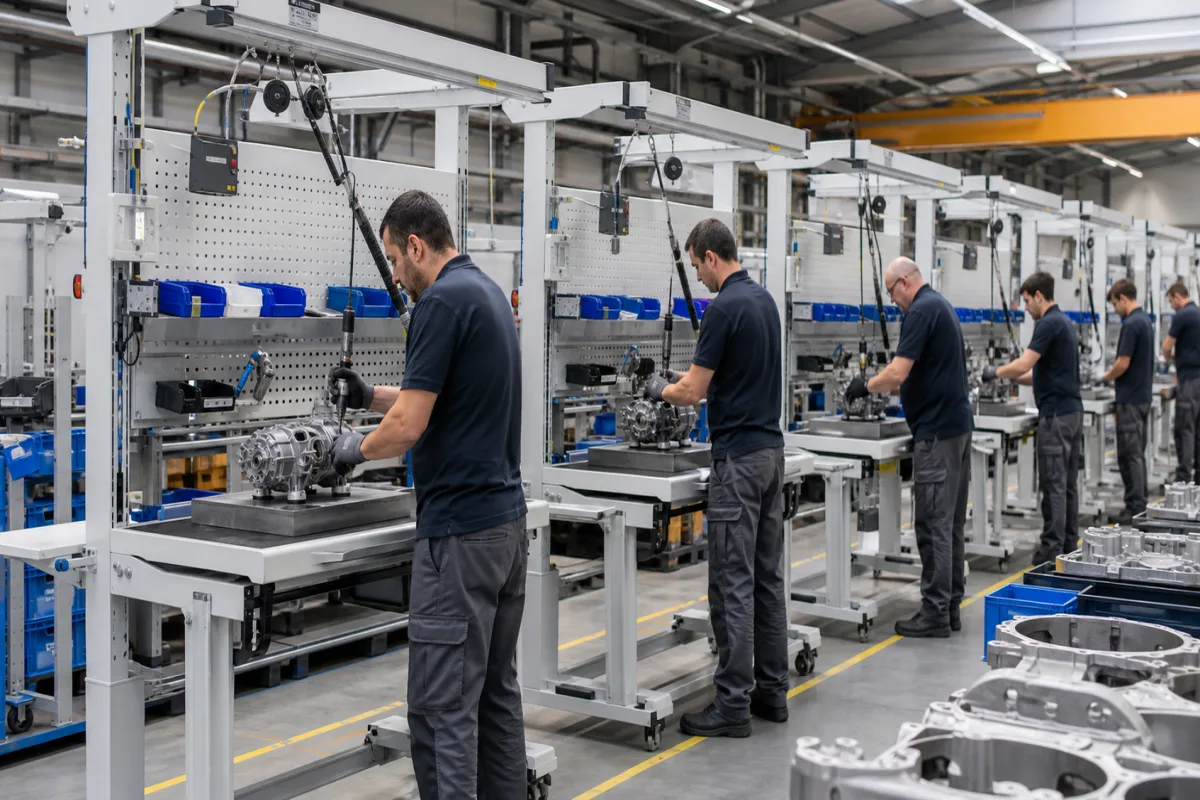
Modular workstations within an automated assembly line where specific assembly operations are performed on products or components.
Product Specifications

Technical details and manufacturing context for Assembly Stations

Definition
Assembly Stations are specialized, modular units within an Automated Assembly Line System designed to perform discrete assembly tasks. Each station is typically configured with specific tools, fixtures, and automation (robotic arms, pick-and-place units, screwdrivers, welders, etc.) to execute operations like part fitting, fastening, welding, gluing, or testing. They are sequentially arranged along the line's conveyor or transfer system, allowing a product to move from one station to the next, with each station adding value until final assembly is complete. These stations are the fundamental building blocks that define the line's capability, throughput, and flexibility.
Working Principle
A product or sub-assembly enters the station via a conveyor, pallet, or robotic transfer. The station's control system (often PLC-based) activates. Fixtures or clamps secure the workpiece. Pre-programmed automation (e.g., a multi-axis robot) or dedicated machinery then performs the assigned task—such as installing a component, driving screws, applying adhesive, or conducting an in-process inspection. Sensors verify task completion and part presence/quality. Upon successful operation, the workpiece is released and transferred to the next station in the sequence. The station then resets, awaiting the next cycle.
Common Materials
Structural Steel (frame), Aluminum (guarding, panels), Stainless Steel (food/cleanroom applications)
Technical Parameters
  • Typical station footprint (Length x Width) to define line layout and spacing. (mm) Standard Spec
Components / BOM
  • Structural Frame
    Provides rigid support and mounting points for all station components, ensuring stability and alignment.
    Material: steel
  • Tooling/Fixture Plate
    Custom-designed plate or nest that locates and holds the workpiece securely during the assembly operation.
    Material: aluminum or steel
  • Safety Guarding
    Physical barriers (mesh, polycarbonate) with interlocked access doors to protect operators from moving parts.
    Material: steel frame with polycarbonate panels
  • Station Controller (PLC/I/O)
    Local programmable logic controller and input/output modules that execute the station's specific sequence and communicate with the line master.
    Material: electronic components in an enclosure
Engineering Reasoning
0.5-2.0 m/s linear actuator speed, 0.1-0.5 mm positioning accuracy, 20-80 N clamping force
Exceeding 2.5 m/s actuator speed causes bearing fatigue failure, positioning error >1.0 mm triggers misalignment, clamping force >100 N induces plastic deformation in fixtures
Design Rationale: Bearing fatigue failure occurs at 2.5 m/s due to Hertzian contact stress exceeding 1.2 GPa yield strength of AISI 52100 steel; positioning errors >1.0 mm exceed kinematic chain tolerance stack-up; clamping forces >100 N exceed 0.2% yield strength of 6061-T6 aluminum fixtures causing permanent deformation
Risk Mitigation (FMEA)
Trigger Pneumatic cylinder seal degradation from 100 ppm particulate contamination
Mode: Actuator velocity drops below 0.3 m/s causing cycle time violation
Strategy: Install 10 μm absolute filters with differential pressure monitoring at 0.5 bar threshold
Trigger Servo motor encoder feedback loss due to EMI exceeding 10 V/m at 100 MHz
Mode: Positional overshoot of 5.0 mm causing collision with adjacent station
Strategy: Implement double-shielded encoder cables with ferrite cores and 30 dB attenuation at 100 MHz

Industry Taxonomies & Aliases

Commonly used trade names and technical identifiers for Assembly Stations.

Applied To / Applications

This component is essential for the following industrial systems and equipment:

Industrial Ecosystem & Supply Chain DNA

Complementary Systems
Downstream Applications
Specialized Tooling

Application Fit & Sizing Matrix

Operational Limits
pressure: Atmospheric (no pressure containment required)
other spec: Payload capacity: 50-500 kg per station, Vibration tolerance: <0.5 mm/s RMS
temperature: 15-35°C (ambient operating range)
Media Compatibility
✓ Electronics assembly (PCBs, connectors) ✓ Small mechanical assemblies (gears, bearings) ✓ Light packaging operations (cartoning, labeling)
Unsuitable: High-temperature welding or soldering environments (>100°C)
Sizing Data Required
  • Product dimensions and weight
  • Cycle time requirements (units/hour)
  • Number of assembly operations per station

Reliability & Engineering Risk Analysis

Failure Mode & Root Cause
Bearing fatigue failure
Cause: Cyclic loading from repeated assembly motions exceeding bearing fatigue limits, often accelerated by improper alignment or inadequate lubrication
Pneumatic system leakage
Cause: Degradation of seals and O-rings due to contamination, improper air filtration, or thermal cycling causing material hardening and cracking
Maintenance Indicators
  • Unusual grinding or knocking sounds during operation indicating mechanical component wear
  • Visible air leaks at fittings or cylinders accompanied by reduced clamping force or slower cycle times
Engineering Tips
  • Implement predictive maintenance with vibration analysis and thermal imaging to detect early bearing degradation before catastrophic failure
  • Install coalescing filters with automatic drains in pneumatic systems and establish regular seal inspection/replacement schedules based on cycle counts

Compliance & Manufacturing Standards

Reference Standards
ISO 9001:2015 - Quality management systems ANSI/ASSE Z244.1 - Control of hazardous energy DIN 8593-0 - Assembly processes
Manufacturing Precision
  • Positional tolerance: +/-0.5mm for fixture alignment
  • Surface flatness: 0.2mm across work surface
Quality Inspection
  • Ergonomic assessment per ISO 11228-3
  • Electrical safety test per IEC 60204-1

Factories Producing Assembly Stations

Verified manufacturers with capability to produce this product in China

✓ 95% Supplier Capability Match Found

P Project Engineer from Brazil Jan 17, 2026
★★★★★
"The technical documentation for this Assembly Stations is very thorough, especially regarding technical reliability."
Technical Specifications Verified
S Sourcing Manager from Canada Jan 14, 2026
★★★★★
"Reliable performance in harsh Machinery and Equipment Manufacturing environments. No issues with the Assembly Stations so far."
Technical Specifications Verified
P Procurement Specialist from United States Jan 11, 2026
★★★★★
"Testing the Assembly Stations now; the technical reliability results are within 1% of the laboratory datasheet."
Technical Specifications Verified
Verification Protocol

“Feedback is collected from verified sourcing managers during RFQ (Request for Quote) and factory evaluation processes on CNFX. These reports represent historical performance data and technical audit summaries from our B2B manufacturing network.”

9 sourcing managers are analyzing this specification now. Last inquiry for Assembly Stations from UAE (1h ago).

Supply Chain Compatible Machinery & Devices

Heavy-Duty CNC Plasma Cutting Machine

Industrial machine for precision metal cutting using plasma arc technology

Explore Specs →
Automated Assembly Line System

Integrated production system for sequential component assembly operations

Explore Specs →
Automated Powder Coating System

Integrated industrial system for applying dry powder coatings to metal substrates.

Explore Specs →
Centrifugal Pump Impeller

Rotating component that transfers energy to fluid in centrifugal pumps.

Explore Specs →

Frequently Asked Questions

What materials are used in your assembly stations for food industry applications?

For food industry and cleanroom applications, we use stainless steel frames and guarding to meet hygiene standards, with aluminum panels where appropriate for lightweight durability.

Can your assembly stations be integrated with existing automated production lines?

Yes, our modular assembly stations are designed with standard PLC/I/O controllers and tooling plates that allow seamless integration with most automated assembly line systems.

What safety features are included in your assembly workstations?

All stations include comprehensive safety guarding, emergency stop systems, and are built with structural steel frames to ensure operator safety and equipment stability during assembly operations.

Can I contact factories directly on CNFX?

CNFX is an open directory, not a transaction platform. Each factory profile provides direct contact information and production details to help you initiate direct inquiries with Chinese suppliers.

Get Quote for Assembly Stations

Request technical pricing, lead times, or customized specifications for Assembly Stations directly from verified manufacturing units.

Your business information is encrypted and only shared with verified Assembly Stations suppliers.

Thank you! Your message has been sent. We'll respond within 1–3 business days.

Need to Manufacture Assembly Stations?

Connect with verified factories specializing in this product category

Add Your Factory Contact Us
Previous Product
Assembly Station
Next Product
Atmosphere Control Enclosure (optional)