Automation · Repeatability, payload and cell safety
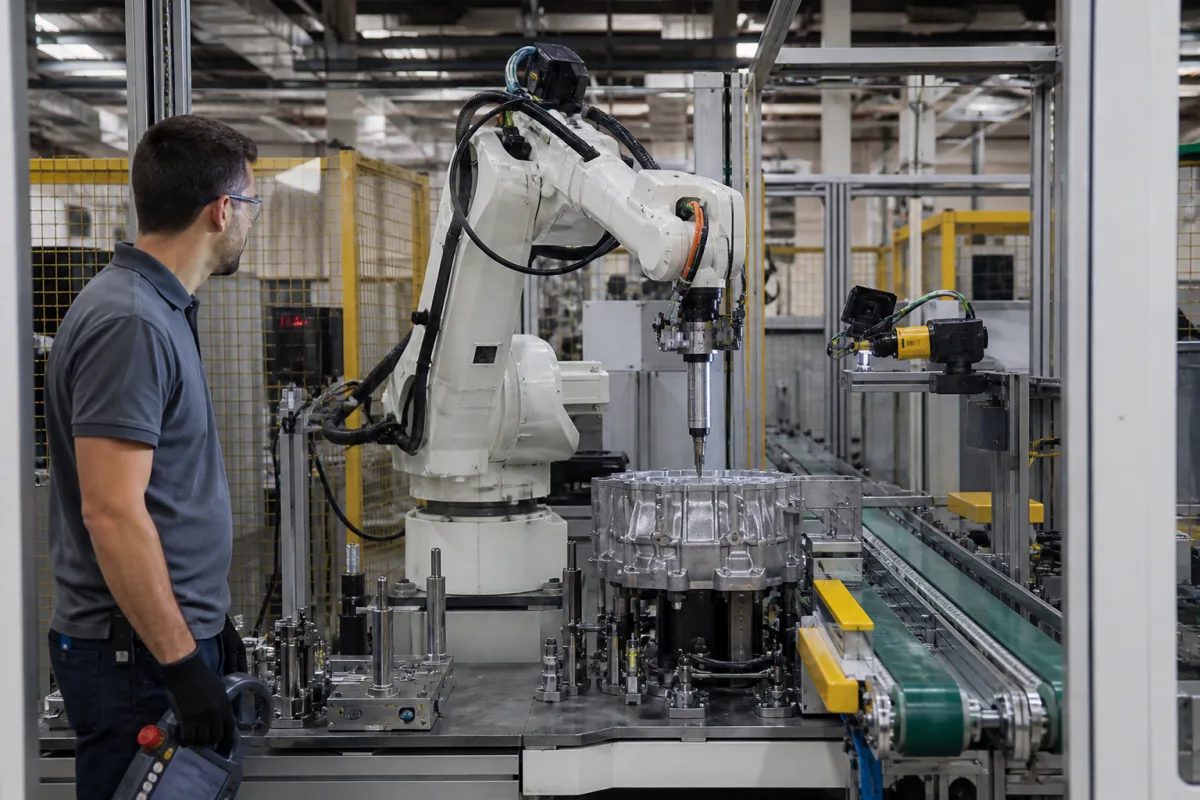
An assembly robot is a system, not an arm: the robot, the gripper or tool, fixtures, vision, controls and guarding together decide whether parts go together every cycle. Choose the arm by repeatability and payload at the reach you need, decide whether the application is collaborative or guarded, and plan programming and maintenance so people are not inside the cell when it moves unexpectedly.
Six-axis, SCARA, delta and collaborative robots used for assembly, screwdriving, insertion, dispensing and pick-and-place. Welding, painting and palletizing cells follow the same safety principles but are outside this page's sizing guidance.
CNFX editorial research · Sources checked October 12, 2026 · 5 sources
A3, the automation trade association, explains that repeatability is how consistently a robot returns to the same position, while accuracy is how close it gets to a commanded coordinate. It gives typical repeatability of ±0.02 to ±0.1 mm and uncalibrated accuracy of about ±1 to ±5 mm for industrial robots. [2]
A3 says "for most industrial applications, repeatability matters more than accuracy because processes are taught by moving the robot to desired positions": the robot returns to the taught point even if that point is offset from the model. A3 notes that accuracy becomes important for offline programming and vision-guided moves, and can be improved by kinematic calibration, while repeatability is built into the design. [2]
Ask the supplier how repeatability and accuracy were measured and under which standard; ISO 9283 test methods were not read for this page.
If parts are located by a camera or programmed offline, specify absolute accuracy or calibration, not just repeatability.
02
Size payload, reach and arm type for the task
OSHA notes that industrial robots "are available in a wide range of sizes, shapes, and structures" with different numbers of axes, which set their working space, and that an industrial robot system includes the end-effector, controller, power, sensors and interfaces as well as the arm. [1]
Count the gripper or tool, cables and the heaviest part in the payload, and check the reach to every fixture and feeder. Suppliers linked to this page list SCARA robots for fast planar assembly and six-axis arms for reaching around parts; Topstar, for example, lists six-axis arms with 715 to 1,813 mm reach and 7 to 35 kg payload. [5][4]
OSHA describes parallel (delta) robots as suited to very high-speed pick-and-place and assembly. [1]
03
Plan guarding, collaborative use and programming safety
OSHA separates collaborative applications, designed for direct interaction with workers, from non-collaborative ones separated by traditional machine safeguarding, and notes that robots can make fast, powerful movements through a volume larger than their base. It cites ANSI/RIA R15.06-2012 Parts 1 and 2 as the robot safety standard. [1]
OSHA reports that studies in Sweden and Japan found "many robot accidents do not occur under normal operating conditions, but instead during assembly, installation, and testing", with errors showing up during initial programming and maintenance. Its examples include a programmer struck during an unexpected motion with no enabling device on the teach pendant, a worker inside inadequate perimeter guarding, and a service worker struck after cleaning a sensor that restarted the cycle. [1]
OSHA advises that no servicing be done in automatic mode unless safeguarding prevents operation, and that safeguarding responsibilities run from the robot maker through the integrator to the employer. Ask who integrates the cell, who does the risk assessment, and what safety functions and guarding are included. [1]
04
Compare what suppliers offer
Suppliers linked to this page list SCARA, six-axis, delta and collaborative robots and assembly cells. [3][4][5]
EVST lists assembly robots and a 12 kg, 1,300 mm collaborative arm; SIASUN lists SCARA robots with 4 kg at 400 mm and 7 kg at 500 mm reach alongside collaborative robots and assembly automation. Treat speed and repeatability figures as supplier statements to confirm on the data sheet. [3][4]
05
Trace the assembly robot system
This is a functional reference built from the sources cited; it is not one maker's parts list.
Part
Role
Fix in the order
Manipulator (arm)
Frame, joints, actuators and sensors that move the tool. [1]
Arm type, axes, payload, reach and repeatability.
End-effector
Gripper, screwdriver, dispenser or other tool. [1]
Tool type, mass and utilities.
Controller and teach pendant
Run programs; pendant teaches positions in manual mode. [1]
Controller, pendant with enabling device and I/O.
Vision and sensors
Locate parts and monitor the process; vision-guided moves need accuracy. [2][1]
Camera, calibration and sensor list.
Safeguarding
Fences, interlocks, presence sensing or collaborative safety functions. [1]
Guarding concept and safety functions.
06
Fill the specification fields with values for your cell
A robot quotation needs task-specific values. The table explains each field, gives published values where a reviewed source states them, and says what to obtain from the supplier.
Explore company information and manufacturing capabilities, then discuss the scope of your project with a relevant supplier.
Share this page
Compiled and source-reviewed by the CNFX editorial team.
Published product pages show what a company offers, not tested performance. Confirm the legal seller, factory and scope for your order. How we source and review
· Page last updated 13 October 2026
Buyer questions
What is the difference between robot accuracy and repeatability?
A3 explains repeatability is how consistently a robot returns to the same point and accuracy is how close it gets to a commanded coordinate; typical repeatability is ±0.02–0.1 mm, uncalibrated accuracy ±1–5 mm. [2]
When do robot accidents occur?
OSHA cites studies finding "many robot accidents do not occur under normal operating conditions, but instead during assembly, installation, and testing". [1]
Which safety standard covers industrial robots in the US?
OSHA cites ANSI/RIA R15.06-2012 Parts 1 and 2 for robots and robot systems. [1]
Sources and what still needs a direct check
Sources checked 2026-10-12. OSHA's Technical Manual is a US government source; A3 is the automation industry association. Supplier pages describe their own offers. ANSI/RIA R15.06, ISO 10218 and ISO 9283 were not read for this page.