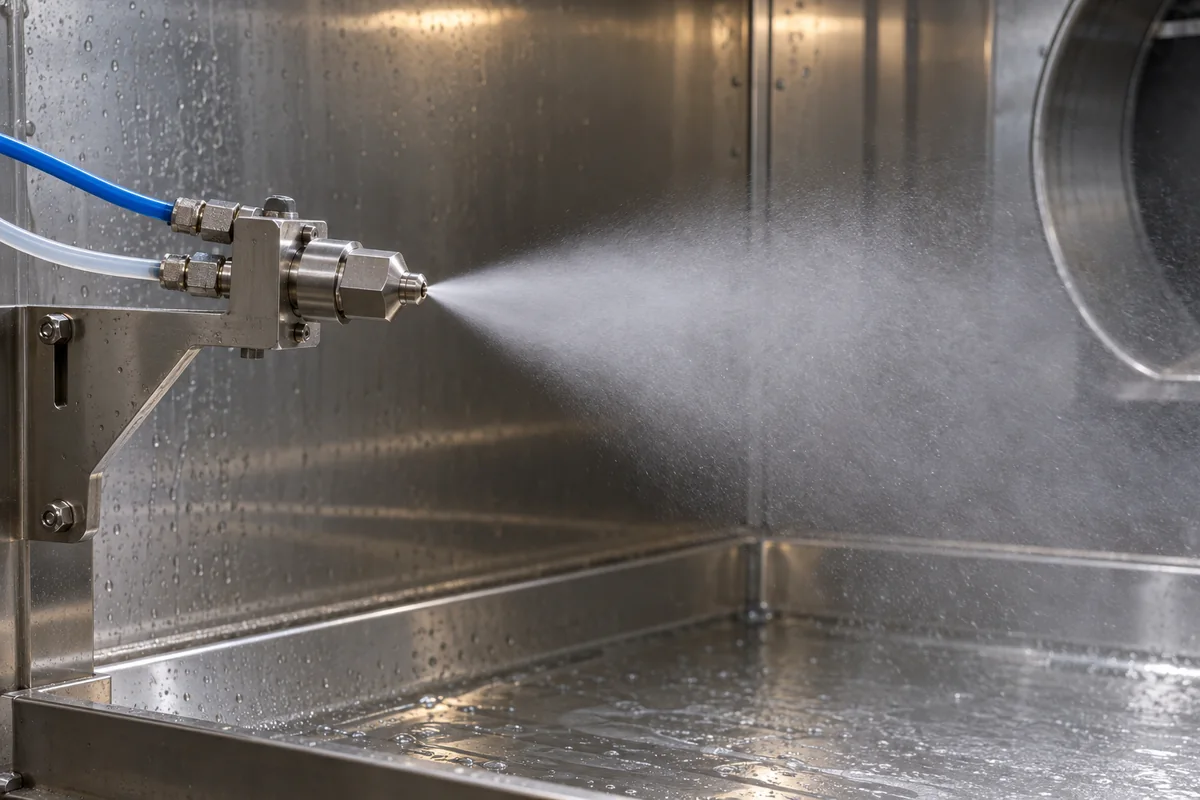
Air-atomizing (two-fluid) nozzle: internal-mix and external-mix air caps, siphon feed and the air-to-liquid ratio
Two-fluid nozzles · Internal or external mixing, air-to-liquid ratio, siphon feed and the droplet sizes they give
An air-atomizing nozzle, also called a two-fluid nozzle, breaks liquid into a mist with a second stream of compressed air rather than with liquid pressure alone. Its behaviour is set by three choices: whether air and liquid meet inside the cap or outside it, whether the liquid is pushed in under pressure or drawn up by the air, and how much air is spent per kilogram of liquid.
Two-fluid nozzles that atomize a liquid with compressed air: internal-mix and external-mix air caps, pressure-fed and siphon or gravity-fed bodies, and no-drip versions with a shut-off needle. Single-fluid hydraulic nozzles and the general choice of spray pattern, flow and wear material are covered on the Spray nozzle page; spray gun manifolds for tablet pan coaters are covered on the Tablet coating spray system page; ultrasonic atomizers are covered on the Piezoelectric ultrasonic transducer page; dry-fog humidifier systems are covered on the Humidification system page. Bottle rinsing nozzles, dispensing nozzles and gas-atomization nozzles for metal powder are outside this page.
CNFX editorial research · Sources checked October 12, 2026 · 4 sources
Internal-mix or external-mix cap: liquid viscosity and whether air and liquid can be set apart
EXAIR's catalogue draws the line at viscosity. Its internal-mix nozzles mix liquid and compressed air inside the nozzle for fine atomization, need both feeds pressurized, and are rated for liquids up to 300 cP. Its external-mix nozzles bring the two streams together outside the cap with independent air and liquid control for a precise volume flow, and are listed for liquids above 300 cP and for high-volume spraying of heavy coatings. [1]
Inside an internal-mix body the air and the liquid share the same passages, so one supply changes the other. In a tangential-air internal-mix atomizer tested by Yadav and Kushari, water flow at a fixed 68.9 kPa liquid pressure fell from 9.9 g/s to 3.02 g/s as air pressure was raised from 137.8 to 344.73 kPa; the authors attribute this to air taking up more of the flow area inside the atomizer. [2]
Editorial calculation: (9.9 − 3.02) / 9.9 ≈ 0.69, so in that test about 69% of the liquid flow was lost by raising the air pressure alone. With an internal-mix cap, a flow-rate figure is only meaningful when quoted together with both the air and the liquid pressure. [2]
EXAIR also lists no-drip versions of both cap types that positively stop liquid flow when the compressed air is shut off. [1]
State the liquid's viscosity at spraying temperature, whether air and liquid flow must be adjustable separately, and whether the spray must stop without dripping when the air is switched off.
02
Air-to-liquid mass ratio against Sauter mean diameter
The air-to-liquid mass ratio (ALR) is the main control on droplet size in a two-fluid nozzle. Yadav and Kushari ran their internally mixed atomizer from an ALR of 0.0277 to 0.623 and measured with a phase Doppler analyser that droplet size fell as ALR rose at a given liquid pressure; at the centreline, 50 mm below the tip, the Sauter mean diameter (SMD) dropped from 158.5 to 49.9 µm as air pressure went from 137.8 to 344.73 kPa. [2]
The same study reports sprays with centreline SMD below 60 µm already at an ALR of about 0.1. At an ALR of 0.269 the SMD was 60–120 µm across the central ±10 mm of the spray, with much larger droplets at the edges where velocities were lower, so a single SMD figure for a nozzle depends on where in the spray it was measured. [2]
Kim and co-authors, studying the mixing chamber of an internal-mix atomizer by laser diffraction, found that chamber length changed the internal flow pattern and the SMD, and that at air/water mass ratios below 0.2 the SMD became smaller as the liquid mixed more fully with the air inside the chamber. [3]
Ikeuchi notes for its BIMV flat-spray pneumatic nozzle that the spray distribution also depends on the air-water ratio: mountain-shaped at a low ratio, becoming even as the ratio rises. [4] Ikeuchi's catalogue grades its pneumatic nozzles by droplet class: dry fog below 10 µm, fine fog 10–100 µm and fine drizzle 100–300 µm. [4]
Editorial calculation: a nozzle spraying 1 L/min of water (about 16.7 g/s) at an ALR of 0.1 needs about 1.67 g/s of air; at an assumed air density of 1.2 kg/m³ that is about 1.4 L/s, or roughly 83 L/min of free air, before any allowance for pattern air or leakage. Doubling the ALR doubles the compressor load. [2]
03
Siphon and gravity feed when no liquid pump is available
Where there is no liquid pressure, the air stream itself can draw the liquid. EXAIR's siphon-fed air-atomizing nozzles work with gravity-fed liquids or lift liquid from as much as 36 in (91 cm) below the nozzle, are rated for viscosities up to 200 cP, and are aimed at thin coatings. [1]
A pressure-fed nozzle gives a wider operating window. Ikeuchi's BIMV pressure-fed flat-spray nozzle is specified for a mean droplet size of 100 µm or less, with a large turn-down ratio at liquid pressures of 0.1–0.3 MPa, spray capacities of 0.017–3.3 L/min across the range, air consumption of 7–245 L/min, spray angles of 45–110°, free passage of 0.2–2.2 mm, and Rc 1/8 or Rc 1/4 connections. [4]
The 0.2 mm lower end of that free-passage range means strainers on both lines are part of the specification for the smallest caps. Air consumption also belongs in the comparison: across the BIMV range it spans a factor of 35 (editorial calculation: 245 / 7). [4]
04
Data to send for a two-fluid nozzle
Paste it into your enquiry below or into an email to a maker, then replace every bracket.
Liquid: [name; viscosity at spray temperature; solids or fibres]
Feed: [pressure-fed (liquid pressure) or siphon/gravity (lift height)]
Air: [available pressure; free-air volume per nozzle]
Spray: [flow per nozzle; target droplet size and how it is measured; pattern and angle]
Mixing: [internal or external; no-drip shut-off needed]
Mounting: [thread size; distance to target; materials]
Two-fluid nozzle makers with internal-mix, external-mix and siphon models
The listings below range from internal-mix full-cone caps to external-mix flat-fan caps with clean-out needles, and five of the seven list siphon-fed bodies alongside pressure-fed ones.
BOYUAN Spraying
Manufacturing site to be confirmed for the order
Lists BYCO internal-mix full-cone air atomizing nozzles.
Lists internal- and external-mix air atomizing nozzles in pressure and siphon/gravity versions, in 304 or 316 stainless steel with air cap, fluid cap and needle valve.
Explore company information and manufacturing capabilities, then discuss the scope of your project with a relevant supplier.
Share this page
Compiled and source-reviewed by the CNFX editorial team.
Each manufacturer above links to the page on that company's own website where the product is listed, with the date we checked it. How we source and review
· Page last updated 13 October 2026
Buyer questions
When should an external-mix air cap be chosen over internal-mix?
EXAIR rates its internal-mix nozzles for liquids up to 300 cP with both feeds pressurized, and its external-mix nozzles for liquids above 300 cP with independent air and liquid control. [1]
How much does the air-to-liquid ratio change droplet size?
In one internal-mix atomizer, centreline SMD fell from 158.5 to 49.9 µm as air pressure rose from 137.8 to 344.73 kPa; SMD below 60 µm was reached at an ALR of about 0.1. [2]
How high can a siphon-fed nozzle lift liquid?
EXAIR lists siphon heights up to 36 in (91 cm) for liquids up to 200 cP. [1]
Does the mixing chamber shape matter?
Kim and co-authors found that mixing-chamber length changed the flow pattern and the SMD, with finer sprays at air/water ratios below 0.2 when liquid and air mixed more fully. [3]
Sources and what still needs a direct check
Sources checked 2026-10-12. EXAIR and Ikeuchi are nozzle makers and their figures describe their own ranges. The droplet-size measurements come from two laboratory studies of internal-mix atomizers, one using phase Doppler and one laser diffraction.