Industry-Verified Manufacturing Data (2026)

Atmosphere Control Enclosure (optional)

Based on aggregated insights from multiple verified factory profiles within the CNFX directory, the standard Atmosphere Control Enclosure (optional) used in the Machinery and Equipment Manufacturing sector typically supports operational capacities ranging from standard industrial configurations to heavy-duty production requirements.

Technical Definition & Core Assembly

A canonical Atmosphere Control Enclosure (optional) is characterized by the integration of Enclosure Frame and Viewing Window. In industrial production environments, manufacturers listed on CNFX commonly emphasize Stainless steel construction to support stable, high-cycle operation across diverse manufacturing scenarios.

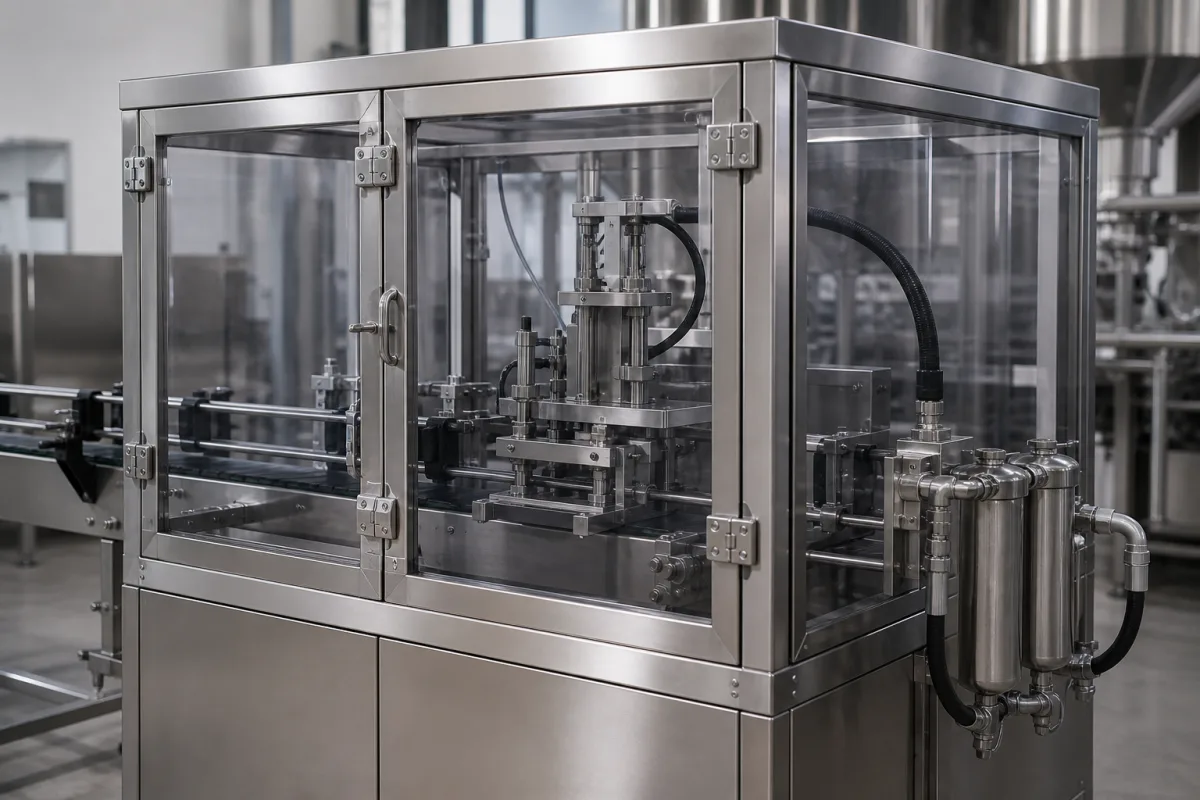
Optional enclosure that creates and maintains a controlled atmosphere environment within the Final Sealing Station
Product Specifications

Technical details and manufacturing context for Atmosphere Control Enclosure (optional)

Definition
An optional protective enclosure component of the Final Sealing Station designed to establish and sustain a specific atmospheric composition (such as inert gas, vacuum, or modified atmosphere) around the sealing area to prevent oxidation, contamination, or other atmospheric interference during the sealing process, particularly critical for sensitive materials or high-precision applications.
Working Principle
The enclosure creates a sealed chamber around the sealing zone. Atmosphere control systems (gas purging, vacuum pumps, or gas mixing) then establish the desired internal atmosphere. Sensors monitor and maintain atmospheric parameters (oxygen levels, humidity, pressure) throughout the sealing operation.
Common Materials
Stainless steel, Tempered glass, Sealing gaskets
Technical Parameters
  • Internal dimensions of the enclosure chamber (mm) Standard Spec
Components / BOM
  • Enclosure Frame
    Structural support and mounting for transparent panels and sealing system
    Material: Stainless steel
  • Viewing Window
    Allows visual monitoring of the sealing process while maintaining atmospheric integrity
    Material: Tempered glass
  • Access Door
    Sealed entry point for loading/unloading with integrated locking mechanism
    Material: Stainless steel with silicone gasket
  • Gas Inlet/Outlet Ports
    Connections for atmosphere control systems (gas supply, vacuum, exhaust)
    Material: Stainless steel
Engineering Reasoning
0.8-1.2 bar absolute pressure, 20-25°C temperature, <100 ppm oxygen concentration
Pressure differential >0.5 bar across enclosure walls, temperature deviation >±5°C from setpoint, oxygen concentration >500 ppm
Design Rationale: Excessive pressure differential causes structural deformation via von Mises yield criterion (σ_vm > 250 MPa for 316L stainless steel), temperature gradients induce thermal stress exceeding material's thermal fatigue limit (ΔT > 30°C), oxygen ingress initiates galvanic corrosion at sealing interfaces
Risk Mitigation (FMEA)
Trigger Seal material degradation due to ozone exposure (0.1 ppm threshold)
Mode: Atmosphere leakage rate exceeding 0.1% volume/hour
Strategy: Install redundant Viton-FKM double-lip seals with continuous helium leak detection (sensitivity 1×10^-9 mbar·L/s)
Trigger Thermal runaway in heating elements due to PID controller integral windup
Mode: Localized temperature hotspots exceeding 80°C
Strategy: Implement cascade control with feedforward compensation and hardware limiters (SSR cutoff at 75°C)

Industry Taxonomies & Aliases

Commonly used trade names and technical identifiers for Atmosphere Control Enclosure (optional).

Applied To / Applications

This component is essential for the following industrial systems and equipment:

Industrial Ecosystem & Supply Chain DNA

Complementary Systems
Downstream Applications
Specialized Tooling

Application Fit & Sizing Matrix

Operational Limits
pressure: Atmospheric to 1.5 bar gauge (positive pressure mode), -0.2 to 0 bar gauge (negative pressure mode)
flow rate: 10-100 L/min (inert gas purge), adjustable via mass flow controller
temperature: 15°C to 35°C (operating ambient), internal control ±1°C
oxygen level: Controllable from 0.1 ppm to 21% (ambient) with oxygen analyzer feedback
humidity control: Maintains <1% RH (dew point -40°C) with optional desiccant system
Media Compatibility
✓ Inert gases (N₂, Ar, CO₂) ✓ Dry air (dew point < -40°C) ✓ Cleanroom environments (ISO Class 5-7)
Unsuitable: Corrosive atmospheres (HCl, H₂S, chlorine) or explosive environments (flammable solvents)
Sizing Data Required
  • Required enclosure volume (L) and dimensions (L×W×H)
  • Target atmosphere purity (O₂/H₂O ppm levels)
  • Process throughput (units/hour) and door opening frequency

Reliability & Engineering Risk Analysis

Failure Mode & Root Cause
Seal degradation
Cause: Exposure to corrosive atmospheres or temperature cycling leading to material embrittlement and loss of sealing integrity
Control system malfunction
Cause: Moisture ingress, electrical interference, or component aging disrupting sensor accuracy and actuator response
Maintenance Indicators
  • Audible alarm from pressure/temperature sensors indicating deviation from setpoints
  • Visible condensation or moisture accumulation inside the enclosure indicating seal failure
Engineering Tips
  • Implement regular seal integrity testing using pressure decay or tracer gas methods to detect leaks before catastrophic failure
  • Install redundant sensors with automated cross-validation to detect control system drift and enable predictive maintenance

Compliance & Manufacturing Standards

Reference Standards
ISO 14644-1:2015 Cleanrooms and associated controlled environments ANSI/ASHRAE 110-2016 Method of Testing Performance of Laboratory Fume Hoods DIN EN 14175-1:2016 Fume cupboards - Part 1: Vocabulary
Manufacturing Precision
  • Seal Integrity: Leak rate ≤ 0.1% of enclosure volume per hour
  • Temperature Control: ±0.5°C from setpoint
Quality Inspection
  • Helium Leak Detection Test
  • Particle Count Test per ISO 14644-1

Factories Producing Atmosphere Control Enclosure (optional)

Verified manufacturers with capability to produce this product in China

✓ 94% Supplier Capability Match Found

S Sourcing Manager from United Arab Emirates Feb 25, 2026
★★★★★
"The technical documentation for this Atmosphere Control Enclosure (optional) is very thorough, especially regarding technical reliability."
Technical Specifications Verified
P Procurement Specialist from Australia Feb 22, 2026
★★★★☆
"Reliable performance in harsh Machinery and Equipment Manufacturing environments. No issues with the Atmosphere Control Enclosure (optional) so far. (Delivery took slightly longer than expected, but technical support was excellent.)"
Technical Specifications Verified
T Technical Director from Singapore Feb 19, 2026
★★★★★
"Testing the Atmosphere Control Enclosure (optional) now; the technical reliability results are within 1% of the laboratory datasheet."
Technical Specifications Verified
Verification Protocol

“Feedback is collected from verified sourcing managers during RFQ (Request for Quote) and factory evaluation processes on CNFX. These reports represent historical performance data and technical audit summaries from our B2B manufacturing network.”

12 sourcing managers are analyzing this specification now. Last inquiry for Atmosphere Control Enclosure (optional) from India (1h ago).

Supply Chain Compatible Machinery & Devices

Heavy-Duty CNC Plasma Cutting Machine

Industrial machine for precision metal cutting using plasma arc technology

Explore Specs →
Automated Assembly Line System

Integrated production system for sequential component assembly operations

Explore Specs →
Automated Powder Coating System

Integrated industrial system for applying dry powder coatings to metal substrates.

Explore Specs →
Centrifugal Pump Impeller

Rotating component that transfers energy to fluid in centrifugal pumps.

Explore Specs →

Frequently Asked Questions

What is the primary function of the Atmosphere Control Enclosure?

The Atmosphere Control Enclosure creates and maintains a controlled environment within the Final Sealing Station, allowing for precise atmospheric conditions during sealing processes in machinery manufacturing.

What materials are used in the construction of this enclosure?

The enclosure is constructed from durable stainless steel for the frame, tempered glass for the viewing window, and high-quality sealing gaskets to ensure airtight performance and longevity.

How does the enclosure integrate with existing sealing stations?

As an optional accessory, the enclosure is designed to seamlessly integrate with Final Sealing Stations through standardized mounting points and includes gas inlet/outlet ports for atmosphere control system connections.

Can I contact factories directly on CNFX?

CNFX is an open directory, not a transaction platform. Each factory profile provides direct contact information and production details to help you initiate direct inquiries with Chinese suppliers.

Get Quote for Atmosphere Control Enclosure (optional)

Request technical pricing, lead times, or customized specifications for Atmosphere Control Enclosure (optional) directly from verified manufacturing units.

Your business information is encrypted and only shared with verified Atmosphere Control Enclosure (optional) suppliers.

Thank you! Your message has been sent. We'll respond within 1–3 business days.

Need to Manufacture Atmosphere Control Enclosure (optional)?

Connect with verified factories specializing in this product category

Add Your Factory Contact Us
Previous Product
Assembly Stations
Next Product
Atomizing Nozzle