Industry-Verified Manufacturing Data (2026)

Automated Cleaning Module

Based on aggregated insights from multiple verified factory profiles within the CNFX directory, the standard Automated Cleaning Module used in the Machinery and Equipment Manufacturing sector typically supports operational capacities ranging from standard industrial configurations to heavy-duty production requirements.

Technical Definition & Core Assembly

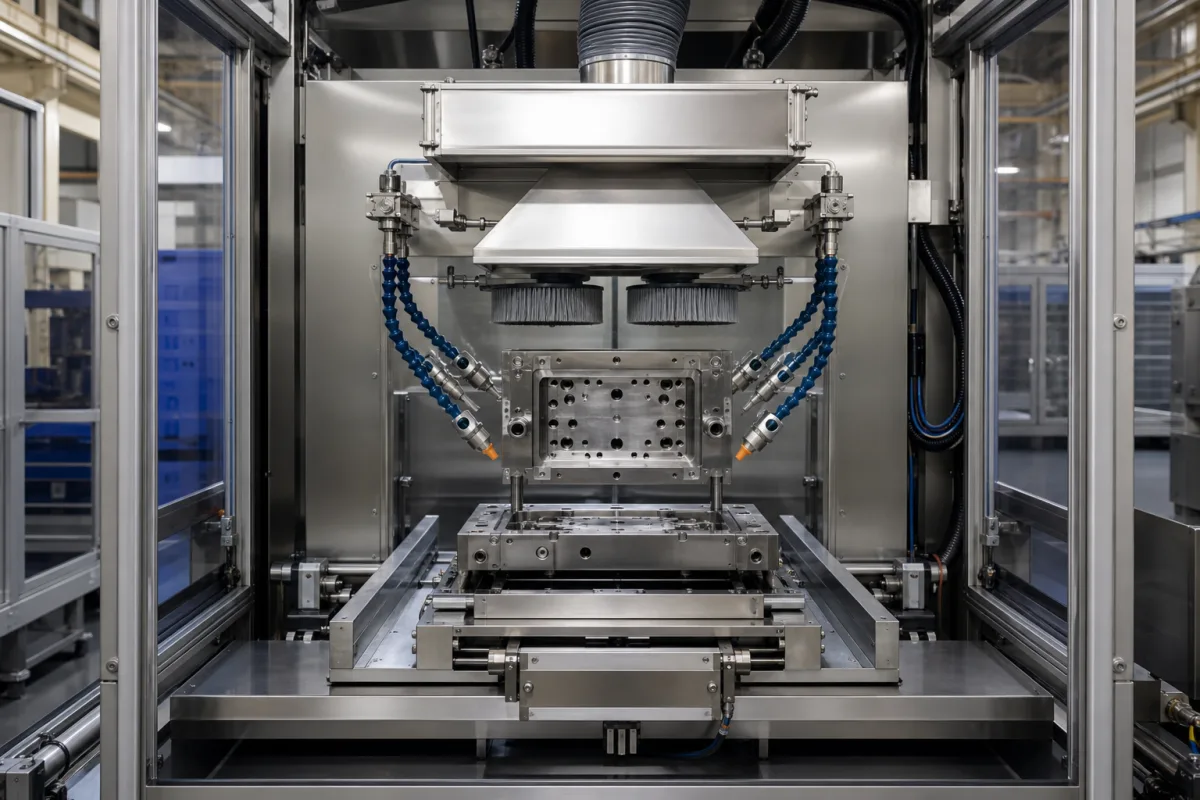
A canonical Automated Cleaning Module is characterized by the integration of Cleaning Nozzle Array and Brush Mechanism. In industrial production environments, manufacturers listed on CNFX commonly emphasize Stainless Steel construction to support stable, high-cycle operation across diverse manufacturing scenarios.

A specialized component within an Automated Mold Preparation Station that performs automated cleaning of molds between production cycles.
Product Specifications

Technical details and manufacturing context for Automated Cleaning Module

Definition
The Automated Cleaning Module is an integral part of the Automated Mold Preparation Station, designed to systematically and efficiently clean molds after each use. It ensures removal of residual materials, contaminants, and debris from mold surfaces, cavities, and intricate geometries through automated processes, preparing molds for subsequent production cycles while maintaining consistent quality and reducing manual intervention.
Working Principle
The module typically employs a combination of mechanical brushing, high-pressure fluid jets (air, water, or specialized cleaning solutions), and vacuum extraction systems. It follows programmed sequences to target specific mold areas, with sensors monitoring cleanliness levels and adjusting cleaning parameters as needed to ensure thorough contamination removal without damaging mold surfaces.
Common Materials
Stainless Steel
Technical Parameters
  • Module dimensions for integration into mold preparation stations (mm) Per Request
Components / BOM
Engineering Reasoning
0.5-2.0 MPa (5-20 bar) at 60-80°C cleaning fluid temperature
Fluid pressure exceeding 2.5 MPa (25 bar) or dropping below 0.3 MPa (3 bar) for >30 seconds
Design Rationale: Cavitation-induced erosion at low pressure (below vapor pressure of cleaning fluid at operating temperature) and mechanical fatigue from pressure cycling beyond yield strength of stainless steel 316L components (σ_y = 290 MPa)
Risk Mitigation (FMEA)
Trigger Particulate contamination exceeding 15 μm in cleaning fluid
Mode: Nozzle orifice erosion increasing diameter from 0.5 mm to >0.8 mm
Strategy: Install 10 μm absolute filtration with differential pressure monitoring (ΔP > 0.15 MPa triggers maintenance)
Trigger Thermal cycling between 20°C ambient and 80°C operating temperature at >5 cycles/hour
Mode: Thermal fatigue cracking in welded joints (ΔT = 60°C, α = 16.5 μm/m·°C for 316L)
Strategy: Implement controlled temperature ramp (max 10°C/minute) and expansion loop design in piping

Industry Taxonomies & Aliases

Commonly used trade names and technical identifiers for Automated Cleaning Module.

Applied To / Applications

This component is essential for the following industrial systems and equipment:

Industrial Ecosystem & Supply Chain DNA

Complementary Systems
Downstream Applications
Specialized Tooling

Application Fit & Sizing Matrix

Operational Limits
pressure: Max 10 bar
flow rate: 10-50 L/min
temperature: 5°C to 60°C
slurry concentration: Up to 20% solids by weight
Media Compatibility
✓ Water-based cleaning solutions ✓ Mild alkaline detergents ✓ Non-abrasive solvent blends
Unsuitable: Highly corrosive acids (e.g., hydrochloric, sulfuric)
Sizing Data Required
  • Mold cavity volume (L)
  • Required cleaning cycle time (seconds)
  • Mold surface material type

Reliability & Engineering Risk Analysis

Failure Mode & Root Cause
Abrasive erosion
Cause: Prolonged exposure to particulate-laden cleaning solutions causing gradual wear on pump impellers, seals, and nozzle orifices, leading to reduced pressure and flow rates.
Cavitation
Cause: Insufficient net positive suction head (NPSH) due to clogged inlet filters, excessive fluid temperature, or pump overspeed, resulting in vapor bubble formation and implosion damage to internal components.
Maintenance Indicators
  • Unusual high-pitched whining or grinding noises from the pump assembly, indicating cavitation or bearing wear
  • Visible fluid leaks around seals or joints, or a significant drop in cleaning pressure/flow rate during operation
Engineering Tips
  • Implement a routine filter inspection and replacement schedule for both inlet and recirculation lines to minimize abrasive particle ingress and maintain optimal NPSH
  • Calibrate and monitor operating parameters (pressure, temperature, flow rate) against manufacturer specifications, and perform periodic vibration analysis to detect early-stage mechanical issues

Compliance & Manufacturing Standards

Reference Standards
ISO 14644-1:2015 (Cleanrooms and associated controlled environments) ANSI/UL 61010-1 (Safety requirements for electrical equipment for measurement, control, and laboratory use) CE marking per Machinery Directive 2006/42/EC
Manufacturing Precision
  • Sealing surface flatness: 0.05mm
  • Nozzle alignment: +/-0.1° angular tolerance
Quality Inspection
  • Leak test (pressure decay method)
  • Particle emission test (ISO 14644-14)

Factories Producing Automated Cleaning Module

Verified manufacturers with capability to produce this product in China

✓ 96% Supplier Capability Match Found

P Project Engineer from Australia Feb 18, 2026
★★★★★
"Testing the Automated Cleaning Module now; the technical reliability results are within 1% of the laboratory datasheet."
Technical Specifications Verified
S Sourcing Manager from Singapore Feb 15, 2026
★★★★★
"Impressive build quality. Especially the technical reliability is very stable during long-term operation."
Technical Specifications Verified
P Procurement Specialist from Germany Feb 12, 2026
★★★★★
"As a professional in the Machinery and Equipment Manufacturing sector, I confirm this Automated Cleaning Module meets all ISO standards."
Technical Specifications Verified
Verification Protocol

“Feedback is collected from verified sourcing managers during RFQ (Request for Quote) and factory evaluation processes on CNFX. These reports represent historical performance data and technical audit summaries from our B2B manufacturing network.”

6 sourcing managers are analyzing this specification now. Last inquiry for Automated Cleaning Module from USA (41m ago).

Supply Chain Compatible Machinery & Devices

Automated Assembly Line System

Integrated production system for sequential component assembly operations

Explore Specs →
Automated Powder Coating System

Integrated industrial system for applying dry powder coatings to metal substrates.

Explore Specs →
Centrifugal Pump Impeller

Rotating component that transfers energy to fluid in centrifugal pumps.

Explore Specs →
High-Precision CNC Laser Cutting Machine

Computer-controlled industrial machine using focused laser beams to cut sheet metal with micron-level accuracy.

Explore Specs →

Frequently Asked Questions

What materials is the Automated Cleaning Module constructed from?

The module is constructed entirely from stainless steel for durability, corrosion resistance, and compliance with industrial hygiene standards in machinery manufacturing environments.

How does the contamination sensor improve cleaning efficiency?

The contamination sensor detects residual particles on molds after cleaning cycles, allowing the system to adjust cleaning parameters or trigger additional cleaning passes to ensure complete mold preparation.

Can this module be integrated with existing Automated Mold Preparation Stations?

Yes, the Automated Cleaning Module is designed as a specialized component that can be integrated into most industrial mold preparation stations, with standardized connections for brush mechanisms, nozzle arrays, and vacuum systems.

Can I contact factories directly on CNFX?

CNFX is an open directory, not a transaction platform. Each factory profile provides direct contact information and production details to help you initiate direct inquiries with Chinese suppliers.

Get Quote for Automated Cleaning Module

Request technical pricing, lead times, or customized specifications for Automated Cleaning Module directly from verified manufacturing units.

Your business information is encrypted and only shared with verified Automated Cleaning Module suppliers.

Thank you! Your message has been sent. We'll respond within 1–3 business days.

Need to Manufacture Automated Cleaning Module?

Connect with verified factories specializing in this product category

Add Your Factory Contact Us
Previous Product
Automated Assembly Line System
Next Product
Automated Component Feeding System