Industry-Verified Manufacturing Data (2026)

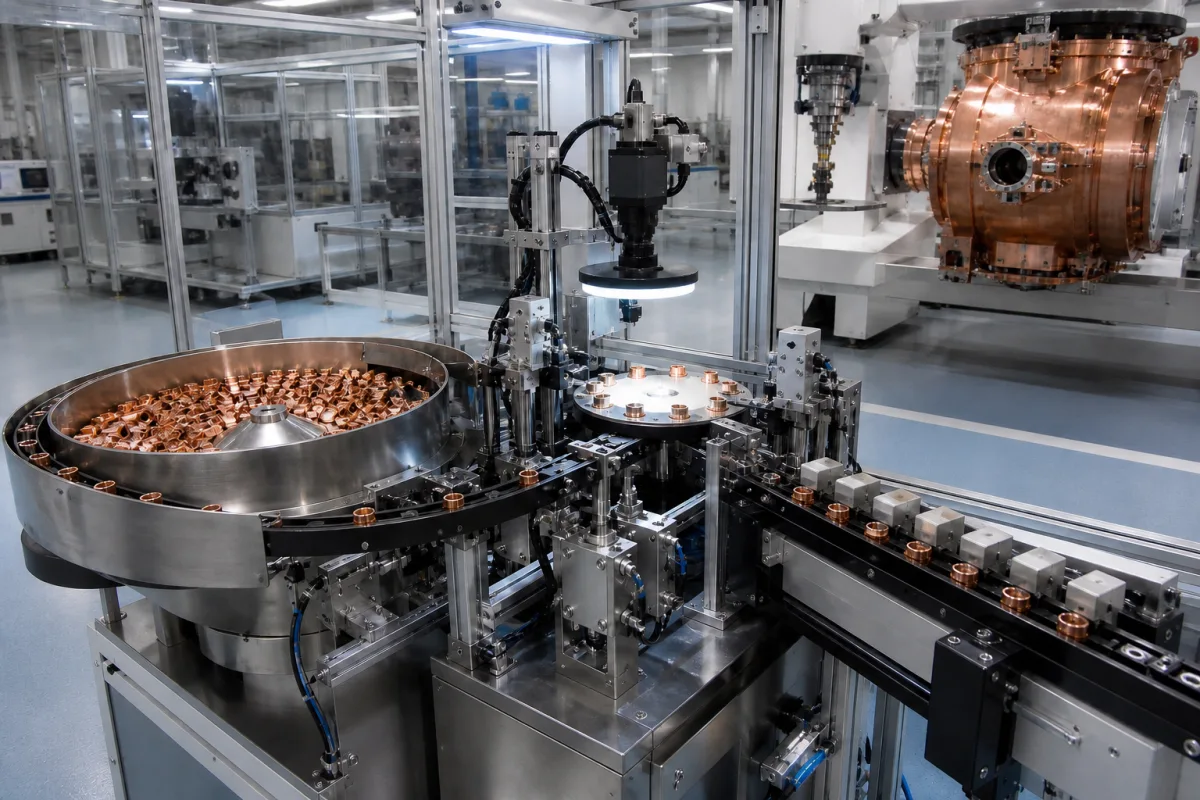
Automated Component Feeding System

Based on aggregated insights from multiple verified factory profiles within the CNFX directory, the standard Automated Component Feeding System used in the Machinery and Equipment Manufacturing sector typically supports operational capacities ranging from standard industrial configurations to heavy-duty production requirements.

Technical Definition & Core Assembly

A canonical Automated Component Feeding System is characterized by the integration of Component Magazine/Rack and Picker/Shuttle Mechanism. In industrial production environments, manufacturers listed on CNFX commonly emphasize Stainless Steel (frames, guides) construction to support stable, high-cycle operation across diverse manufacturing scenarios.

A precision automated system that supplies components to the assembly line of a radiotherapy linear accelerator.

Product Specifications

Technical details and manufacturing context for Automated Component Feeding System

Definition
An automated component feeding system is a critical sub-assembly within the Integrated Radiotherapy Linear Accelerator Assembly System. It precisely delivers various mechanical, electronic, and optical components (such as waveguide segments, collimator leaves, target assemblies, and sensor modules) to designated workstations along the assembly line. Its primary role is to ensure a continuous, accurate, and contamination-free supply of parts, synchronizing with robotic arms and assembly processes to maintain high throughput and precision in the manufacturing of complex medical radiation therapy equipment.
Working Principle
The system typically operates using a combination of programmable logic controllers (PLCs), servo motors, and precision linear actuators. Components are stored in organized magazines or trays. Upon receiving a signal from the assembly line's master control system, the feeding mechanism (e.g., a gantry, conveyor belt, or robotic shuttle) retrieves a specific component from storage. It then transports it along a guided path to a precise drop-off or hand-off point. Sensors (optical, inductive) verify component presence, orientation, and correct delivery. The operation is governed by software that integrates with the overall Manufacturing Execution System (MES) for tracking and scheduling.
Common Materials
Stainless Steel (frames, guides), Aluminum Alloy (carriers), Engineering Plastics (trays, liners), Precision Ball Screws & Linear Guides
Technical Parameters
  • Positioning Accuracy of Component Delivery (mm) Per Request
Components / BOM
  • Component Magazine/Rack
    Stores components in an organized, accessible manner for the picker.
    Material: Stainless Steel / Aluminum
  • Picker/Shuttle Mechanism
    Precisely retrieves a component from the magazine.
    Material: Aluminum Alloy with Gripper (Polymer/Rubber)
  • Linear Transport Module
    Moves the component from storage to the delivery point along a guided path.
    Material: Aluminum Profile, Steel Rails, Ball Screw
  • Control Cabinet (with PLC)
    Houses the programmable logic controller and drives that execute the feeding sequence.
    Material: Steel Enclosure
  • Sensor Array
    Detects component presence, verifies pick/drop, and ensures safety.
    Material: Various (Optical sensors, Inductive Proximity Sensors)
Engineering Reasoning
0.5-2.0 m/s feed velocity, 0.01-0.05 mm positioning accuracy, 20-40 kPa vacuum pressure
Feed velocity exceeds 2.5 m/s causing component misalignment >0.1 mm, vacuum pressure drops below 15 kPa causing component slippage, positioning repeatability exceeds 0.08 mm RMS error
Design Rationale: Inertial overshoot at feed velocities >2.5 m/s due to servo motor torque limitations (τ_max = 12 N·m), Bernoulli's principle failure at vacuum pressures <15 kPa causing insufficient suction force (F_suction < 0.8 N), thermal expansion of linear guides at ambient temperature >35°C causing positioning drift (α_steel = 11×10^-6 /°C)
Risk Mitigation (FMEA)
Trigger Servo motor encoder signal loss due to electromagnetic interference from adjacent high-frequency RF sources (2.45 GHz microwave generators)
Mode: Uncontrolled feed velocity acceleration to 3.0 m/s causing component collision with assembly fixture
Strategy: Shielded encoder cables with double-layer Faraday cage (0.5 mm copper + 0.3 mm aluminum) and differential signal transmission with 100 Ω termination impedance
Trigger Vacuum pump oil contamination with particulate matter >5 μm diameter from component abrasion
Mode: Progressive vacuum pressure decay from 40 kPa to 10 kPa over 72 hours of continuous operation
Strategy: Two-stage filtration system with 1 μm absolute rated pre-filter and 0.01 μm HEPA final filter, coupled with oil quality monitoring via dielectric constant measurement (ε_r < 2.2 triggers maintenance)

Industry Taxonomies & Aliases

Commonly used trade names and technical identifiers for Automated Component Feeding System.

Industrial Ecosystem & Supply Chain DNA

Complementary Systems
Downstream Applications
Specialized Tooling

Application Fit & Sizing Matrix

Operational Limits
pressure: 0.5-2.0 bar (feed pressure), vacuum to 1.5 bar (system)
other spec: Flow Rate: 10-500 components/min, Slurry Concentration: Not applicable (dry feeding), Particle Size: 0.5-50 mm, Humidity: <60% RH
temperature: 15-35°C (operating), 5-45°C (storage)
Media Compatibility
✓ Medical-grade stainless steel components ✓ Ceramic radiation shielding elements ✓ Precision-machined aluminum parts
Unsuitable: Corrosive chemical environments or abrasive particulate slurries
Sizing Data Required
  • Component dimensions and weight
  • Required feed rate (components per minute)
  • Assembly line interface specifications (connection type, positioning accuracy)

Reliability & Engineering Risk Analysis

Failure Mode & Root Cause
Component jamming or misalignment
Cause: Wear and tear on guide rails, accumulation of debris, or improper calibration leading to mechanical obstruction and feeding errors.
Sensor or actuator failure
Cause: Environmental contamination (dust, moisture), electrical interference, or fatigue from repetitive motion cycles causing inaccurate detection or actuation.
Maintenance Indicators
  • Irregular or inconsistent feeding rhythm, such as stuttering, delays, or double feeds, indicating mechanical or control issues.
  • Unusual noises like grinding, clicking, or high-pitched whining from motors or moving parts, signaling wear, misalignment, or impending failure.
Engineering Tips
  • Implement a preventive maintenance schedule with regular cleaning of feeding paths and lubrication of moving components to reduce wear and contamination.
  • Install condition monitoring sensors (e.g., vibration, temperature) on critical parts like motors and actuators to enable predictive maintenance and early fault detection.

Compliance & Manufacturing Standards

Reference Standards
ISO 12100:2010 Safety of machinery - General principles for design - Risk assessment and risk reduction ANSI B11.19-2019 Performance Requirements for Safeguarding CE Marking - Machinery Directive 2006/42/EC
Manufacturing Precision
  • Component alignment: +/-0.05mm
  • Feeding mechanism repeatability: +/-0.01mm
Quality Inspection
  • Functional safety test (EN ISO 13849-1)
  • Dimensional verification using coordinate measuring machine (CMM)

Factories Producing Automated Component Feeding System

Verified manufacturers with capability to produce this product in China

✓ 92% Supplier Capability Match Found

P Project Engineer from United States Feb 06, 2026
★★★★★
"Testing the Automated Component Feeding System now; the technical reliability results are within 1% of the laboratory datasheet."
Technical Specifications Verified
S Sourcing Manager from United Arab Emirates Feb 03, 2026
★★★★★
"Impressive build quality. Especially the technical reliability is very stable during long-term operation."
Technical Specifications Verified
P Procurement Specialist from Australia Jan 31, 2026
★★★★★
"As a professional in the Machinery and Equipment Manufacturing sector, I confirm this Automated Component Feeding System meets all ISO standards."
Technical Specifications Verified
Verification Protocol

“Feedback is collected from verified sourcing managers during RFQ (Request for Quote) and factory evaluation processes on CNFX. These reports represent historical performance data and technical audit summaries from our B2B manufacturing network.”

16 sourcing managers are analyzing this specification now. Last inquiry for Automated Component Feeding System from UAE (1h ago).

Supply Chain Compatible Machinery & Devices

Automated Assembly Line System

Integrated production system for sequential component assembly operations

Explore Specs →
Automated Powder Coating System

Integrated industrial system for applying dry powder coatings to metal substrates.

Explore Specs →
Centrifugal Pump Impeller

Rotating component that transfers energy to fluid in centrifugal pumps.

Explore Specs →
High-Precision CNC Laser Cutting Machine

Computer-controlled industrial machine using focused laser beams to cut sheet metal with micron-level accuracy.

Explore Specs →

Frequently Asked Questions

What materials are used in the Automated Component Feeding System construction?

The system features stainless steel frames and guides, aluminum alloy carriers, engineering plastic trays and liners, and precision ball screws with linear guides for durability and precision in medical equipment manufacturing environments.

How does the system ensure precise component delivery to radiotherapy linear accelerator assembly lines?

The system utilizes a sensor array for real-time component tracking, a linear transport module with precision ball screws, and a PLC-controlled picker/shuttle mechanism that maintains ±0.1mm positioning accuracy for reliable component placement.

What maintenance is required for the Automated Component Feeding System?

Regular maintenance includes cleaning of stainless steel components, lubrication of precision ball screws and linear guides, sensor calibration checks, and PLC software updates. The system is designed for minimal downtime with accessible maintenance points.

Can I contact factories directly on CNFX?

CNFX is an open directory, not a transaction platform. Each factory profile provides direct contact information and production details to help you initiate direct inquiries with Chinese suppliers.

Get Quote for Automated Component Feeding System

Request technical pricing, lead times, or customized specifications for Automated Component Feeding System directly from verified manufacturing units.

Your business information is encrypted and only shared with verified Automated Component Feeding System suppliers.

Thank you! Your message has been sent. We'll respond within 1–3 business days.

Need to Manufacture Automated Component Feeding System?

Connect with verified factories specializing in this product category

Add Your Factory Contact Us
Previous Product
Automated Cleaning Module
Next Product
Automated Conveyance and Palletizing System