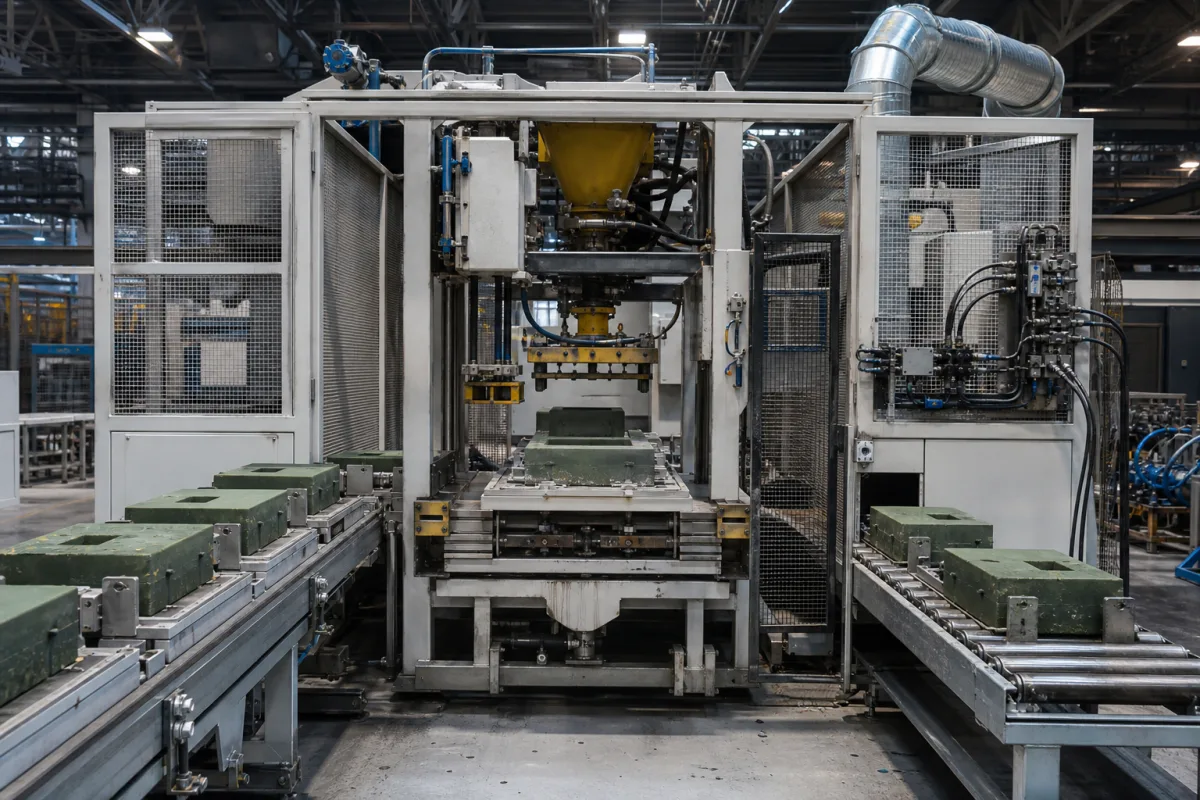
Automated mould preparation station: automatic core setting into the drag of a flaskless matchplate green-sand mould before it is closed
Green-sand moulding lines · automatic core setting into the drag before closing, vacuum core masks, cope-lowering setters, what core setting costs in moulds per hour
On a horizontally parted flaskless moulding machine the drag half of each mould leaves the machine with its cavity facing up, and any sand cores have to be put into it before the cope half is closed over it. An automated mould preparation station does this with a core mask or core-handling tool that holds a set of cores, brings them down into the drag and releases them. The two things to check are how much it slows the moulding cycle and how firmly and accurately it puts each core into its prints.
Automatic core-setting stations on horizontally parted (matchplate) flaskless green-sand moulding machines: core masks and vacuum pockets, how the mask and drag meet, braces and stiffness, and the moulding rate with and without core setting. The moulding machines themselves, their filling, squeeze, mismatch and rated speeds, and the core and filter setter options of vertically parted lines, are covered on the Sand molding machine page; the cores on the Casting core (foundry sand core) and Metal casting mould core pages; robot spraying of core wash on the Robotic coating spray arm page. Robotic shell-building for investment casting is covered on the Automated precision casting production line page and its wax gating trees on the Investment casting runner system page; pouring, shakeout and sand compaction tables have their own pages.
CNFX editorial research · Sources checked October 13, 2026 · 6 sources
A vacuum core mask that swings down while the drag rises to meet it
DISA Industries' patent for a core setter on a flaskless matchplate moulding machine carries the cores in pockets on the flat face of a core mask and holds them there by vacuum, with the mask holder built as a half-open box that forms the vacuum manifold. The mask swings on a horizontal shaft between a loading position, facing sideways away from the mould so cores can be loaded from the side of the machine, and a releasing position facing down. The drag flask then moves horizontally under the mask and is pushed up to it, and the cores are released into the upward-facing cavities. [1]
The patent explains why it moves the drag instead of the mask. An earlier core setter swung, shifted and lowered the mask through a complex linkage, while core placing must be precise and needs relatively high forces to press cores into the cavities without deforming the structure, since deformation can fracture the cores. Letting the drag make the vertical stroke allows a simpler, stiffer guide. Braces fixed to the base frame engage three corners of the core frame in the releasing position to limit bending when the drag pushes up, which the patent says reduces the risk of core rupture. The whole setter can also swing aside on a second axis to leave room for manual core setting or blowing loose sand out of a mould. [1]
Sintokogio's patent for a flaskless top-and-bottom moulding machine takes a different route: a core-handling tool on a carrier is passed to the cope flask while it is lifted at the stripping station, and lowering the cope flask brings the core down onto the lower mould, where it is released. Sintokogio states the aims as a simpler machine and better accuracy of core position than an earlier design in which the drag flask was carried out of the machine and lifted in a cantilevered state. [2]
Send the core drawings, core weights and the number of cores per mould, the binder system, and how the cores sit in their prints, including any that must be pressed in.
02
Moulds per hour with and without core setting
Core setting takes time inside the moulding cycle, and makers publish separate rates for it. Foundry Management & Technology reported the DISA Matchplate at 160 moulds per hour, or 120 with core setting, with a mismatch of at most 0.15 mm. [4] At Progressive Foundry, which runs three DISA Match 20 x 24 machines with speed upgrades and automatic core setters, the plant engineer quoted 170 moulds per hour on a cored job and 213 on an uncored one. [5]
Editorial calculation: 160 moulds per hour is a cycle of 22.5 s and 120 is 30 s, so on the DISA Matchplate figures core setting adds about 7.5 s per mould. On Progressive Foundry's figures, 213 per hour is about 16.9 s and 170 about 21.2 s, a difference of about 4.3 s; these were different jobs, so the gap mixes core setting with pattern differences. [4][5]
Foundry Management & Technology reports that adding the optional automatic core setter at Progressive Foundry removed manual core-setting bottlenecks and reduced physical strain on operators. [5]
Ask the supplier for the cored rate on your pattern, not the uncored maximum, and how long the core mask takes to load by hand or by robot between moulds.
03
What the station builder needs
Paste it into your enquiry below or into an email to a maker, then replace every bracket.
Moulding machine: [make; matchplate or vertical; mould size; rated speed]
Cores: [drawings; weight; number per mould; binder]
Setting: [core mask or gripper; vacuum; press-in force needed]
Loading: [manual or robot; time available per mould]
Rate: [moulds per hour cored, on your pattern]
Changeover: [mask change time; pattern change time]
Explore company information and manufacturing capabilities, then discuss the scope of your project with a relevant supplier.
Share this page
Compiled and source-reviewed by the CNFX editorial team.
Each manufacturer above links to the page on that company's own website where the product is listed, with the date we checked it. How we source and review
· Page last updated 13 October 2026
Buyer questions
How does an automatic core setter hold the cores?
In DISA's patent the cores sit in pockets on a core mask and are held by vacuum, then released into the drag after the drag is raised to the mask. [1]
How much does core setting slow a matchplate machine?
The DISA Matchplate was reported at 160 moulds per hour uncored and 120 with core setting, about 7.5 s more per mould (editorial calculation). [4]
Can a matchplate line with automatic core setting exceed 150 moulds per hour?
Progressive Foundry reported 170 moulds per hour on a cored job with DISA Match 20 x 24 machines with speed upgrades and automatic core setters. [5]
Sources and what still needs a direct check
Sources checked 2026-10-13. Patents from DISA Industries and Sintokogio on core setting in flaskless moulding machines, DISA's matchplate page, two Foundry Management & Technology articles and a Foundry Trade Journal report.