Axis drive motors for CNC router gantries: a NEMA 34 stepper or a 750 W AC servo on a belt-reduced rack-and-pinion drive, compared by travel per revolution, resolution, thrust, speed and inertia
The motors that move a CNC router's gantry, cross slide and head · worked from motor shaft to axis: travel per revolution, step and encoder resolution, thrust at the pinion, speed, reflected inertia and the load on the motor shaft
A CNC router moves a heavy gantry over a long table, so its axis motors are judged at the end of the drive train, not at the motor shaft: how far the gantry moves per motor revolution, how fine one step or encoder count is at the tool, how much thrust the pinion can put into the rack, how fast the axis can travel, and how heavy the gantry looks to the motor. The same arithmetic applies to a stepper or a servo; the figures below take one published rack-and-pinion drive and put a NEMA 34 stepper and a 750 W AC servo on it.
Stepper and AC servo motors used as the X, Y and Z axis drives of CNC routers and similar gantry machines, together with the belt reductions, pinions, racks or screws that turn motor rotation into axis travel, and the resolution, thrust, speed, inertia and shaft-load checks that follow. Sizing a servo motor against its speed-torque curve is covered on the Servo motor page; stepper pull-out torque, inertia and pulse settings on the Stepper motor page; matched servo motor and drive packages with their cables on the Servo motor and drive set page; motors with built-in drives on the Integrated servo or stepper motor page; servo press modules on the Servo motor actuator for press-fitting page; racks and pinions as gearing on the Rack and pinion page.
CNFX editorial research · Sources checked October 13, 2026 · 4 sources
From motor turn to gantry travel: a 1 in pitch-circle pinion behind 2:1 to 3.2:1 belt reductions gives 0.98 to 1.57 in per revolution
Avid CNC, which sells router kits and drive components, bases its rack-and-pinion drives on a pinion with a 1 in pitch circle, so one pinion turn moves the gantry 3.14159 in. A belt reduction between motor and pinion divides that distance: [1][2]
Avid's racks are imperial 20 pitch (20 teeth on a 1 in pitch-circle pinion, a linear pitch of 0.1571 in) with a 20° pressure angle; it warns that module 1, 1.5 or 2 racks, or racks with another pressure angle, are incompatible and cause excessive wear and noise. Its NEMA 34 standard drive uses 2:1 rather than the NEMA 23 drive's 3:1 because the larger motor's torque allows higher speed, and uses larger belts and pulleys for four times the torque capacity. [1][2] A spring-loaded pivot keeps the pinion in mesh for low backlash, and a cam on top sets belt tension. [2]
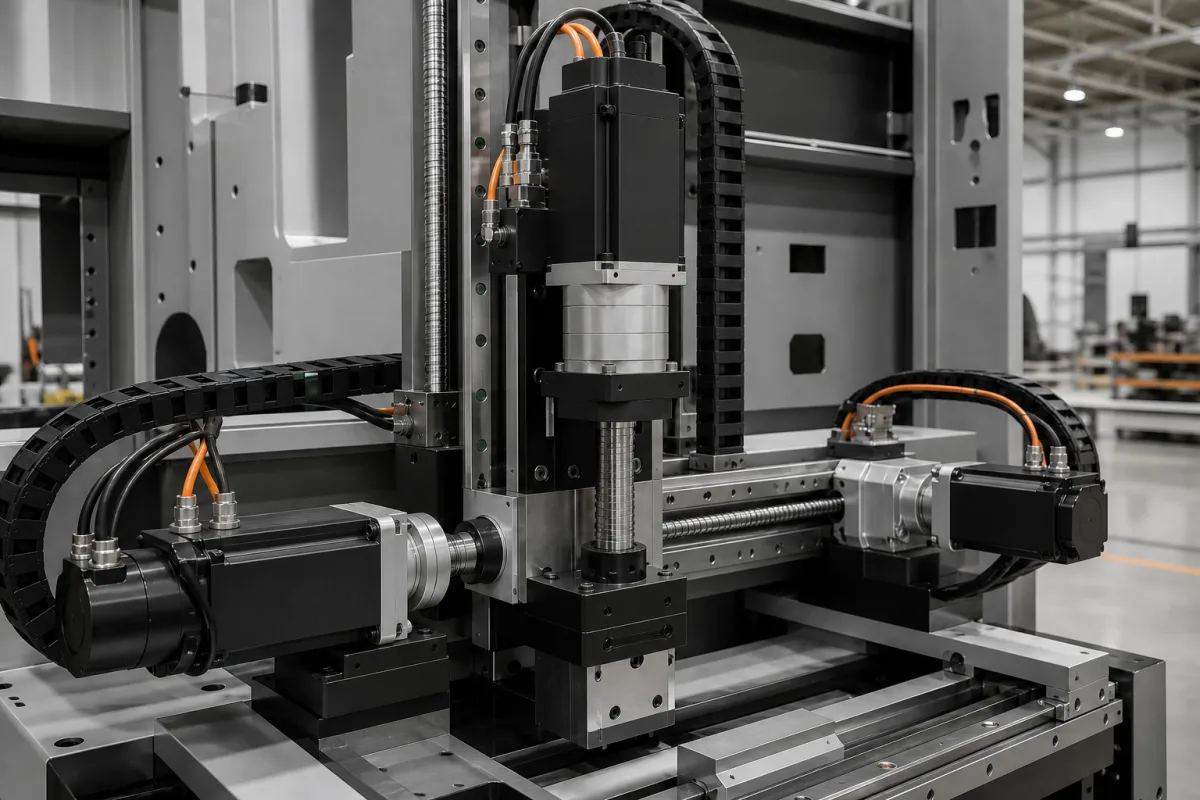
Editorial calculation: 0.00049087 in per microstep is 12.5 µm at the gantry, and 1.5708 in per motor turn on the standard NEMA 34 drive is 39.9 mm. [1][2] On a ball-screw axis, like those in the image above, the screw lead takes the place of the pinion circumference divided by the reduction.
The image shows a gantry carriage with three motors: black motors with orange cables in drag chains, coupled through coupling housings to ball screws on the vertical and horizontal axes.
Avid CNC drive
Belt reduction (pulley teeth)
Travel per motor revolution
Steps per inch, 200-step motor at 10× microstepping
State the drive type on each axis (rack and pinion, belt, ball screw), the pinion pitch and rack standard or screw lead, the reduction ratio, and the resolution needed at the tool.
02
Same drive, two motors: an 8 N·m NEMA 34 stepper and a 750 W servo rated 2.39 N·m, 7.16 N·m peak, 6000 r/min, with 8,388,608 counts per turn
Leadshine's 86CM80 is a two-phase NEMA 34 stepper 98 mm long with 8.0 N·m holding torque at 6.0 A per phase, 0.5 Ω, 4.2 mH, rotor inertia listed as 2.8 kg·cm², IP40 and 3.2 kg; holding torque is a standstill figure, and Leadshine publishes a separate speed-torque curve. [3] Panasonic's MINAS A6 MSMF082L1U2M is a 750 W, 200 V low-inertia AC servo motor: [4]
Editorial calculation, both motors on Avid's 3.2:1 NEMA 34 drive (0.9817 in = 24.9 mm per motor turn, pinion radius 0.5 in = 12.7 mm), ignoring belt and mesh losses: the stepper's 8 N·m holding torque gives at most 8 × 3.2 / 0.0127 = 2016 N of thrust at standstill, falling with speed along its curve; the servo gives 602 N continuously and 1804 N at its 7.16 N·m peak. [3][4][2] The servo's 3000 r/min rated speed is 74.8 m/min of axis travel and its 6000 r/min maximum 149.6 m/min, and one encoder count is 24.9 mm / 8,388,608 = 0.003 µm, so the rack, pinion and belt, not the encoder, set the axis accuracy. [4][2]
Editorial calculation, with an example gantry mass of 100 kg (an assumed value, not from a source): the inertia reflected to the motor is 100 × (0.0249 / 2π)² = 1.57 × 10⁻³ kg·m², 16.4 times the servo's 0.96 × 10⁻⁴ kg·m² rotor inertia and so inside Panasonic's recommended ratio of 20 times or less; at the 2:1 standard drive's 39.9 mm per turn the same example gantry would reflect 4.0 × 10⁻³ kg·m², 42 times. [4][1]
IP65, 2.3 kg, 80 mm flange, oil seal, no brake [4]
Give each axis's moving mass, required rapid speed and acceleration, cutting thrust, drive ratio and pinion or screw data, and ask the supplier for the motor's speed-torque curve and rotor inertia, not only holding or rated torque.
03
The belt pulls on the motor shaft: 392 N radial load in operation on a 750 W servo
A belt reduction puts the belt tension onto the motor shaft as a side load. Panasonic lists the permissible shaft loads for the MSMF082L1U2M: during operation 392 N radial and 147 N thrust in either direction; during assembly 686 N radial, 294 N thrust in the A direction and 392 N in the B direction. [4]
Avid's drives carry the motor on a pivot plate with a tensioning cam, so belt tension is set by adjustment rather than fixed by the mounting. [2] Editorial note: when a router's axis motor is replaced, the new motor's shaft diameter (Avid's PRO drive takes 1/4, 3/8 or 1/2 in shafts with matching pulleys), its permissible radial load and the belt tension the drive needs have to be checked together. [2][4]
State the motor shaft diameter and length, the pulley and belt fitted, the belt tension, and the radial load the motor is rated for in operation.
04
Axis drive details to send
Paste it into your enquiry below or into an email to a maker, then replace every bracket.
Axes: [X, Y, Z travel; moving mass per axis]
Drive: [rack and pinion, belt, ball screw; pinion pitch or screw lead; reduction ratio]
Motion: [rapid speed; acceleration; cutting thrust]
Resolution: [at the tool; microstepping or encoder counts]
Motor: [stepper or servo; frame; shaft diameter; brake on Z]
Controller: [step/direction or fieldbus; supply voltage]
Explore company information and manufacturing capabilities, then discuss the scope of your project with a relevant supplier.
Share this page
Compiled and source-reviewed by the CNFX editorial team.
Each manufacturer above links to the page on that company's own website where the product is listed, with the date we checked it. How we source and review
· Page last updated 13 October 2026
Buyer questions
How far does a CNC router gantry move per motor revolution?
On Avid CNC's rack-and-pinion drives, with a 1 in pitch-circle pinion, it is 1.5708 in with a 2:1 belt reduction and 0.9817 in with 3.2:1; at 10× microstepping on a 200-step motor the latter gives 0.00049087 in (12.5 µm) per step. [1][2]
Stepper or servo for a CNC router axis?
Leadshine's NEMA 34 86CM80 stepper holds 8 N·m at standstill, while Panasonic's 750 W MSMF082L1U2M servo gives 2.39 N·m continuously, 7.16 N·m peak and up to 6000 r/min with a 23-bit encoder; on a 3.2:1 drive that is about 2016 N standstill thrust for the stepper and 602 N continuous, 1804 N peak and 149.6 m/min for the servo, by editorial calculation. [3][4][2]
How much side load can a servo motor shaft take from a belt?
Panasonic lists 392 N radial and 147 N thrust during operation for its 750 W MSMF082L1U2M. [4]
Sources and what still needs a direct check
Sources checked 2026-10-13. Four sources from three publishers: two Avid CNC rack-and-pinion drive pages (standard NEMA 34 drive and PRO drive 2.0) for reductions and travel per revolution, Leadshine's 86CM80 NEMA 34 stepper motor page, and Panasonic's MINAS A6 MSMF082L1U2M servo motor page.