Linear Guideways & Ball Screws
View system integration details
This page explains how Ball Screw Shaft is classified within Machinery and Equipment Manufacturing. Technical values and manufacturer relationships are research references; confirm the current specification and supplier evidence for each order.
The precision-ground shaft that forms the core of a ball screw assembly, converting rotary motion into linear motion.
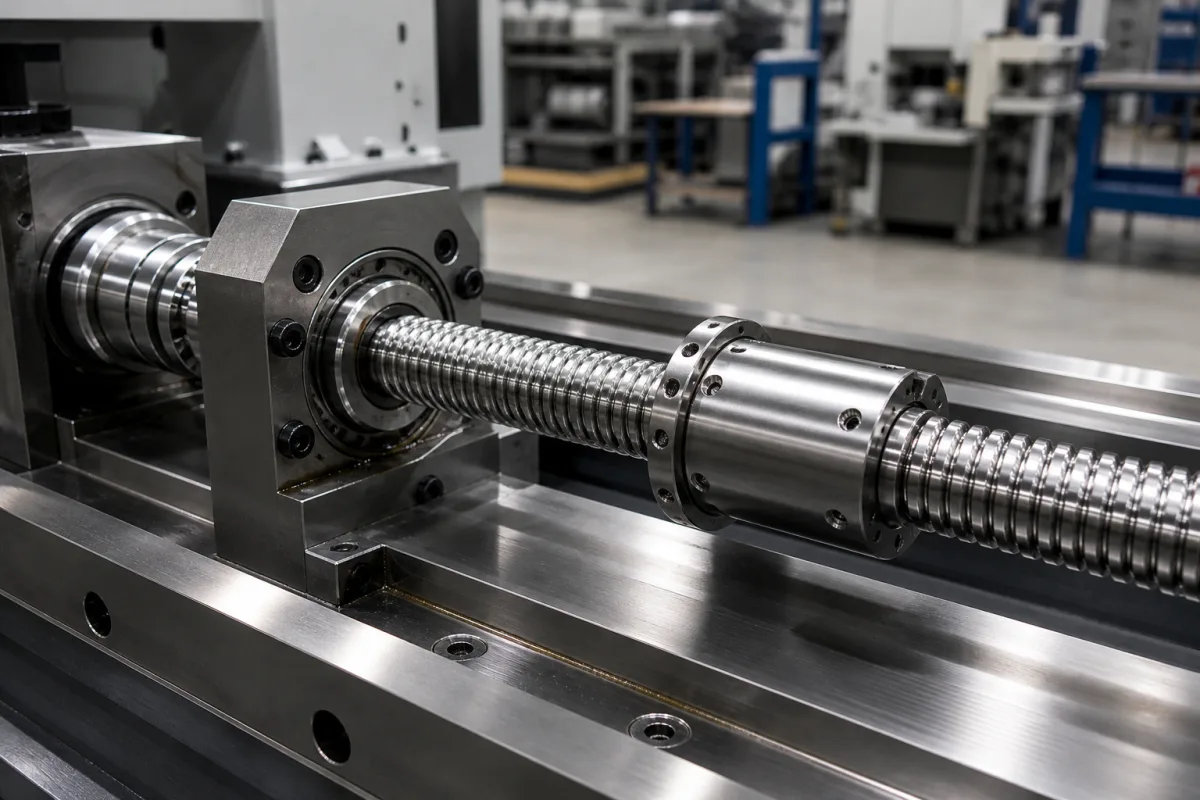
Technical details and manufacturing context for Ball Screw Shaft
| Parameter | Typical range | Notes & selection driver |
|---|---|---|
| Nominal Diameter | 16–80 mm | Standard sizes; custom diameters availableISO 3408 |
| Lead | 5–40 mm | Determines linear travel per revolutionISO 3408 |
| Accuracy Grade | C3–C7 | C3 for high precision, C7 for general useISO 3408 |
| Shaft Length | 500–6000 mm | Custom lengths up to 6000 mm |
| Hardness | 58–62 HRC | Induction hardened for wear resistanceISO 683-17 |
| Surface Roughness | 0.2–0.4 μm Ra | Ground finish for smooth operationISO 4287 |
| Straightness | 0.05–0.1 mm/m | Ensures accurate linear motionISO 1101 |
| Operating Temperature | -20–80 °C | Higher temps may require special lubrication |
| Shaft Material | GCr15 | Equivalent to 52100 bearing steelGB/T 18254 |
| Weight | 2–120 kg | Depends on diameter and length |
Ranges are indicative industry figures for RFQ preparation, not a supplier commitment. Confirm every value and standard with the legal manufacturer before ordering.
| pressure: | Axial load capacity: 5 kN to 500 kN depending on diameter and preload |
| other spec: | Maximum linear speed: 3 m/s, Accuracy grade: C3 to C7 per ISO 3408 |
| temperature: | -20°C to 120°C (standard), up to 200°C with special materials |
Indicative industry ranges for design and RFQ preparation. Confirm the exact figures and applicable standard with the manufacturer before specifying.
Quoted from the published standard.
A practical evidence checklist for RFQ preparation and supplier evaluation.
Compare the published product scope and source details, then include your specifications and quantity in an enquiry.
Manufacturer profiles associated with Ball Screw Shaft.
Explore company information and manufacturing capabilities, then discuss the scope of your project with a relevant supplier.
Ask for use case, specification boundaries, supplier type, and RFQ preparation information for this product.
The shaft is typically made from alloy steel (e.g., SCM420, SCM440) or stainless steel. The material may also be specified as GCr15 (equivalent to 52100 bearing steel) per GB/T 18254. The choice depends on the application's load, environment, and corrosion resistance requirements.
Accuracy grades range from C3 to C7 per ISO 3408. C3 is for high precision applications, while C7 is for general use. The grade affects the positioning accuracy and must be selected based on the required performance.
Standard shaft lengths range from 500 to 6000 mm, with custom lengths available up to 6000 mm. The length affects the straightness and rigidity, so it must be verified for the specific application.
Always confirm the model-specific values, including nominal diameter, lead, accuracy grade, material, hardness, and straightness, with the legal manufacturer or supplier. These parameters are critical for proper function and must be validated against your application's requirements.
This component is essential for the following industrial systems and equipment:
Editorial classification, named public sources where available, and source-reviewed manufacturer records.
Compare manufacturer profiles with relevant product and process capability.