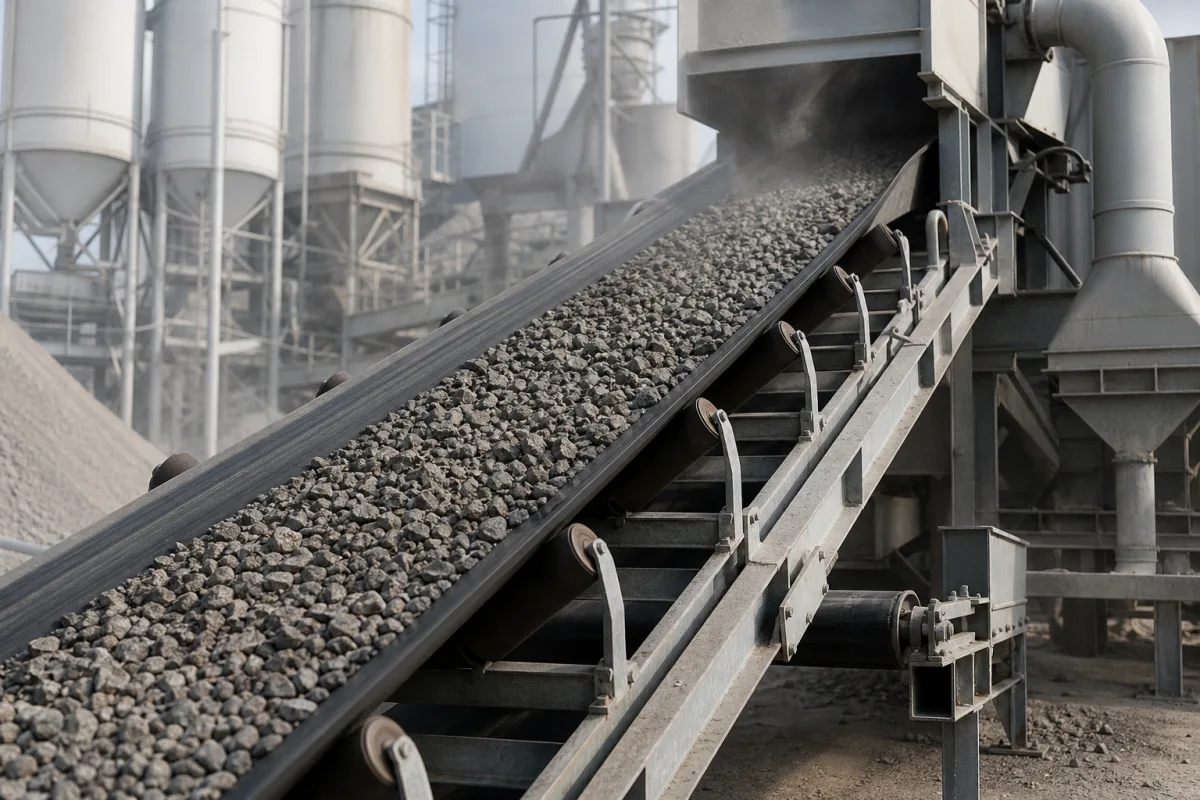
Material handling · Start from the material, not the belt
A belt conveyor carries material on a continuous belt between pulleys, supported by idlers or a slider bed. Its size and speed are set by what it carries: lump size, abrasiveness, density and how the material settles on a moving belt. Start the enquiry with the material and the route, and let belt width, speed and troughing follow.
Bulk-handling troughed belt conveyors for minerals, aggregates, ports and grain, and flat or modular belt conveyors for unit loads in packaging and logistics. Conveyor belting bought on its own is a separate purchase.
CNFX editorial research · Sources checked October 12, 2026 · 10 sources
Rulmeca's design method starts with the conveyed material: the required load volume, lump size, chemical and physical properties, and the conveyor route and height profile. Two angles matter: the angle of repose of a freely heaped pile and the smaller angle of surcharge the material takes on a moving belt, which Rulmeca says "is normally between 5° and 15° (for a few materials up to 20°)". [1]
The surcharge angle and the troughing angle together set the cross-section of material the belt can carry. Rulmeca expresses capacity as the volume carried at 1 m/s for each belt width and troughing arrangement, then scales it to the chosen speed. [1]
Give the supplier the material name, bulk density, lump size (largest and typical), moisture, temperature and abrasiveness, plus the tonnage, length and lift. A request that gives only belt width and length cannot be checked.
02
Relate belt speed, width and troughing
Rulmeca notes that light material, cereals and fines allow high speeds and screened material may run at over 8 m/s, while large unscreened rock may need speeds of about 1.5–3.5 m/s. Speed must fall as lump size, abrasiveness and density rise, and wear at the loading point increases with speed. [1]
The load per metre of belt is qG = Iv ÷ (3.6 × v), where Iv is the tonnage in t/h and v the belt speed in m/s. Higher speed lets a narrower belt carry the same tonnage with less load per metre on idlers and belt. As a calculation example only, 500 t/h at 2.5 m/s gives 500 ÷ (3.6 × 2.5) ≈ 56 kg/m of material. [1]
Troughing sets incline the side rollers — "the angle of the side roller varies from 20° to 45°" in Rulmeca's words — to form the belt into a trough; the angle sets how much material the belt carries. Rulmeca also shows a free edge distance of 0.05 × belt width + 25 mm between the material and the belt edge. [1]
03
Match the conveyor design to the job
Suppliers linked to this page build quite different conveyors under the same name. Decide which design fits before comparing prices.
Design
Where it is offered
Ask for
Troughed bulk conveyors
Belt conveyors with carrying idlers, drive and bend pulleys for minerals and aggregates; idlers, pulleys and belts are also sold separately. [4][3]
Belt width, speed, troughing angle, idler pitch and belt rating for your tonnage and route.
Mobile, radial and telescopic stackers
Tracked, radial and telescopic stacker conveyors for stockpiling. [5]
Stockpile geometry, travel and slewing ranges, and transport dimensions.
Port and ship-loading conveyors
Belt conveyor systems, radial stackers and ship loaders for port terminals, and belt-conveyor hoppers. [6][7]
Ship size, loading rate, dust control and travel.
Modular plastic belt conveyors
Modular and flat-top turning conveyors for food and packaging lines. [8][9]
Belt pitch and material, food-contact compliance, curves and wash-down.
Flat belt conveyors for unit loads
PVC/PU belt conveyors in automated handling lines. [9][10]
Load per item, accumulation, sensors and integration with the line.
04
Design for safe maintenance and lockout
The US Mine Safety and Health Administration reports eight fatalities involving belt conveyors in mining from 26 January 2017 to its alert, and states that proper lock-out/tag-out and blocking against motion could have prevented all of them. [2]
Block the belt and release stored tension
MSHA advises identifying and controlling stored mechanical, electrical, hydraulic and gravitational energy; blocking the belt against movement in both directions; relieving tension at the take-up, while recognising that some tension may remain; and using rated engineered belt clamps anchored to substantial structure, not belt grippers, to restrain a tensioned belt. [2]
Lock out at the disconnect, not the belt switch
MSHA states that belt start and stop controls do not disconnect power and must never be used for lockout; lock and tag the main disconnect and test that the system is dead before work. Ask the supplier where isolators, take-up access, guarding and pull-cord stops will be placed on the layout. [2]
05
Trace the belt conveyor components
This is a functional reference built from the sources cited; it is not one maker's parts list. Sizes and ratings come from the design calculation for your conveyor.
Places material on the belt; the loading point is where wear concentrates. [1][7]
Chute design, skirting and impact idlers.
Guards, pull-cords and isolators
Protect people from nip points and allow safe stops and isolation. [2]
Guard layout, emergency stops and lockable isolators.
06
Fill the specification fields with values for your duty
A belt-conveyor quotation needs duty-specific values. The table explains each field, gives published values where a reviewed source states them, and says what to obtain from the supplier.
These companies build different kinds of belt conveyor: bulk-handling systems and components, mobile stackers, port loaders, and modular or flat belt conveyors for production lines.
SKE Machinery
Location not checked for this product
Focuses on bulk-material belt conveyors, conveyor systems and components, alongside crushers.
Explore company information and manufacturing capabilities, then discuss the scope of your project with a relevant supplier.
Share this page
Compiled and source-reviewed by the CNFX editorial team.
Published product pages show what a company offers, not tested performance. Confirm the legal seller, factory and scope for your order. How we source and review
· Page last updated 13 October 2026
Buyer questions
How fast can a belt conveyor run?
Rulmeca notes screened fines can run at over 8 m/s, but large unscreened rock may need about 1.5–3.5 m/s, because higher speed increases wear and turbulence at loading as lump size and density grow. [1]
Can I lock out a conveyor with its stop button?
No. MSHA states belt start and stop controls do not disconnect power; lock and tag the main disconnect and test the system before work. [2]
Is the belt safe once the conveyor is stopped?
Not necessarily. MSHA warns that a tensioned belt stores energy; release tension at the take-up, block the belt in both directions and use rated clamps, not grippers. [2]
Sources and what still needs a direct check
Sources checked 2026-10-12. Rulmeca's catalogue is a manufacturer's design method; MSHA is a US regulator writing for mines. Supplier pages describe their own offers. CEMA and ISO conveyor standards were not read for this page.