Industry-Verified Manufacturing Data (2026)

Carrier System

Based on aggregated insights from multiple verified factory profiles within the CNFX directory, the standard Carrier System used in the Machinery and Equipment Manufacturing sector typically supports operational capacities ranging from standard industrial configurations to heavy-duty production requirements.

Technical Definition & Core Assembly

A canonical Carrier System is characterized by the integration of Carrier Tray and Drive Motor. In industrial production environments, manufacturers listed on CNFX commonly emphasize Stainless Steel (304/316) construction to support stable, high-cycle operation across diverse manufacturing scenarios.

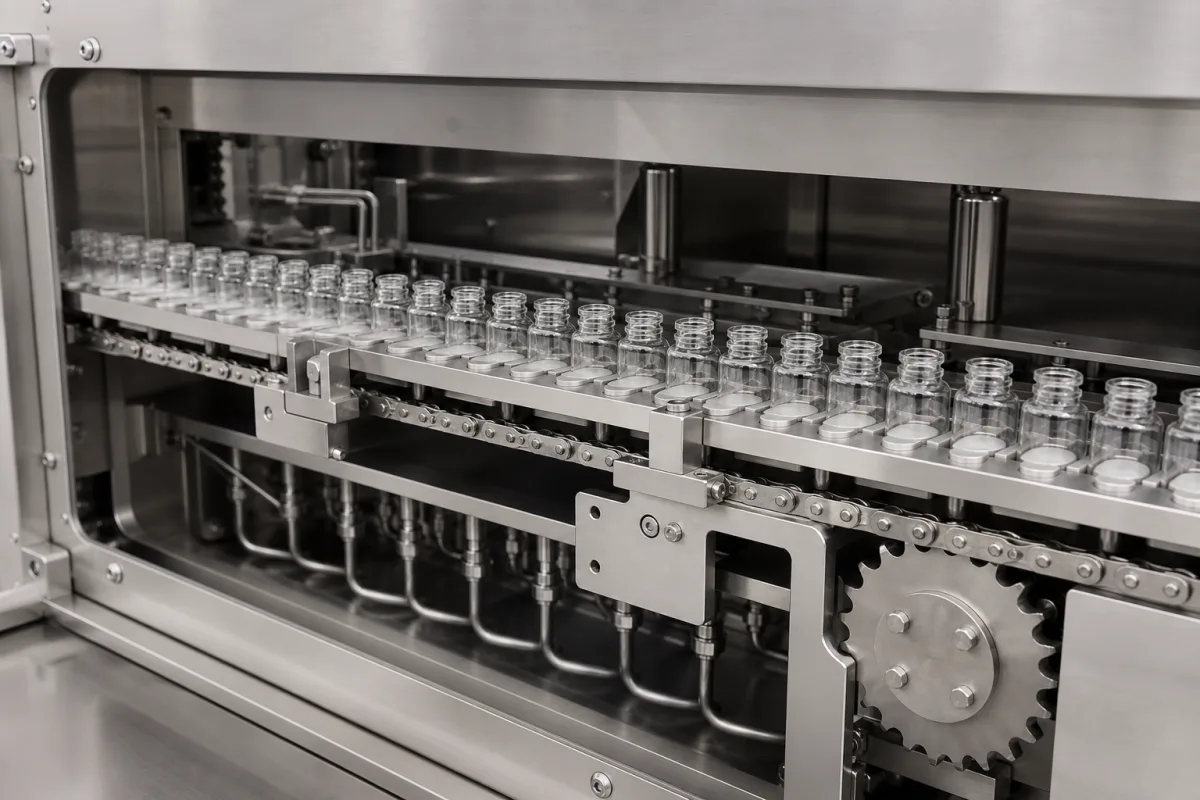
A mechanical system within a vial/syringe washer that transports containers through the cleaning process.
Product Specifications

Technical details and manufacturing context for Carrier System

Definition
The carrier system is a critical component of vial/syringe washers that securely holds and moves containers (vials, syringes, or other labware) through various cleaning stages including washing, rinsing, and drying zones. It ensures precise positioning and consistent movement for thorough and uniform cleaning.
Working Principle
The system typically uses conveyor belts, rotating carousels, or linear transport mechanisms powered by electric motors. Containers are loaded onto carriers or trays that move along a predetermined path through the washer's chambers, with timing and speed controlled to optimize cleaning efficiency.
Common Materials
Stainless Steel (304/316), Food-grade Plastics, Anodized Aluminum
Technical Parameters
  • Carrier track width and spacing between carriers (mm) Per Request
Components / BOM
  • Carrier Tray
    Holds and secures containers during transport through cleaning cycles
    Material: Stainless Steel
  • Drive Motor
    Provides power to move the carrier system through the washer
    Material: Steel Housing with Copper Windings
  • Guide Rails
    Ensures precise alignment and prevents deviation of carriers during movement
    Material: Stainless Steel
  • Sprockets/Gears
    Transfers motion from motor to carrier track or conveyor
    Material: Hardened Steel
Engineering Reasoning
0.5-2.0 m/s linear transport speed, 0.1-0.5 bar pneumatic pressure, 5-35°C ambient temperature
Chain elongation exceeding 2% of original length, sprocket tooth wear beyond 0.5 mm, bearing clearance exceeding 0.1 mm
Design Rationale: Progressive plastic deformation of chain links under cyclic loading exceeding 350 MPa yield strength of AISI 304 stainless steel, following Basquin's law for high-cycle fatigue
Risk Mitigation (FMEA)
Trigger Misalignment exceeding 0.2 mm/m between drive and idler sprockets
Mode: Accelerated chain wear and derailment
Strategy: Laser-aligned mounting fixtures with 0.05 mm tolerance and real-time alignment monitoring via capacitive sensors
Trigger Contaminant ingress (e.g., 0.1 mm particulate) into roller bearings
Mode: Increased friction coefficient from 0.0015 to >0.005, leading to motor overload
Strategy: IP67-rated sealed bearings with labyrinth seals and positive-pressure purge system at 0.15 bar above ambient

Industry Taxonomies & Aliases

Commonly used trade names and technical identifiers for Carrier System.

Applied To / Applications

This component is essential for the following industrial systems and equipment:

Industrial Ecosystem & Supply Chain DNA

Complementary Systems
Downstream Applications
Specialized Tooling

Application Fit & Sizing Matrix

Operational Limits
pressure: Atmospheric to 2 bar (29 psi)
flow rate: 0.5 to 5 L/min per nozzle
temperature: Ambient to 85°C (185°F)
slurry concentration: Up to 5% solids by weight
Media Compatibility
✓ Aqueous cleaning solutions (e.g., DI water, detergents) ✓ Pharmaceutical-grade solvents (e.g., isopropyl alcohol) ✓ Stainless steel or PTFE-coated vial/syringe containers
Unsuitable: Highly corrosive acids (e.g., concentrated hydrochloric acid) or abrasive slurries exceeding 5% solids
Sizing Data Required
  • Container dimensions (diameter and length)
  • Throughput requirement (units per hour)
  • Cleaning cycle time (including wash, rinse, and dry phases)

Reliability & Engineering Risk Analysis

Failure Mode & Root Cause
Compressor bearing failure
Cause: Inadequate lubrication, contamination from moisture or particulates, misalignment, or excessive vibration leading to premature wear and eventual seizure.
Refrigerant coil fouling/corrosion
Cause: Accumulation of dirt, debris, or biological growth on coil surfaces, combined with exposure to corrosive environments or improper chemical treatments, reducing heat transfer efficiency and causing leaks.
Maintenance Indicators
  • Unusual grinding or knocking noises from the compressor unit, indicating potential bearing or mechanical component failure.
  • Visible refrigerant oil stains or frost accumulation on piping/coils, signaling leaks or improper refrigerant flow requiring immediate inspection.
Engineering Tips
  • Implement a proactive lubrication management program with scheduled oil analysis to monitor contamination levels and ensure proper viscosity, extending compressor and bearing life.
  • Regularly clean and inspect evaporator and condenser coils using non-corrosive solutions, and apply protective coatings in corrosive environments to prevent fouling and corrosion-induced failures.

Compliance & Manufacturing Standards

Reference Standards
ISO 9001:2015 - Quality Management Systems ANSI MH14.1 - Standard for Industrial Overhead Cranes and Monorails DIN 15018 - Cranes; Steel Structures; Principles for Design, Calculation and Construction
Manufacturing Precision
  • Wheel Alignment: +/-0.5mm over 10m track length
  • Load Hook Rotation Tolerance: Maximum 5 degrees under rated load
Quality Inspection
  • Non-Destructive Testing (NDT) - Magnetic Particle Inspection for weld integrity
  • Load Testing - 125% of rated capacity static test per ANSI/ASME B30 standards

Factories Producing Carrier System

Verified manufacturers with capability to produce this product in China

✓ 92% Supplier Capability Match Found

T Technical Director from United States Feb 15, 2026
★★★★★
"Standard OEM quality for Machinery and Equipment Manufacturing applications. The Carrier System arrived with full certification."
Technical Specifications Verified
P Project Engineer from United Arab Emirates Feb 12, 2026
★★★★☆
"Great transparency on the Carrier System components. Essential for our Machinery and Equipment Manufacturing supply chain. (Delivery took slightly longer than expected, but technical support was excellent.)"
Technical Specifications Verified
S Sourcing Manager from Australia Feb 09, 2026
★★★★★
"The Carrier System we sourced perfectly fits our Machinery and Equipment Manufacturing production line requirements."
Technical Specifications Verified
Verification Protocol

“Feedback is collected from verified sourcing managers during RFQ (Request for Quote) and factory evaluation processes on CNFX. These reports represent historical performance data and technical audit summaries from our B2B manufacturing network.”

8 sourcing managers are analyzing this specification now. Last inquiry for Carrier System from India (1h ago).

Supply Chain Compatible Machinery & Devices

Automated Assembly Line System

Integrated production system for sequential component assembly operations

Explore Specs →
Automated Powder Coating System

Integrated industrial system for applying dry powder coatings to metal substrates.

Explore Specs →
Centrifugal Pump Impeller

Rotating component that transfers energy to fluid in centrifugal pumps.

Explore Specs →
High-Precision CNC Laser Cutting Machine

Computer-controlled industrial machine using focused laser beams to cut sheet metal with micron-level accuracy.

Explore Specs →

Frequently Asked Questions

What materials are used in the Carrier System for contamination prevention?

The Carrier System utilizes 304/316 stainless steel, food-grade plastics, and anodized aluminum to ensure corrosion resistance, durability, and compliance with hygiene standards in pharmaceutical and laboratory equipment manufacturing.

How does the Carrier System integrate with vial/syringe washer operations?

The system transports containers through cleaning stages via carrier trays on guide rails, powered by a drive motor with sprockets/gears, ensuring precise movement and consistent processing in automated washing equipment.

What maintenance is required for the Carrier System components?

Regular inspection of drive motors, lubrication of sprockets/gears, and cleaning of stainless steel guide rails and carrier trays are recommended to maintain optimal performance and longevity in industrial washing applications.

Can I contact factories directly on CNFX?

CNFX is an open directory, not a transaction platform. Each factory profile provides direct contact information and production details to help you initiate direct inquiries with Chinese suppliers.

Get Quote for Carrier System

Request technical pricing, lead times, or customized specifications for Carrier System directly from verified manufacturing units.

Your business information is encrypted and only shared with verified Carrier System suppliers.

Thank you! Your message has been sent. We'll respond within 1–3 business days.

Need to Manufacture Carrier System?

Connect with verified factories specializing in this product category

Add Your Factory Contact Us
Previous Product
Carrier Rollers
Next Product
Carrier Trolley