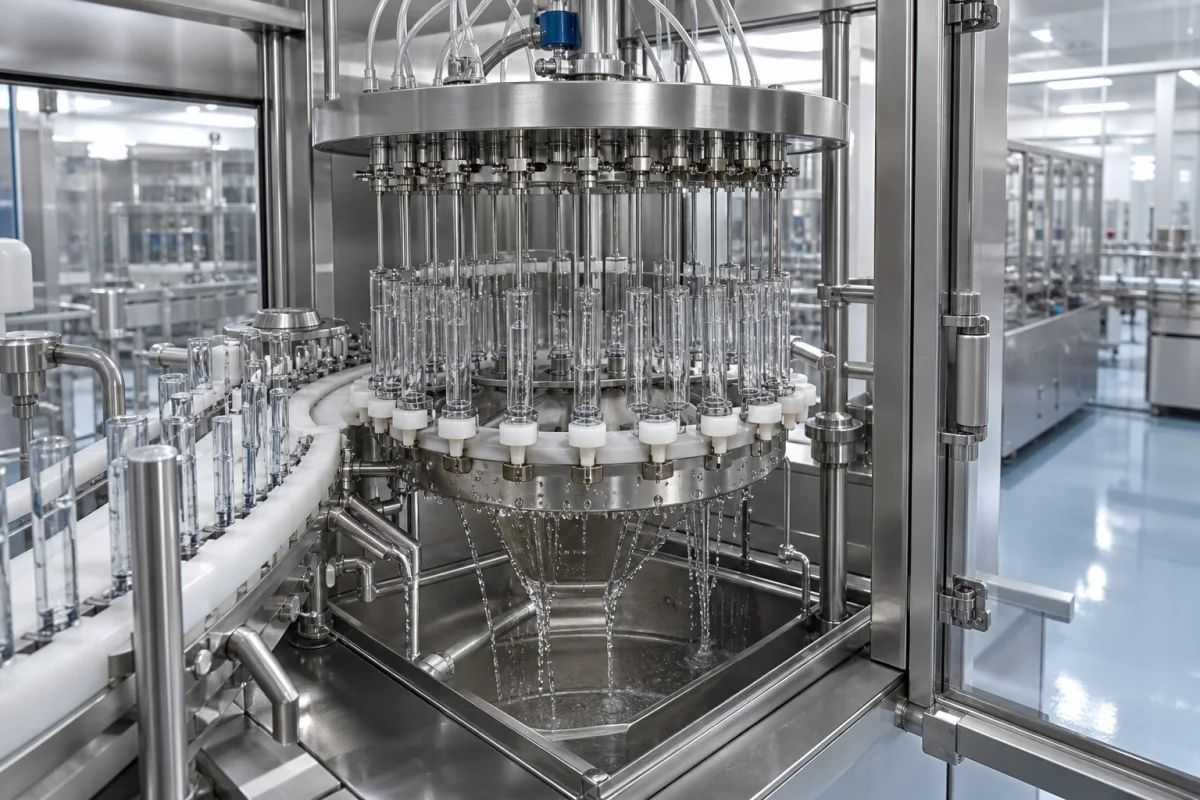
Vial and syringe washers for sterile filling lines · Inverted-container washing with purified water, WFI and filtered air, water quality as a high-risk utility, WFI production and circulation, and the downstream depyrogenation that washing must feed
A vial or syringe washer cleans empty glass vials, cartridges or syringe barrels before they are depyrogenated and filled, for example by holding the containers inverted on a rotary or linear transport while needles spray purified water, water for injection (WFI) and filtered compressed air inside and outside in a programmed sequence. Ask three things first: which container formats and output it must handle, which water and air qualities and how much of each it uses, and how it hands containers to the depyrogenation tunnel or steriliser without recontamination.
Washing machines for empty pharmaceutical vials, cartridges, ampoules and syringe barrels ahead of sterilisation or depyrogenation. Depyrogenation tunnels, ready-to-use nested syringe processing, filling and closing machines, and bottle rinsers for beverages are outside this page.
CNFX editorial research · Sources checked October 11, 2026 · 4 sources
EU GMP Annex 1 (August 2022) treats utilities that contact the product directly, such as water for washing and rinsing and gases and steam for sterilisation, as higher-risk utilities, whose critical parameters and quality attributes should be monitored and trended. It requires WFI to be produced by distillation or an equivalent purification process, such as reverse osmosis combined with electrodeionisation, ultrafiltration or nanofiltration, and stored and distributed to minimise microbial growth, for example by constant circulation above 70 °C. [1]
Annex 1 also asks for turbulent flow in water distribution to limit biofilm, scheduled sterilisation or sanitisation of water systems, and continuous monitoring such as TOC and conductivity on WFI systems. [1]
Editorial note: ask the supplier for the washing sequence (stations, media, pressures and times), water and air consumption per container, how the final rinse uses WFI, how needles and nozzles are kept clean and drained, and how the machine's own water lines are sanitised.
Give the supplier the container types and sizes (vials, cartridges, syringe barrels), output per hour, washing sequence and media (purified water, WFI, recirculated water, filtered air), water temperature and pressure, air filtration, ultrasonic bath if needed, interface to the depyrogenation tunnel or steriliser, cleanroom grade at infeed and outfeed, change parts, CIP/sanitisation and documentation for qualification.
02
Check the WFI feed to the washer against FDA inspection points
The US FDA's Guide to Inspections of High Purity Water Systems says that for parenteral products where pyrogens are a concern, Water for Injection is expected both in formulation and in the final washing of components and equipment. It treats hot systems at 65–80 °C as self-sanitising, and gives FDA policy that less than 10 CFU/100 ml is an acceptable action limit for WFI, with WFI sample volumes of 100–300 ml preferred and volumes under 100 ml unacceptable. [4]
The guide names a washer or hose connection as the site of one problem it describes: after the outlet is flushed and drained, non-sterile air left in the pipe can contaminate the circulating system when the primary valve is reopened. It quotes the proposed LVP Regulations' dead-leg definition, an unused branch no longer than six diameters of the unused pipe measured from the axis of the pipe in use, developed for hot 75–80 °C loops; in colder 65–75 °C systems it says any unused piping can form biofilm. [4]
On endotoxin, the guide reports that still fabricators it reviewed guaranteed only a 2.5-log to 3-log endotoxin reduction, so feedwater spiking to 250 EU/ml can leave unacceptable levels in the distillate; it cites three new stills that periodically yielded WFI above 0.25 EU/ml. Editorial calculation: a 3-log reduction of 250 EU/ml leaves 0.25 EU/ml, and a 2.5-log reduction leaves about 0.79 EU/ml. [4]
WFI point at the washer
FDA guide value
Ask the supplier or utility owner
Loop temperature
65–80 °C hot systems treated as self-sanitising. [4]
Temperature at the washer's WFI inlet and any cooler.
100–300 ml preferred; under 100 ml unacceptable. [4]
Sample port size and location.
Branch to washer
Dead leg no longer than six pipe diameters (75–80 °C loops). [4]
Drop length and drain/flush sequence.
03
Link washing to depyrogenation and transfer
Annex 1 says items entering grade A or B areas should, where possible, be sterilised and passed through double-ended sterilisers such as depyrogenation tunnels sealed into the wall; dry-heat tunnels should keep airflow protecting the grade A sterilising zone, with HEPA-filtered air tested at least twice a year. When a thermal process is used for depyrogenation, validation should show a suitable Fh value and at least a 3-log₁₀ reduction in endotoxin, using containers spiked with endotoxin that represent the materials processed. [1]
Editorial calculation: a 3-log₁₀ reduction takes a challenge of 1,000 endotoxin units per container down to 1 unit; the washer's job is to remove particles and loose contamination so the downstream process starts from a consistent load, so ask how washer performance is verified (particles, residual water) rather than relying on depyrogenation alone. [1]
Editorial note: agree with the supplier how washed containers are protected between the washer outfeed and the tunnel infeed, including transfer speed, air protection and what happens during stoppages.
04
Compare published washer formats and ratings
Two published machine descriptions show how washer ratings are stated. Steriline describes its RA-RC rotary washing machine for vials, ampoules and cartridges, using intermittent or continuous motion, with capacity up to 24,000 pieces per hour over 2R to 100H vials, 1–10 ml ampoules and 1–3 ml cartridges; product contact parts are AISI 316L and the frame, shafts and bearings AISI 304. [2]
Steriline lists options of ultrasonic bath, recycled water, new water, compressed air and siliconisation, monitoring of pressure and temperature of the cleansing fluids, one-directional vial processing, and PLC/HMI recipes per glassware size protected by password; it states compliance with cGMP, GAMP and 21 CFR Part 11. [2]
Biopharma Process Systems lists for its RW series dedicated media manifolds (one for water, one for air), 304/316L stainless steel, electropolished internal surfaces, piping run from high to low against stagnation, self-draining at batch end, WFI recycling with filtration for a second use on the automatic models, an optional WFI skid supplying WFI at 80 °C, and a validation package (FRS, DDS, FAT/SAT, IQ/OQ). It states the RW-1150 has 14 water/air stations with a combined exposure of about 20 seconds at 30 indexes per minute, and gives typical batch sizes of 1,000–8,000 vials (RW-250) and 10,000–25,000 vials (automatic models). [3]
Editorial calculation: 400 vials per minute × 60 = 24,000 per hour, the same figure as the Steriline maximum; a 25,000-vial batch at 200 vials per minute takes 25,000 / 200 = 125 minutes of washing before changeover. Ratings are maxima and depend on the format, so ask for the rate at your smallest and largest container.
Machine
Container range
Output stated
Changeover stated
Steriline RA-RC
2R–100H vials, 1–10 ml ampoules, 1–3 ml cartridges
Up to 24,000 pcs/h
Quick change-over (no time given)
Biopharma RW-250 (semi-automatic)
2–100 ml glass or plastic vials
Up to 70 vials/min
15 min
Biopharma RW-500
1–100 ml vials
Up to 120 vials/min, dependent on format
20 min
Biopharma RW-800
2–250 ml vials
Up to 200 vials/min
20 min
Biopharma RW-1150
2–500 ml vials
Up to 400 vials/min
20 min
Ask for the rated output per container format, number of water and air stations, exposure time per medium, changeover time and change parts, and whether WFI is recycled and at which stage.
05
Find vial and syringe washer manufacturers
The companies in the manufacturer list below show this product on their own websites. Confirm the legal seller, factory and scope for your order.
06
Trace the washer components
This is a functional reference built from the sources cited; it is not one maker's design.
Part
Role
Fix in the order
Infeed and grippers
Invert and hold containers.
Format change parts.
Spray needles and nozzles
Wash inside and outside; stations and exposure set per recipe. [2][3]
Fill the specification fields with values for your line
A vial or syringe washer quotation needs values for your containers and plant. The table explains each field, gives published values where a reviewed source states them, and says what to obtain from the supplier.
Field
What it means and published values
Ask the supplier for
Container formats
Vials, ampoules, cartridges, syringe barrels; for example 2R–100H vials, 1–10 ml ampoules, 1–3 ml cartridges on one rotary machine. [2]
Size range and change parts.
Output (containers/h)
Up to 24,000 pcs/h [2]; 70 to 400 vials/min across one model range. [3]
Explore company information and manufacturing capabilities, then discuss the scope of your project with a relevant supplier.
Share this page
Compiled and source-reviewed by the CNFX editorial team.
Published product pages show what a company offers, not tested performance. Confirm the legal seller, factory, qualification support and scope for your order. How we source and review
· Page last updated 13 October 2026
Buyer questions
What water should a vial washer use for the final rinse?
EU GMP Annex 1 treats washing and rinsing water as a high-risk utility; WFI must be produced by distillation or an equivalent process. [1]
How is WFI kept free of microbial growth?
Annex 1 gives constant circulation above 70 °C as an example, with turbulent flow and continuous TOC and conductivity monitoring. [1]
What endotoxin reduction must the downstream depyrogenation show?
At least a 3-log₁₀ reduction when a thermal process is used. [1]
How fast can a rotary vial washer run?
Published maxima include up to 24,000 pieces per hour for one rotary machine and 70 to 400 vials per minute across another range, depending on container format. [2][3]
Can WFI be reused in a vial washer?
One supplier lists recycling, filtering and reusing WFI for a second wash, and an optional skid supplying WFI at 80 °C. [3]
What microbial action limit applies to WFI used for the final rinse?
The FDA's high-purity water inspection guide gives agency policy that less than 10 CFU/100 ml is an acceptable action limit for WFI, sampled in 100–300 ml volumes. [4]
Sources and what still needs a direct check
Sources checked 2026-10-11. EU GMP Annex 1 sets requirements for sterile medicinal product manufacture in the EU, and the US FDA's high-purity water inspection guide sets out what FDA investigators check in WFI systems; neither specifies washer designs. Machine performance for your line must come from the supplier's tests and your qualification.