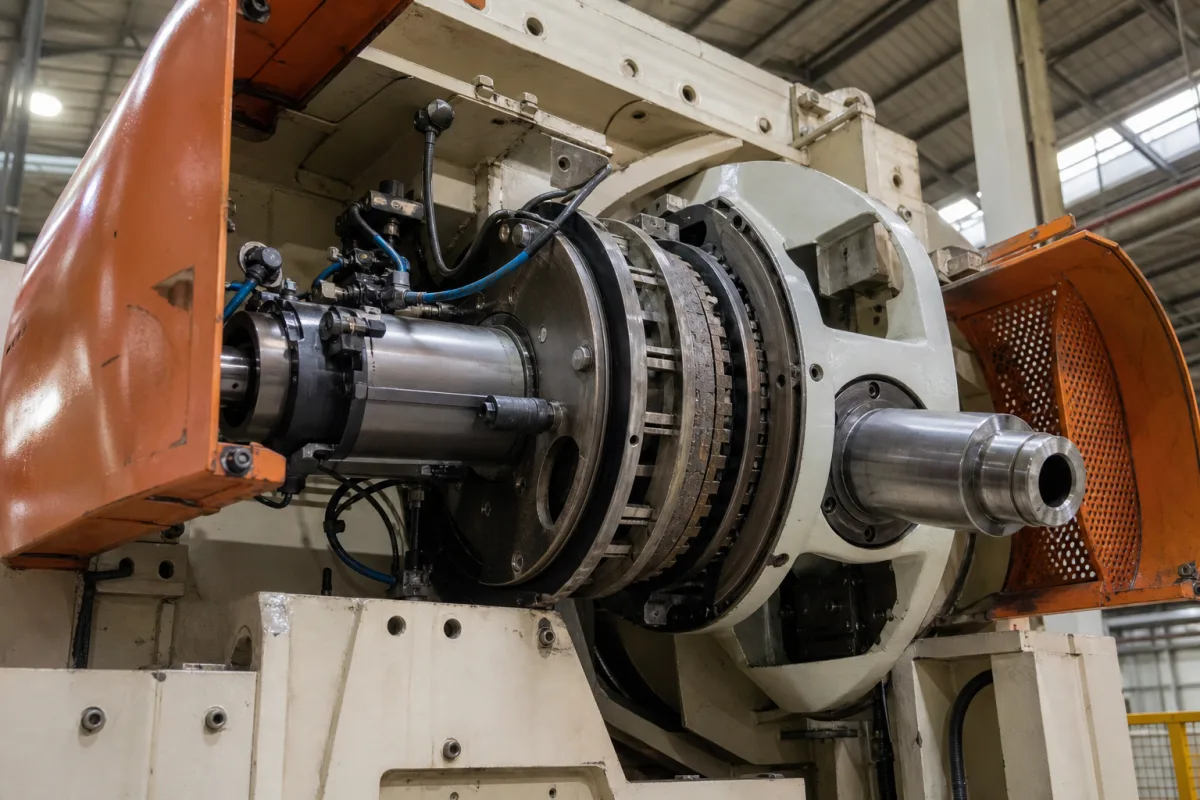
Clutch and brake units for mechanical power presses · Part-revolution clutches with spring-applied brakes, dry friction versus oil shear (wet) units, OSHA clutch/brake control and brake monitoring rules, stopping time and safety distance, and weekly inspection
A press clutch-brake connects the continuously turning flywheel of a mechanical press to the crankshaft for each stroke and stops and holds the slide at the end of it. It sets how fast and safely the press can start, stop and inch, and is central to operator protection. Ask three things first: which press, torque and stroke rate it must handle, whether a dry friction or oil shear unit suits your duty, and how its controls, brake monitoring and stopping time meet the safety rules for your guarding.
Clutch and brake units (combined or separate) and their control valves and brake monitors for mechanical power presses, including pneumatic dry friction and oil shear (wet) types. Hydraulic presses, servo press drives, press brakes and complete presses (see precision mechanical stamping press) are outside this page except where compared.
CNFX editorial research · Sources checked October 11, 2026 · 4 sources
US patent 5,806,641 (Independent clutch and brake for a press) explains that dry friction clutch/brakes start and stop a press by rubbing dry friction material against reaction members, which wears both and generates heat; the faster the press runs and the flywheel turns, the more wear and heat, requiring periodic gap adjustment, and the unit's mass limits heat dissipation and so the trip rate, while adding mass adds inertia to start and stop. Oil shear units were developed to remove these problems: properly designed, they give little or no plate wear and no brake fade, more precise operation and longer uptime, and the oil film carries heat away from the disk stacks so there is practically no limit on trip rate or flywheel speed, with unlimited inching. [2]
US patent 6,095,298 (Wet clutch/brake for a mechanical press, 2000) adds that the flywheel, belt-driven from the motor and mounted on one end of the crankshaft, stores the press's energy; when the clutch engages, the flywheel slows as the driven parts come up to speed and the motor restores the lost energy. It notes that multiple-disk stacks reduce clutch/brake inertia, allowing mechanical interlocking of clutch and brake without an inertia penalty, and identifies undamped clearances at drive disks, driven disks and drive pins as wear points in wet units. [3]
Editorial note: give the supplier the press tonnage, flywheel energy and speed, strokes per minute, inching needs and existing mounting, and ask for the stopping time it guarantees at 90° of crank rotation.
Give the supplier the press make, model and tonnage, crankshaft and flywheel arrangement, flywheel speed, required torque, strokes per minute and continuous or single-stroke duty, inching needs, dry or oil shear preference, air or hydraulic supply, control valve and brake monitor requirements, guarding type used, target stopping time, mounting dimensions, and maintenance access.
02
Meet the clutch, brake and control rules
OSHA's mechanical power press rule (29 CFR 1910.217) requires friction brakes for stopping or holding the slide to be inherently self-engaging, needing external power or force to disengage, with capacity to stop the slide quickly and hold it at any point. For part-revolution clutches, the clutch must release and the brake apply when the clutch engaging means is removed or de-energised; a red stop control must immediately deactivate the clutch and apply the brake; Off, Inch, Single Stroke and Continuous modes must be selectable; air-clutch controls must not significantly lengthen stopping time on a valve failure and must then inhibit further operation; and the control must deactivate if clutch air or counterbalance air fails. [1]
Where required, a brake monitor must prevent the next stroke if stopping time or braking distance deteriorates beyond what the safety distance allows, and monitor brake performance on every stroke. For two-hand controls and presence-sensing devices the safety distance is Ds = 63 in/s × Ts, where Ts is the press stopping time measured at about 90° of crankshaft rotation. Employers must inspect and test each press at least weekly for the condition of the clutch/brake mechanism, antirepeat feature and single-stroke mechanism under the directed inspection programme, and keep certification records. The rule excludes press brakes and hydraulic and pneumatic power presses. [1]
Editorial calculation: a stopping time Ts of 0.2 s gives Ds = 63 × 0.2 = 12.6 in (about 320 mm); a slower brake directly pushes the guard or control further from the die. [1]
03
Size the unit by clutch torque, brake torque, speed and inertia
Nidec Drive Technology's DESCH Lutex LKB, a dry-running clutch-brake unit for mechanical presses and shearing machines, shows the ratings a combined unit is sized by: 15 sizes from 05 to 75, clutch torque from 250 to 115,000 N·m, brake torque from 140 to 65,000 N·m, allowable maximum input speed from 500 to 2,800 rpm and moment of inertia from 0.018 to 255 kg·m². The clutch torque is a static value at an actuating pressure of 6 bar, and the maker offers customised designs. [4]
Editorial calculation: at the top of this series the brake torque is about 57% of the clutch torque (65,000 ÷ 115,000), so quote clutch and brake torque separately, and ask what torque the unit delivers at the air pressure available at your press rather than at 6 bar. [4]
Editorial note: ask for the moment of inertia of the unit, because US 5,806,641 notes that added mass adds inertia to start and stop [2], and OSHA ties the guard's safety distance to the press stopping time [1].
04
Trace the clutch-brake system
This is a functional reference built from the sources cited; it is not one maker's design.
Fill the specification fields with values for your press
A clutch-brake quotation needs values for your press. The table explains each field, gives published values where a reviewed source states them, and says what to obtain from the supplier.
Field
What it means and published values
Ask the supplier for
Rated Torque (N·m)
Clutch and brake torque.
Values.
Operating Pressure (MPa)
Air or hydraulic actuation.
Value.
Response Time (s)
Stopping time Ts at ~90° crank sets safety distance. [1]
The manufacturer below lists press clutch and brake units on its own website; each card links to the page reviewed. Confirm ratings, materials and approvals for your order.
Shanghai Yuyi Machinery Co., Ltd.
Manufacturing site to be confirmed for the order
Lists AS/DS series combined clutch/brake units with pneumatic control, rated to 120,000 Nm clutch torque and 50,000 Nm brake torque.
Explore company information and manufacturing capabilities, then discuss the scope of your project with a relevant supplier.
Share this page
Compiled and source-reviewed by the CNFX editorial team.
Published product pages show what a company offers, not tested performance. Confirm the legal seller, factory and scope for your order. How we source and review
· Page last updated 13 October 2026
Buyer questions
What must a press brake do under OSHA 1910.217?
Engage by itself, need external power to release, stop the slide quickly and hold it at any point in its travel. [1]
How does stopping time affect guarding?
Safety distance for two-hand controls and presence sensing is 63 in/s times stopping time at about 90° of crank rotation. [1]
Dry friction or oil shear clutch-brake?
US 5,806,641 says dry units wear and heat up, limiting trip rate, while oil shear units have little wear, no brake fade and carry heat away in oil. [2]
What torque does a press clutch-brake unit need to state?
Clutch and brake torque separately: Nidec Drive Technology lists its DESCH Lutex LKB dry-running unit in 15 sizes with 250 to 115,000 N·m clutch torque (static, at 6 bar) and 140 to 65,000 N·m brake torque. [4]
Sources and what still needs a direct check
Sources checked 2026-10-11. 29 CFR 1910.217 is the US federal mechanical power press rule; the two US patents describe clutch-brake units in their own terms. Other countries' press safety standards differ.