Industry-Verified Manufacturing Data (2026)

Containment Hood

Based on aggregated insights from multiple verified factory profiles within the CNFX directory, the standard Containment Hood used in the Machinery and Equipment Manufacturing sector typically supports operational capacities ranging from standard industrial configurations to heavy-duty production requirements.

Technical Definition & Core Assembly

A canonical Containment Hood is characterized by the integration of Housing Frame and Observation Window. In industrial production environments, manufacturers listed on CNFX commonly emphasize Galvanized steel construction to support stable, high-cycle operation across diverse manufacturing scenarios.

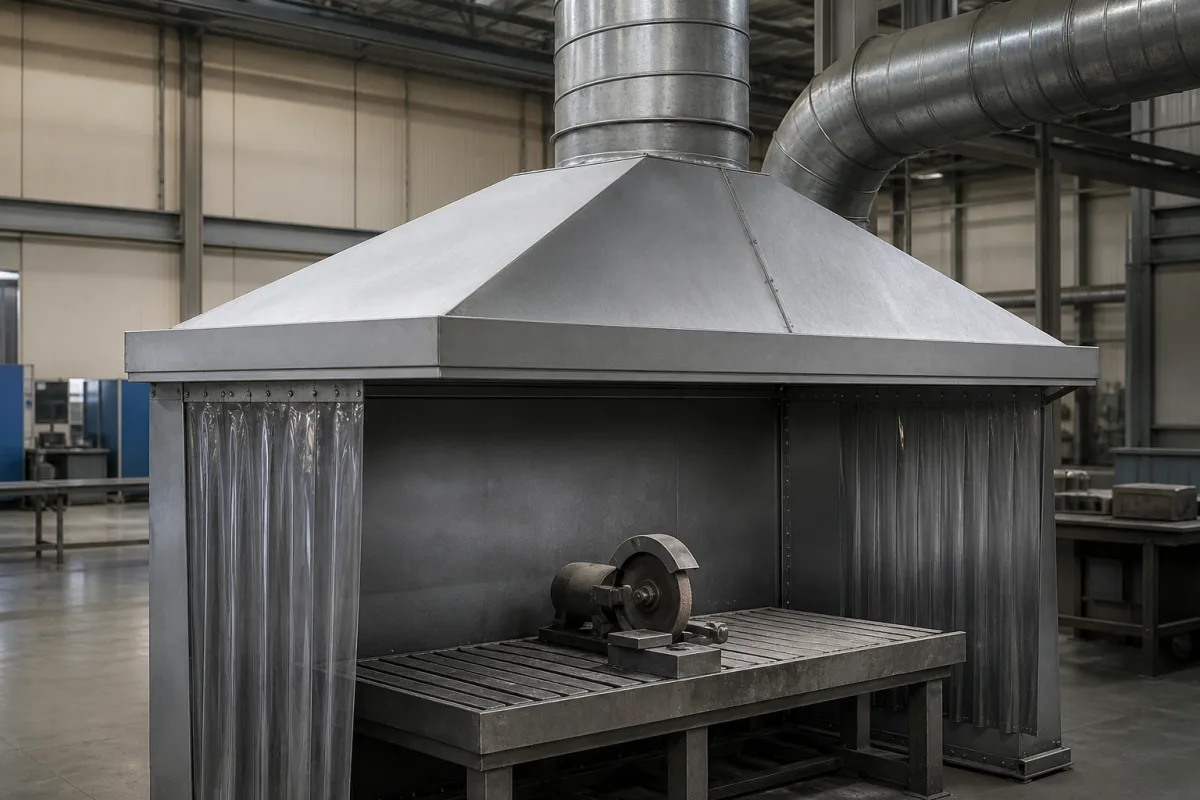
A protective enclosure designed to capture and contain airborne dust particles at their source within industrial processes.

Product Specifications

Technical details and manufacturing context for Containment Hood

Definition
A containment hood is a critical component of a dust containment system that physically encloses dust-generating equipment or processes. It creates a controlled environment to prevent dust dispersion into the workplace atmosphere by capturing emissions at the point of generation. The hood is typically connected to an extraction system that removes the captured dust for filtration or disposal, ensuring worker safety and maintaining air quality standards in manufacturing facilities.
Working Principle
The containment hood operates on the principle of local exhaust ventilation. It creates an enclosure around dust-producing machinery or processes, establishing negative pressure within the hood through connection to an extraction system. This negative pressure draws airborne dust particles into the hood before they can disperse into the surrounding environment. The captured dust is then transported through ductwork to filtration equipment for removal from the air stream.
Common Materials
Galvanized steel, Stainless steel, Polycarbonate
Technical Parameters
  • Dimensions (length × width × height) of the hood enclosure (mm) Customizable
Components / BOM
  • Housing Frame
    Structural framework providing rigidity and mounting points for the hood
    Material: Galvanized steel
  • Observation Window
    Transparent panel allowing visual monitoring of enclosed processes
    Material: Polycarbonate
  • Access Door
    Sealed entry point for maintenance and process adjustments
    Material: Stainless steel
  • Duct Connection Flange
    Interface for connecting to extraction ductwork system
    Material: Galvanized steel
Engineering Reasoning
0.5-2.0 m/s capture velocity at hood face
Capture velocity drops below 0.25 m/s at source distance of 0.3 m
Design Rationale: Boundary layer separation due to insufficient static pressure differential (ΔP < 75 Pa) between hood interior and ambient environment
Risk Mitigation (FMEA)
Trigger Filter loading exceeding 500 g/m² particulate accumulation
Mode: Airflow reduction to 30% of design capacity
Strategy: Differential pressure monitoring with automatic filter cleaning at 250 Pa ΔP
Trigger Hood face velocity exceeding 3.5 m/s
Mode: Particle re-entrainment and escape from containment zone
Strategy: Variable frequency drive control maintaining 1.2-1.8 m/s face velocity

Industry Taxonomies & Aliases

Commonly used trade names and technical identifiers for Containment Hood.

Applied To / Applications

This component is essential for the following industrial systems and equipment:

Industrial Ecosystem & Supply Chain DNA

Complementary Systems
Downstream Applications
Specialized Tooling

Application Fit & Sizing Matrix

Operational Limits
pressure: Atmospheric to 0.5 psi differential
flow rate: Up to 5000 CFM
temperature: -20°C to 120°C
slurry concentration: Up to 40% solids by weight
Media Compatibility
✓ Wood dust ✓ Metal grinding particles ✓ Pharmaceutical powders
Unsuitable: High-velocity abrasive blasting environments
Sizing Data Required
  • Source capture area dimensions
  • Required air velocity at capture face
  • Process particle size distribution

Reliability & Engineering Risk Analysis

Failure Mode & Root Cause
Corrosion and chemical degradation
Cause: Exposure to aggressive process chemicals, high humidity, or acidic/alkaline fumes leading to material breakdown, pitting, or stress corrosion cracking.
Structural fatigue and mechanical failure
Cause: Cyclic thermal stresses from heating/cooling cycles, vibration from connected equipment, or physical impact causing cracks, weld failures, or distortion.
Maintenance Indicators
  • Visible cracks, warping, or corrosion spots on the hood surface
  • Unusual vibrations, rattling noises, or increased airflow resistance during operation
Engineering Tips
  • Implement regular non-destructive testing (e.g., visual inspection, ultrasonic thickness testing) to monitor material integrity and detect early degradation
  • Ensure proper installation with vibration isolation mounts and maintain balanced airflow to minimize mechanical stress and thermal cycling effects

Compliance & Manufacturing Standards

Reference Standards
ISO 14644-1:2015 Cleanrooms and associated controlled environments ANSI/ASHRAE 110-2016 Method of Testing Performance of Laboratory Fume Hoods DIN 12924-1:2015 Laboratory equipment - Fume hoods - Part 1: Safety requirements and testing
Manufacturing Precision
  • Face Velocity: +/-0.05 m/s
  • Sash Opening Height: +/-2 mm
Quality Inspection
  • Face Velocity Uniformity Test
  • Tracer Gas Containment Test

Factories Producing Containment Hood

Verified manufacturers with capability to produce this product in China

✓ 96% Supplier Capability Match Found

P Project Engineer from Australia Jan 21, 2026
★★★★★
"As a professional in the Machinery and Equipment Manufacturing sector, I confirm this Containment Hood meets all ISO standards."
Technical Specifications Verified
S Sourcing Manager from Singapore Jan 18, 2026
★★★★★
"Standard OEM quality for Machinery and Equipment Manufacturing applications. The Containment Hood arrived with full certification."
Technical Specifications Verified
P Procurement Specialist from Germany Jan 15, 2026
★★★★★
"Great transparency on the Containment Hood components. Essential for our Machinery and Equipment Manufacturing supply chain."
Technical Specifications Verified
Verification Protocol

“Feedback is collected from verified sourcing managers during RFQ (Request for Quote) and factory evaluation processes on CNFX. These reports represent historical performance data and technical audit summaries from our B2B manufacturing network.”

17 sourcing managers are analyzing this specification now. Last inquiry for Containment Hood from Thailand (1h ago).

Supply Chain Compatible Machinery & Devices

Hydraulic Press

Industrial machine using hydraulic pressure to compress, form, or assemble materials

Explore Specs →
Heavy-Duty CNC Plasma Cutting Machine

Industrial machine for precision metal cutting using plasma arc technology

Explore Specs →
Automated Assembly Line System

Integrated production system for sequential component assembly operations

Explore Specs →
Automated Powder Coating System

Integrated industrial system for applying dry powder coatings to metal substrates.

Explore Specs →

Frequently Asked Questions

What materials are available for containment hoods in machinery manufacturing?

Our containment hoods are constructed from galvanized steel for general use, stainless steel for corrosive environments, and polycarbonate for visibility and impact resistance in observation areas.

How does a containment hood improve industrial dust control?

Containment hoods capture airborne dust particles directly at their source during industrial processes, preventing dispersion into the workspace and improving air quality, safety, and regulatory compliance.

What standard components are included in a containment hood BOM?

Standard bill of materials includes: housing frame for structural integrity, access door for maintenance, duct connection flange for ventilation systems, and observation window for process monitoring.

Can I contact factories directly on CNFX?

CNFX is an open directory, not a transaction platform. Each factory profile provides direct contact information and production details to help you initiate direct inquiries with Chinese suppliers.

Get Quote for Containment Hood

Request technical pricing, lead times, or customized specifications for Containment Hood directly from verified manufacturing units.

Your business information is encrypted and only shared with verified Containment Hood suppliers.

Thank you! Your message has been sent. We'll respond within 1–3 business days.

Need to Manufacture Containment Hood?

Connect with verified factories specializing in this product category

Add Your Factory Contact Us
Previous Product
Container Positioning System
Next Product
Contamination Sensor