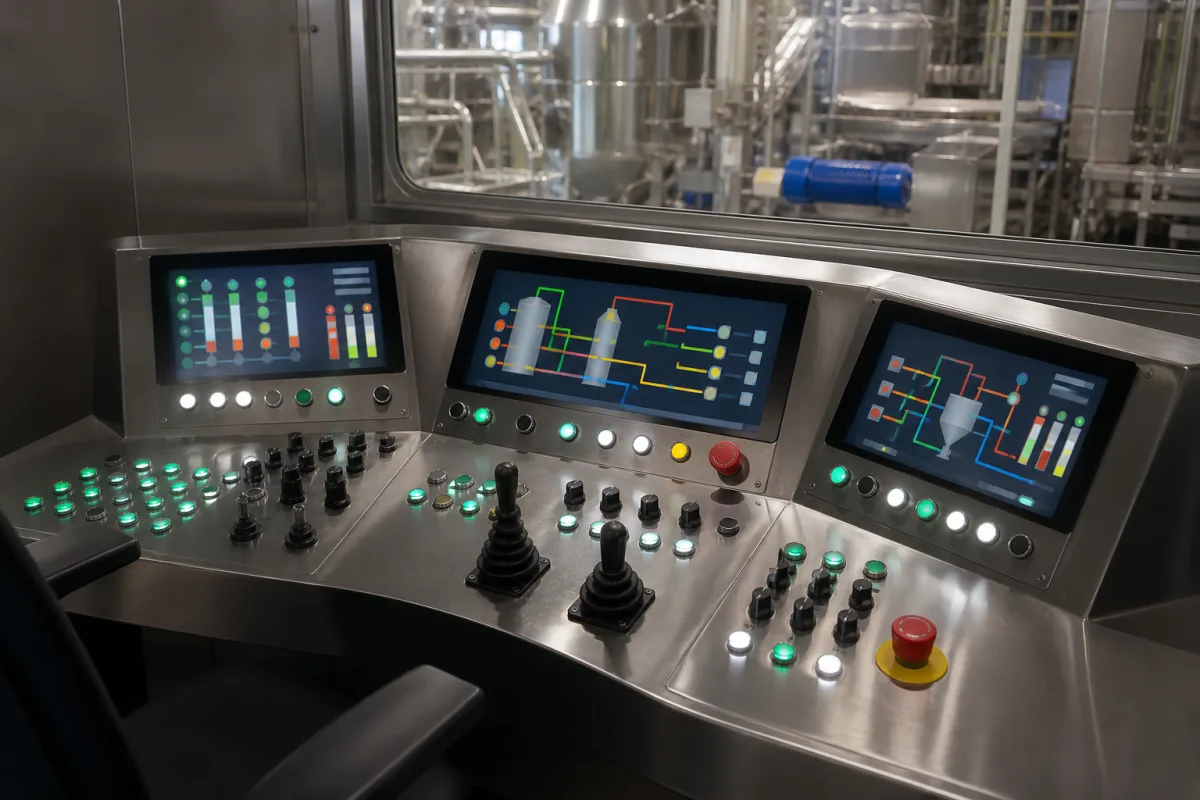
Operator console: layout from tasks, control colours, seated work
The console in the illustration is a stainless desk in a control cabin looking out over the plant: three screens with process mimics, two joysticks, rows of illuminated pushbuttons and two red emergency stops, and an operator's chair. Screens and alarms are designed with care, but an operator spends twelve-hour shifts at the desk itself, reaching for its buttons and sitting in its chair.
Covers operator control consoles and control desks in plant control rooms and cabins: deriving console shape and size from task analysis and equipment lists, physical layout in the room, pushbutton, pilot-light and emergency-stop colours, colour-vision considerations, and seated-workstation issues reported by operators. Alarm numbers and priorities on operator screens are on Control interface panel for process monitoring; PLC and drive cabinets are on Control cabinet and PLC control panel pages; garage door control stations and high-voltage test control desks are outside this page.
CNFX editorial research · Sources checked October 13, 2026 · 3 sources
Wang and co-authors (Scientific Reports, 2023), designing the Shanghai Metro control centre to ISO 11064 and Chinese standards, describe how console dimensions should be derived.
The console should follow from work analysis: each position's tasks and results set the requirements for its work area, and the console's shape depends on the input devices, communication equipment and displays it carries, how often each is used and how the position interacts with others. Their sequence: analyse each position's duties and display and control needs (number of users, visual requirements, communication with other posts); list every display, control and communication device with screen size, model, shape, size and mounting; lay out and size the controls and displays for the task and working posture, including maintenance space; then fix the console's overall dimensions.
Only after each console is sized are the consoles placed in the room. In the Shanghai case, 139 dispatchers worked in 2,150 m², with a standard dispatching desk area of 1.1 × 2.8 m, a general dispatcher area of 1.1 × 3.8 m and a public dispatching area of 1.1 × 1.8 m; four room layouts were compared by simulated evacuation time.
Shanghai Metro control centre (Wang et al.)
Value
Total area
2,150 m²
Dispatchers
139
Standard dispatching desk area
1.1 × 2.8 m (3.08 m²)
General dispatcher area
1.1 × 3.8 m (4.18 m²)
Public dispatching area
1.1 × 1.8 m (1.98 m²)
Areas in m² are Editorial calculations. Ask the console builder for the equipment list and task analysis behind the drawing, not only the drawing.
02
Pushbutton, lamp and emergency-stop colours
Schneider Electric's note on pushbutton colours summarises how IEC 60204-1 treats them.
IEC 60204-1 gives colour guidance for pushbuttons and pilot lights as advice; the standard says manufacturer and user may agree different choices. The familiar cases are the emergency stop as a red mushroom button on a yellow background, a blue reset button and a green start button, and where the choice is not obvious white and grey are the favoured recommendation. The standard explains what the colours mean but does not define the colours themselves; Schneider points to ISO 3864-4, which sets acceptance areas for signal-light colours.
In ISO 3864-4 amber covers both yellow and orange. Schneider explains that for colour-blind operators a yellow lamp is easier to tell from a nearby red one than an orange lamp, while an orange lamp is easier to tell from a nearby green one, so contrast with the neighbouring colours on the panel is a good guide.
Element
Colour practice (Schneider summary of IEC 60204-1)
Emergency stop
Red mushroom on a yellow background
Reset
Blue
Start
Green (familiar case)
Unclear function
White or grey preferred
Amber pilot light
Yellow or orange per ISO 3864-4; choose by neighbouring colours
Ask for the console's colour scheme as a table against IEC 60204-1 and the plant's own conventions, and check it with a colour-vision simulation of the panel.
03
What operators report about their workstations
Janizadeh and co-authors (Scientific Reports, 2025) interviewed fifteen control-room operators in three Iranian process industries and coded 580 issues into 14 categories.
Workload led with 197 codes, then health hazards with 69 and workstation design with 54. Within workstation design, 40.7% concerned chairs and desks, 38.9% displays and mice, 9.3% privacy and personal space, and 3.7% each access to necessary information, use of natural light and footrests. Operators described old, low-quality chairs, broken height adjustment and long repair and replacement times for twelve-hour shifts; prolonged sitting topped the workload complaints, linked to shoulder, neck and back pain.
For a console builder, the point is that the desk, chair, display mounts and footrest are part of the console order, not furniture added later.
Workstation sub-category (54 codes)
Share
≈ Codes
Chair and desk
40.7%
22
Display and mouse
38.9%
21
Privacy and personal space
9.3%
5
Access to information / natural light / footrest
3.7% each
2 each
Code counts are Editorial calculations from the percentages. Ask for adjustable desk height or a matched chair range, display arms, footrests and spare-part lead times as part of the console scope.
04
What to give a console builder
Paste it into your enquiry below or into an email to a maker, then replace every bracket.
Provide the task analysis per position, the list of screens, control devices, joysticks, pushbuttons and communication equipment with sizes, the room plan and view requirements, operator population and shift length, and the plant's colour conventions. Ask for the console drawing derived from that list, reach and viewing checks, pushbutton and lamp colour schedule against IEC 60204-1, emergency-stop arrangement, desk height adjustment, chair, display mounts, footrests and cable management.
2 companies list this product among what they make. Company figures are quoted from each
company's own website; every card states where the relationship came from.
Ktron Space
TBC
Ktron Space's site lists control console desks, height-adjustable and smart consoles, ergonomic chairs and monitor stands for industrial control rooms.
Explore company information and manufacturing capabilities, then discuss the scope of your project with a relevant supplier.
Share this page
Compiled and source-reviewed by the CNFX editorial team.
Each manufacturer above links to the page on that company's own website where the product is listed, with the date we checked it. How we source and review
· Page last updated 13 October 2026
Buyer questions
How should console size be decided?
From work analysis: each position's tasks and its list of displays, controls and communication devices with sizes and mounting, then layout for the posture, then overall dimensions (Wang et al.). [1]
What colour is an emergency stop?
A red mushroom button on a yellow background, as Schneider summarises the familiar IEC 60204-1 practice. [3]
Yellow or orange for an amber lamp?
ISO 3864-4 amber covers both; Schneider notes yellow separates better from red, orange better from green, for colour-blind operators. [3]
What do operators complain about at the console?
In Janizadeh et al.'s interviews, chairs and desks (40.7% of workstation codes) and displays and mice (38.9%). [2]
Sources and what still needs a direct check
Sources checked 2026-10-13. Two peer-reviewed control-room studies and a component maker's note on control colours.