Editorial Technical Reference

Control Panel / Interface

This page explains how Control Panel / Interface is classified within Machinery and Equipment Manufacturing. Technical values and manufacturer relationships are research references; confirm the current specification and supplier evidence for each order.

Technical Definition & Core Assembly

User interface and control system for operating and monitoring test chamber functions
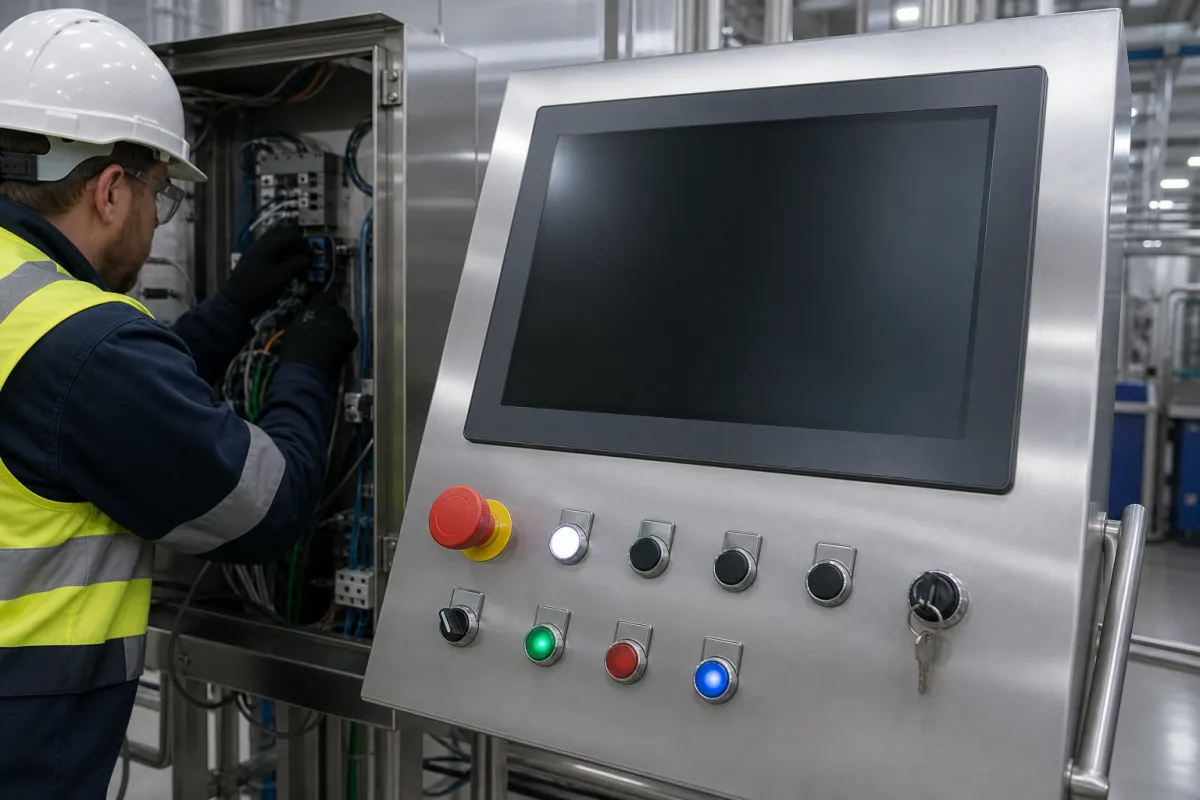
Representative product image. Confirm appearance and specifications with the manufacturer.

Product Specifications

Technical details and manufacturing context for Control Panel / Interface

Definition
The control panel/interface is the primary human-machine interface component of a test chamber, providing operators with controls, displays, and monitoring capabilities to set parameters, initiate tests, and observe real-time conditions within the chamber environment. It receives operator inputs through buttons, touchscreens, or dials, processes these commands through embedded controllers or PLC systems, sends control signals to chamber components (heaters, coolers, humidifiers, etc.), and displays feedback from sensors monitoring temperature, humidity, pressure, and other environmental parameters. Typical specifications include display sizes from 7 to 10 inches, touch screen resolutions from 1024×600 to 1920×1080 pixels, control accuracy of ±0.1 to ±0.5 °C, temperature and humidity display resolutions of 0.1 °C and 0.1 % RH, programmable steps from 100 to 1000, communication interfaces such as RS232/485, Ethernet, and USB, supply voltage of 220–240 V AC, power consumption of 50–200 W (excluding chamber heating/cooling), operating temperature of 0–50 °C, ingress protection ratings of IP54 to IP65 per IEC 60529, panel material of 304 stainless steel per ASTM A240, and weight of 5–15 kg. Materials on file include polycarbonate, stainless steel, and aluminum alloy. These values are reference ranges and must be verified for the specific model and application with the legal manufacturer or supplier. The control panel is a component, not a standalone product, and its suitability depends on the test chamber's requirements. When selecting, confirm the display size, resolution, control accuracy, communication interfaces, and environmental ratings match your operational needs. Always verify model-specific values and standards with the manufacturer or supplier before procurement.
Working Principle
The control panel/interface receives operator inputs via buttons, touchscreens, or dials. These commands are processed by embedded controllers or PLC systems, which then send control signals to chamber components such as heaters, coolers, and humidifiers. Simultaneously, sensors monitoring temperature, humidity, pressure, and other parameters provide feedback, which is displayed on the panel. The system allows setting parameters, initiating tests, and observing real-time conditions. The control logic ensures that the chamber environment is maintained according to the programmed profile. Communication interfaces like RS232/485, Ethernet, and USB enable remote monitoring and data logging. The panel's operating temperature range is 0–50 °C, and its power consumption is 50–200 W, excluding chamber heating/cooling loads.
Common Materials
Polycarbonate, Stainless Steel, Aluminum Alloy
Technical Parameters
ParameterTypical rangeNotes & selection driver
Display Size7–10 inchLarger for multi-zone control
Touch Screen Resolution1024×600–1920×1080 pixelsHigher for detailed graphs
Control Accuracy±0.1–±0.5 °CTighter for calibration chambers
Temperature Display Resolution0.1 °CMinimum for readability
Humidity Display Resolution0.1 % RHFor precise humidity control
Programmable Steps100–1000 stepsMore for complex profiles
Communication InterfaceRS232/485, Ethernet, USBFor remote monitoring
Supply Voltage220–240 V ACSingle phase typical
Power Consumption50–200 WExcludes chamber heating/cooling
Operating Temperature0–50 °CFor controller electronics
Ingress ProtectionIP54–IP65Higher for dusty/wet areasIEC 60529
Panel Material304 stainless steelCorrosion resistantASTM A240
Weight5–15 kgFor mounting considerations

Ranges are indicative industry figures for RFQ preparation, not a supplier commitment. Confirm every value and standard with the legal manufacturer before ordering.

Components / BOM
  • Display Screen
    Visual interface for showing chamber parameters, test status, and system information
    Material: Glass/Plastic Composite
  • Control Buttons/Dials Part
    Physical inputs for operator commands and parameter adjustments
    Material: Plastic/Metal
  • Processor Board
    Central processing unit for interpreting inputs and managing control logic
    Material: Fiberglass/Copper
  • Connection Ports Part
    Interfaces for connecting to chamber sensors, actuators, and external systems
    Material: Brass/Stainless Steel

Applied To / Applications

This component is essential for the following industrial systems and equipment:

Industrial Ecosystem & Supply Chain Structure

Complementary Systems
Downstream Applications
Specialized Tooling

Application Fit & Sizing Matrix

Operational Limits
pressure: Standard atmospheric (non-pressurized enclosure)
other spec: IP65/NEMA 4X rating, 24VDC power input, 10-90% non-condensing humidity
temperature: Ambient to 50°C (operating), -20°C to 70°C (storage)
Media Compatibility
✓ Clean room air environments ✓ Laboratory-grade nitrogen atmospheres ✓ Dry inert gas purged enclosures
Unsuitable: High particulate/dust environments without additional filtration
Sizing Data Required
  • Number of chamber control points required
  • Communication protocol requirements (Ethernet/IP, Profibus, etc.)
  • Display size and HMI complexity needs

Reliability & Engineering Risk Analysis

Failure Mode & Root Cause
Electrical contact degradation
Cause: Oxidation, dust accumulation, or mechanical wear on switches, relays, or connectors leading to increased resistance, arcing, or intermittent operation.
Display/interface component failure
Cause: Backlight burnout, LCD degradation, or touchscreen unresponsiveness due to prolonged use, thermal cycling, or physical damage from contaminants or impact.
Maintenance Indicators
  • Intermittent or unresponsive controls (e.g., buttons, touchscreens, or switches failing to register inputs consistently)
  • Unusual audible noises (e.g., buzzing, clicking from relays or transformers) or visible signs like flickering displays, burnt odors, or discoloration on components
Engineering Tips
  • Implement regular cleaning and inspection schedules using non-conductive cleaners and compressed air to remove dust and contaminants that can cause overheating or electrical shorts.
  • Ensure proper environmental controls (e.g., temperature, humidity, and vibration isolation) and use surge protection devices to shield sensitive electronics from operational stresses and power fluctuations.

Indicative industry ranges for design and RFQ preparation. Confirm the exact figures and applicable standard with the manufacturer before specifying.

Compliance & Manufacturing Standards

Applicable Standards
ISO 13849-1: Safety of machinery - Safety-related parts of control systems IEC 60204-1: Safety of machinery - Electrical equipment of machines UL 508A: Standard for Industrial Control Panels

Quoted from the published standard.

Manufacturing Precision
  • Enclosure door gap: +/- 0.5mm
  • Mounting hole alignment: +/- 0.2mm
Quality Inspection
  • Dielectric withstand test (HIPOT)
  • Functional safety verification test

Manufacturers of Control Panel / Interface

Manufacturer profiles associated with Control Panel / Interface.

Sourcing Control Panel / Interface from China?
Tell us your specification and target quantity — we will match it against manufacturer records and come back with the factories that fit.
Request manufacturers We manufacture this

Manufacturer listings support early research and capability understanding. They are not certification, ranking, or transaction guarantees.

Technical documentation
Request current drawings, revision history, and a signed specification sheet.
Manufacturing capability
Verify equipment lists, process limits, capacity, and representative production evidence.
Inspection readiness
Confirm test methods, calibrated equipment, sampling plans, and traceable reports.
Supplier transparency
Check the legal entity, factory address, ownership, certifications, and direct contacts.

CNFX does not score or rank suppliers. Buyers must verify all claims and documents with the legal manufacturer before ordering.

Supply Chain Compatible Machinery & Devices

Automated Powder Coating System

Integrated industrial system for applying dry powder coatings to metal substrates.

Explore Specs →
Centrifugal Pump Impeller

The centrifugal pump impeller is a critical rotating component that converts mechanical energy from the motor into kinetic energy in fluid systems.

Explore Specs →
High-Precision CNC Laser Cutting Machine

Computer-controlled industrial machine using focused laser beams to cut sheet metal with micron-level accuracy.

Explore Specs →
Industrial-Grade Hydraulic Cylinder Piston Rod

This industrial-grade piston rod is a precision-ground cylindrical component designed for use in hydraulic cylinders.

Explore Specs →

Frequently Asked Questions

What are the typical display sizes and resolutions for test chamber control panels?

Display sizes typically range from 7 to 10 inches, with touch screen resolutions from 1024×600 to 1920×1080 pixels. These are reference ranges; confirm the exact specifications for your model with the manufacturer.

What communication interfaces are commonly available on these control panels?

Common interfaces include RS232/485, Ethernet, and USB. These allow for remote monitoring, data logging, and integration with external systems. Verify the availability and compatibility with your setup.

What is the control accuracy of these panels?

Control accuracy is typically ±0.1 to ±0.5 °C, depending on the model and application. For calibration chambers, tighter accuracy may be required. Always check the manufacturer's specifications.

What ingress protection ratings are available?

Ingress protection ratings range from IP54 to IP65 per IEC 60529. Higher ratings are suitable for dusty or wet environments. Confirm the rating needed for your installation location.

Data Basis

Editorial classification, named public sources where available, and source-reviewed manufacturer records.

Preliminary Technical Classification
This page supports structured research, RFQ preparation, and supplier evaluation. It does not replace buyer-led supplier qualification, standards review, or technical approval.
Buyer enquiry

Request manufacturing insight for Control Panel / Interface

Ask for use case, specification boundaries, supplier type, and RFQ preparation information for this product.

Where it goes
Straight to the CNFX editorial desk, and to the manufacturer if this product is linked to a claimed profile. Nothing is broadcast to a supplier list.
Your details stay here
We do not sell or rent enquiry data, and we do not add you to a mailing list. Used only to answer this request.
No commission, no middleman
CNFX is a directory. We take no cut of any order and never negotiate on a supplier's behalf.
What we don't claim
A listing is not an endorsement. Qualify every supplier and verify every figure yourself before ordering.

Your business information is used only to process this request.

Thank you! Your message has been sent. We'll respond within 1–3 business days.
Sorry, we couldn't send your message. Please try again, or email us at contact@cnfx.com.

Need to Manufacture Control Panel / Interface?

Compare manufacturer profiles with relevant product and process capability.

Previous Product
Z-axis Ram/Spindle
Last Product
Get QuotesChat