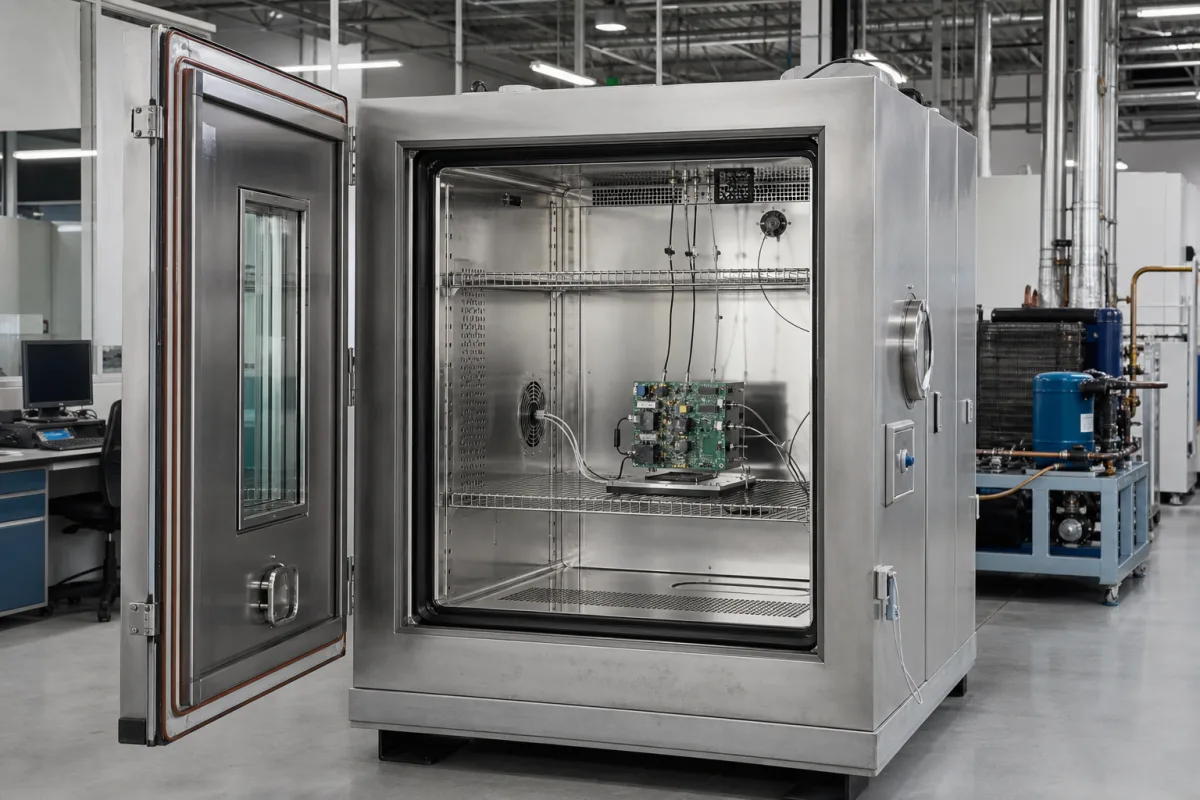
Environmental testing · Empty-chamber specs vs your real load
Chamber data sheets describe an empty chamber. Your test does not: a rack of powered electronics or a pallet of packs changes how fast the chamber ramps and how even the temperature stays. Start from the conditions your test standard requires, ask how each performance figure was measured, and give the supplier your load so the offer covers the test you will actually run.
Temperature, temperature–humidity, rapid-change, thermal shock, stability and battery test chambers, benchtop to walk-in. Salt spray, xenon and vibration systems share some points but are outside this page.
CNFX editorial research · Sources checked October 10, 2026 · 6 sources
Read chamber performance figures as empty-chamber values
IEC 60068-3-5 gives a uniform method of confirming that temperature test chambers, without specimens, meet the requirements of the IEC 60068-2 climatic tests, for use in regular performance monitoring. It treats temperature fluctuation, temperature gradient, temperature variation in space and temperature rate of change as separate characteristics, measured at specified sensor locations in the working space. [1]
Measurements in chambers with a load are covered by a separate part, IEC 60068-3-7, and uncertainty of chamber conditions by IEC 60068-3-11. Those parts were not read for this page. [1]
Ask the supplier which of these characteristics each data-sheet figure refers to, at what setpoints, where the sensors were placed and whether the chamber was empty. A single ‘±0.5 °C’ can mean fluctuation at the centre or gradient across the whole working space.
Name the test standards and severities you must run (for example IEC 60068-2 tests, automotive or battery standards) and let the supplier confirm the chamber can reach them, rather than comparing data-sheet numbers alone.
02
State your load so ramp rate and uniformity hold
Because performance is confirmed without specimens, the mass, heat capacity, heat dissipation and airflow blockage of your load decide what the chamber achieves in your test. Suppliers linked to this page offer rapid temperature-change chambers quoted at 5 to 15 °C/min; ask at what load that rate applies. [3][1]
Give the supplier the specimen mass and material, any fixtures, the power the specimens dissipate when energised, and how they are arranged on shelves. Ask for a loaded ramp-rate calculation or test, cable ports for powered specimens, and the refrigeration and heating capacity at your extremes.
03
Match stability chambers to the storage conditions required
For pharmaceutical stability studies, ICH Q1A(R2) sets general-case storage conditions: long-term 25 °C ± 2 °C / 60% RH ± 5% RH or 30 °C ± 2 °C / 65% RH ± 5% RH, intermediate 30 °C ± 2 °C / 65% RH ± 5% RH, and accelerated 40 °C ± 2 °C / 75% RH ± 5% RH; products for refrigerator storage are held long-term at 5 °C ± 3 °C. [2]
The guideline asks for long-term testing of at least 12 months at submission, at a frequency that "should normally be every 3 months over the first year, every 6 months over the second year, and annually thereafter", and a 6-month accelerated study with at least three time points. A stability chamber therefore runs continuously for years at fixed conditions; ask for monitoring, alarms, data logging and backup on loss of power or refrigeration. [2]
Laboao and other suppliers list drug stability test chambers; confirm the uniformity and fluctuation achieved at your conditions and loading. [6]
04
Compare what suppliers build
Suppliers linked to this page list temperature–humidity, high–low temperature, rapid-change, thermal shock, altitude, walk-in, battery and drug-stability chambers. [4][5][3]
Sanwood lists battery test chambers for EV and energy storage cells alongside thermal shock and altitude chambers; Yinhe lists lithium-cell, rapid-change and comprehensive chambers. Battery chambers need safety features for cell venting or fire; ask what is fitted and to which standard. [4][5]
05
Trace the test chamber components
This is a functional reference built from the sources cited; it is not one maker's parts list.
Part
Role
Fix in the order
Insulated enclosure and working space
Holds the conditions; performance is confirmed in the working space. [1]
Inner volume, working-space dimensions and interior material.
Fill the specification fields with values for your test
A chamber quotation needs test-specific values. The table explains each field, gives published values where a reviewed source states them, and says what to obtain from the supplier.
Explore company information and manufacturing capabilities, then discuss the scope of your project with a relevant supplier.
Share this page
Compiled and source-reviewed by the CNFX editorial team.
Published product pages show what a company offers, not tested performance. Confirm the legal seller, factory and scope for your order. How we source and review
· Page last updated 13 October 2026
Buyer questions
Are chamber data-sheet figures measured with a load?
IEC 60068-3-5 confirms chamber performance without specimens; measurements with load are covered by IEC 60068-3-7. Ask how each figure was measured. [1]
What conditions does an ICH stability chamber need?
ICH Q1A(R2) general-case conditions are 25 °C/60% RH or 30 °C/65% RH long-term, 30 °C/65% RH intermediate and 40 °C/75% RH accelerated, each ± 2 °C and ± 5% RH. [2]
Is temperature uniformity the same as fluctuation?
No. IEC 60068-3-5 treats fluctuation, gradient, variation in space and rate of change as separate characteristics. [1]
Sources and what still needs a direct check
Sources checked 2026-10-10. IEC 60068-3-5 was read from the publisher's preview (scope, definitions and contents only). ICH Q1A(R2) is the international stability guideline. Supplier pages describe their own offers. IEC 60068-3-7 and 60068-3-11 were not read for this page.