Editorial Technical Reference

Coordinate Measuring Machine (CMM) Arm

This page explains how Coordinate Measuring Machine (CMM) Arm is classified within Machinery and Equipment Manufacturing. Technical values and manufacturer relationships are research references; confirm the current specification and supplier evidence for each order.

Technical Definition & Core Assembly

The articulated robotic arm component of a Coordinate Measuring Machine that physically contacts and measures workpiece surfaces.
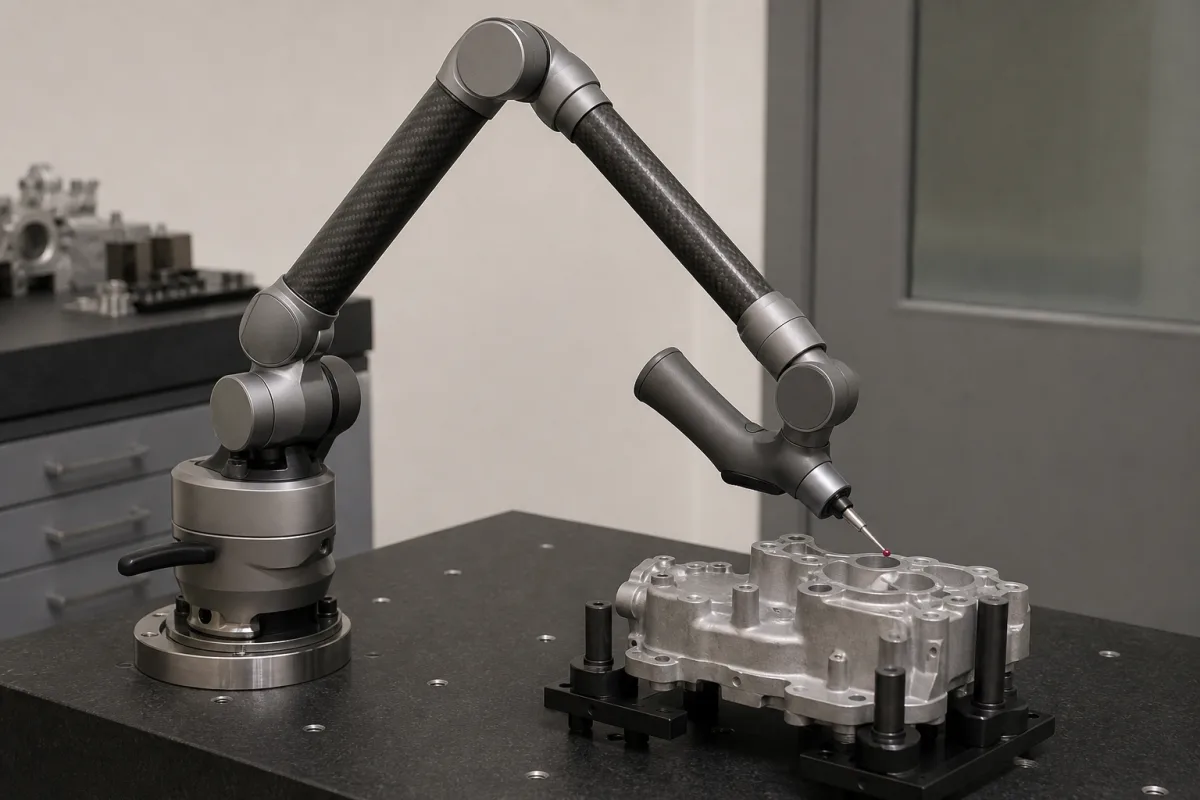
Coordinate Measuring Machine (CMM) Arm in a manufacturing environment
Representative product image. Confirm appearance and specifications with the manufacturer.

Product Specifications

Technical details and manufacturing context for Coordinate Measuring Machine (CMM) Arm

Definition
The CMM Arm is a precision mechanical component used within a Quality Control Station. It positions a measurement probe in three-dimensional space to collect dimensional data from manufactured parts. The arm enables accurate measurement of complex geometries through programmed movement paths. Constructed from materials such as carbon fiber composite, aluminum alloy, or stainless steel, the arm balances rigidity with weight reduction. Its articulated design typically features 6 to 7 axes, allowing flexible probe orientation. The measuring range spans from 500 to 3000 mm, accommodating various part sizes. Probe repeatability is specified as ±0.02 to ±0.05 mm, and volumetric accuracy as ±0.05 to ±0.10 mm, both per ISO 10360-2. Arm resolution ranges from 0.001 to 0.005 mm. The arm supports a maximum load capacity of 10 to 50 kg, including the probe and accessories. Operating temperature range is 10 to 40 °C, with a non-condensing humidity range of 10 to 90% RH. The ingress protection rating is IP54 to IP65 per IEC 60529. The arm's weight is 10 to 50 kg, affecting portability and mounting. Power supply is 24 V DC ±10%. These parameters are directory reference ranges; actual values must be confirmed with the legal manufacturer or supplier for specific models and applications. The arm's performance is critical for measurement consistency and overall accuracy. Proper selection requires evaluating the measuring range, repeatability, accuracy, resolution, number of axes, load capacity, environmental tolerances, and physical dimensions against the intended measurement tasks. Verification of compliance with ISO 10360-2 and IEC 60529 should be requested from the supplier. Maintenance signals include unusual joint friction, encoder drift, or probe deflection anomalies. Failure boundaries include operation outside specified temperature, humidity, or load limits, which can degrade accuracy. The arm is not a standalone measuring device; it requires integration with a CMM controller and software.
Working Principle
The arm moves through programmed coordinates using precision joints and encoders, bringing the measurement probe into contact with the workpiece. Positional data from the arm's encoders combines with probe deflection data to calculate precise dimensional measurements. The articulated structure allows the probe to approach the part from various angles, enabling measurement of complex geometries. The control system interprets the encoder signals and probe contact to determine surface points, which are then used to construct a dimensional map of the part.
Common Materials
Carbon fiber composite, Aluminum alloy, Stainless steel
Technical Parameters
ParameterTypical rangeNotes & selection driver
Measuring Range500–3000 mmDefines the maximum part size that can be measured.
Probe Repeatability±0.02–±0.05 mmCritical for measurement consistency.ISO 10360-2
Volumetric Accuracy±0.05–±0.10 mmOverall accuracy over the measuring volume.ISO 10360-2
Arm Resolution0.001–0.005 mmSmallest increment the arm can detect.
Number of Axes6–7More axes allow greater flexibility in probe orientation.
Maximum Load Capacity10–50 kgWeight of the probe and accessories the arm can support.
Operating Temperature Range10–40 °COutside this range, accuracy may degrade.
Humidity Range10–90 % RHNon-condensing; high humidity can affect electronics.
Ingress Protection RatingIP54–IP65Protection against dust and water jets.IEC 60529
Arm MaterialAluminum alloy / carbon fiberCarbon fiber reduces weight and thermal expansion.
Weight10–50 kgAffects portability and mounting requirements.
Power Supply24 ±10% V DCStandard industrial DC supply.

Ranges are indicative industry figures for RFQ preparation, not a supplier commitment. Confirm every value and standard with the legal manufacturer before ordering.

Components / BOM
  • Probe Mount
    Interface for attaching various measurement probes
    Material: Stainless steel
  • Articulation Joints
    Provide rotational movement between arm segments
    Material: Aluminum alloy with precision bearings
  • Encoder System
    Measures angular position of each joint
    Material: Glass scale or magnetic encoder components
  • Arm Segments
    The rigid links between joints; their length and stiffness set the arm's reach and its measuring accuracy.

Industry Taxonomies & Aliases

Commonly used trade names and technical identifiers for Coordinate Measuring Machine (CMM) Arm.

Applied To / Applications

This component is essential for the following industrial systems and equipment:

Industrial Ecosystem & Supply Chain Structure

Complementary Systems
Downstream Applications
Specialized Tooling

Application Fit & Sizing Matrix

Operational Limits
pressure: Contact force: 0.1N to 5N (adjustable probe pressure)
other spec: Relative humidity: 30% to 70% non-condensing, Vibration tolerance: <0.5g RMS, Accuracy: ±0.001mm to ±0.025mm depending on arm length
temperature: 15°C to 30°C (operating), 0°C to 40°C (storage)
Media Compatibility
✓ Metallic surfaces (steel, aluminum, titanium) ✓ Plastic/composite components ✓ Machined/ground surfaces
Unsuitable: Abrasive slurry environments or high-particulate atmospheres
Sizing Data Required
  • Maximum measurement volume (working envelope dimensions)
  • Required measurement accuracy/tolerance
  • Workpiece material and surface characteristics

Reliability & Engineering Risk Analysis

Failure Mode & Root Cause
Encoder drift or failure
Cause: Contamination from dust, coolant, or metal particles entering the encoder housing, leading to signal degradation or complete loss of positional feedback.
Bearing wear or seizure in rotary joints
Cause: Inadequate lubrication, ingress of contaminants, or excessive loading causing increased friction, play, or binding in the arm's articulation points.
Maintenance Indicators
  • Audible grinding, clicking, or binding noises during arm movement, indicating mechanical interference or bearing issues.
  • Visual misalignment or 'drift' in repeated measurements, or error messages related to positional feedback (e.g., encoder faults), signaling calibration loss or sensor failure.
Engineering Tips
  • Implement strict environmental controls: maintain clean, temperature-stable conditions (e.g., ISO 7 cleanroom standards if possible), use protective covers when idle, and regularly clean seals and air filters to prevent contaminant ingress.
  • Adhere to a proactive lubrication schedule using manufacturer-specified greases for bearings and joints, and perform routine calibration checks (e.g., weekly or per usage cycles) using master artifacts to detect and correct drift early.

Indicative industry ranges for design and RFQ preparation. Confirm the exact figures and applicable standard with the manufacturer before specifying.

Compliance & Manufacturing Standards

Applicable Standards
ISO 10360-2:2009 - Acceptance and reverification tests for coordinate measuring machines (CMMs) ASME B89.4.10360.2 - Performance Evaluation of Coordinate Measuring Systems VDI/VDE 2617 - Accuracy of coordinate measuring machines; characteristics and their checking

Quoted from the published standard.

Manufacturing Precision
  • Positional Accuracy: ±(2.0 + L/300) μm where L is measured length in mm
  • Repeatability: ≤ 1.5 μm at 95% confidence level
Quality Inspection
  • Laser Interferometer Calibration Test for volumetric accuracy verification
  • Ball Bar Test for dynamic performance and geometric error assessment

Manufacturers of Coordinate Measuring Machine (CMM) Arm

Manufacturer profiles associated with Coordinate Measuring Machine (CMM) Arm.

Sourcing Coordinate Measuring Machine (CMM) Arm from China?
Tell us your specification and target quantity — we will match it against manufacturer records and come back with the factories that fit.
Request manufacturers We manufacture this

Manufacturer listings support early research and capability understanding. They are not certification, ranking, or transaction guarantees.

Share this page
Technical documentation
Request current drawings, revision history, and a signed specification sheet.
Manufacturing capability
Verify equipment lists, process limits, capacity, and representative production evidence.
Inspection readiness
Confirm test methods, calibrated equipment, sampling plans, and traceable reports.
Supplier transparency
Check the legal entity, factory address, ownership, certifications, and direct contacts.

CNFX does not score or rank suppliers. Buyers must verify all claims and documents with the legal manufacturer before ordering.

Supply Chain Compatible Machinery & Devices

Automated Powder Coating System

Integrated industrial system for applying dry powder coatings to metal substrates.

Explore Specs →
Centrifugal Pump Impeller

The centrifugal pump impeller is a critical rotating component that converts mechanical energy from the motor into kinetic energy in fluid systems.

Explore Specs →
High-Precision CNC Laser Cutting Machine

Computer-controlled industrial machine using focused laser beams to cut sheet metal with micron-level accuracy.

Explore Specs →
Industrial-Grade Hydraulic Cylinder Piston Rod

This industrial-grade piston rod is a precision-ground cylindrical component designed for use in hydraulic cylinders.

Explore Specs →

Frequently Asked Questions

What is the measuring range of a typical CMM arm?

The measuring range is typically 500 to 3000 mm, but this is a directory reference. Confirm the exact range for the specific model with the manufacturer.

What standards apply to CMM arm accuracy?

Probe repeatability and volumetric accuracy are often specified per ISO 10360-2. However, compliance must be verified with the supplier for the actual product.

What materials are commonly used for CMM arms?

Common materials include carbon fiber composite, aluminum alloy, and stainless steel. The choice affects weight, rigidity, and thermal stability.

What environmental conditions can affect CMM arm performance?

The arm operates within a temperature range of 10–40 °C and humidity of 10–90% RH (non-condensing). Operating outside these ranges may degrade accuracy.

Data Basis

Editorial classification, named public sources where available, and source-reviewed manufacturer records.

Preliminary Technical Classification
This page supports structured research, RFQ preparation, and supplier evaluation. It does not replace buyer-led supplier qualification, standards review, or technical approval.
Buyer enquiry

Request manufacturing insight for Coordinate Measuring Machine (CMM) Arm

Ask for use case, specification boundaries, supplier type, and RFQ preparation information for this product.

Where it goes
Straight to the CNFX editorial desk, and to the manufacturer if this product is linked to a claimed profile. Nothing is broadcast to a supplier list.
Your details stay here
We do not sell or rent enquiry data, and we do not add you to a mailing list. Used only to answer this request.
No commission, no middleman
CNFX is a directory. We take no cut of any order and never negotiate on a supplier's behalf.
What we don't claim
A listing is not an endorsement. Qualify every supplier and verify every figure yourself before ordering.

Your business information is used only to process this request.

Thank you! Your message has been sent. We'll respond within 1–3 business days.
Sorry, we couldn't send your message. Please try again, or email us at [email protected].

Need to Manufacture Coordinate Measuring Machine (CMM) Arm?

Compare manufacturer profiles with relevant product and process capability.

Previous Product
Z-axis Ram/Spindle
Last Product
Get QuotesChat