Industry-Verified Manufacturing Data (2026)

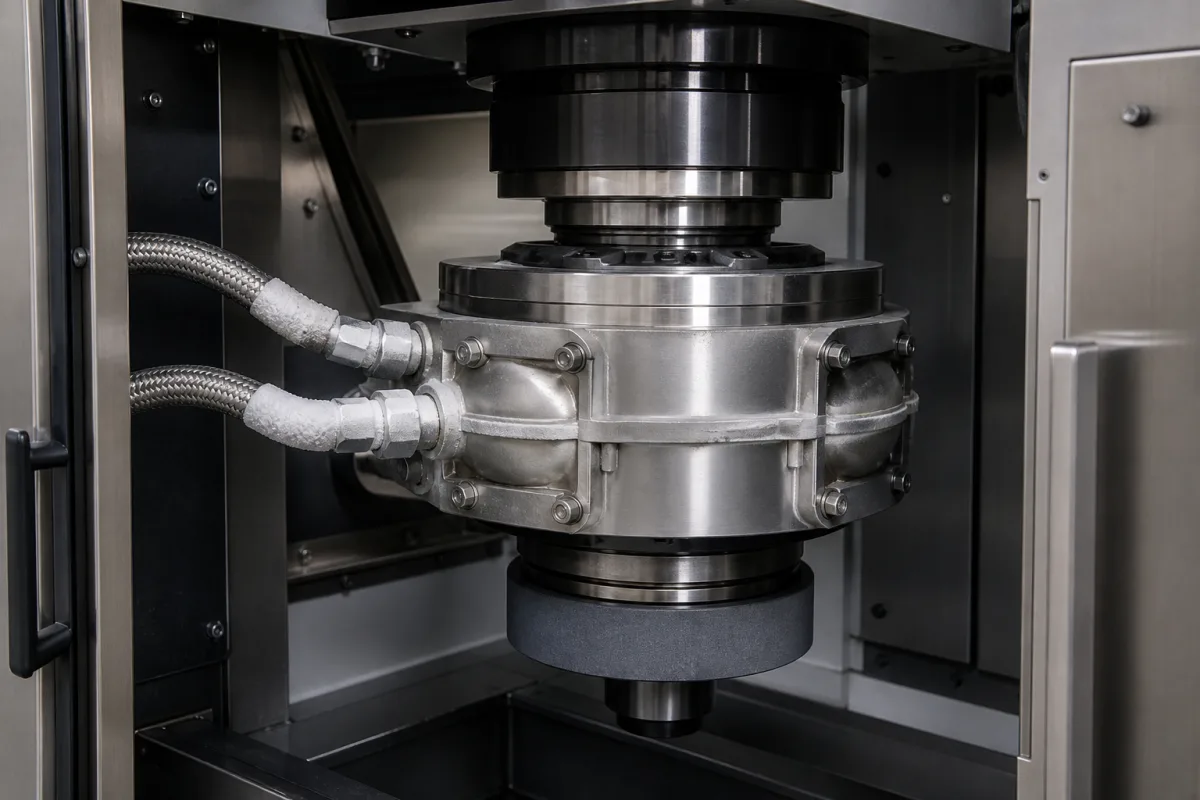
Cryogenic Cooling Jacket

Based on aggregated insights from multiple verified factory profiles within the CNFX directory, the standard Cryogenic Cooling Jacket used in the Machinery and Equipment Manufacturing sector typically supports operational capacities ranging from standard industrial configurations to heavy-duty production requirements.

Technical Definition & Core Assembly

A canonical Cryogenic Cooling Jacket is characterized by the integration of Coolant Inlet Port and Coolant Outlet Port. In industrial production environments, manufacturers listed on CNFX commonly emphasize Stainless steel construction to support stable, high-cycle operation across diverse manufacturing scenarios.

A specialized cooling component that maintains cryogenic temperatures around critical grinding head elements to prevent thermal damage and ensure precision machining.
Product Specifications

Technical details and manufacturing context for Cryogenic Cooling Jacket

Definition
The Cryogenic Cooling Jacket is an integral part of the Grinding Head Assembly designed to envelop and maintain extremely low temperatures around grinding components. It functions as a thermal management system that prevents overheating during high-precision machining operations, particularly in applications involving hard or heat-sensitive materials. By circulating cryogenic fluids (typically liquid nitrogen or specialized coolants) through its sealed channels, it absorbs and dissipates heat generated by friction, ensuring dimensional stability and preventing thermal expansion that could compromise machining accuracy.
Working Principle
The jacket operates by circulating cryogenic fluid through internal channels or passages that surround the grinding components. As heat transfers from the grinding operation into the jacket walls, the cryogenic fluid absorbs this thermal energy, maintaining the grinding head at optimal operating temperatures. This prevents thermal deformation, reduces tool wear, and maintains material properties during precision machining processes.
Common Materials
Stainless steel, Copper alloy, High-grade aluminum
Technical Parameters
  • Inner diameter matching grinding head components (mm) Per Request
Components / BOM
  • Coolant Inlet Port
    Entry point for cryogenic fluid into the jacket system
    Material: Stainless steel
  • Coolant Outlet Port
    Exit point for cryogenic fluid after heat absorption
    Material: Stainless steel
  • Thermal Insulation Layer
    Minimizes heat transfer between jacket and external environment
    Material: Polyurethane foam or vacuum insulation
Engineering Reasoning
4-77 K (-269 to -196°C) with 0.5 K stability
Thermal runaway initiates at 85 K (-188°C) with 2 K/min gradient
Design Rationale: Phase transition of liquid nitrogen coolant to gaseous state at 77.36 K (-195.79°C) causing loss of latent heat absorption capacity
Risk Mitigation (FMEA)
Trigger Micro-crack propagation in vacuum insulation layer exceeding 0.1 mm depth
Mode: Thermal conductivity increase from 0.001 to 0.1 W/m·K causing 15 K/min temperature rise
Strategy: Multi-layer superinsulation with 30 alternating aluminum-coated polyester films and fiberglass spacers
Trigger Helium permeation through stainless steel 316L walls at 10^-9 mbar·L/s leak rate
Mode: Convective heat transfer coefficient increase from 5 to 50 W/m²·K
Strategy: Double-walled construction with 0.5 mm vacuum gap and getter material coating

Industry Taxonomies & Aliases

Commonly used trade names and technical identifiers for Cryogenic Cooling Jacket.

Applied To / Applications

This component is essential for the following industrial systems and equipment:

Industrial Ecosystem & Supply Chain DNA

Complementary Systems
Downstream Applications
Specialized Tooling

Application Fit & Sizing Matrix

Operational Limits
pressure: Up to 10 bar (150 psi) operating pressure
flow rate: 2-20 L/min (cryogenic fluid)
temperature: -196°C to 25°C (liquid nitrogen range to ambient)
slurry concentration: Up to 30% solids by weight (abrasive media)
Media Compatibility
✓ Liquid nitrogen (LN2) ✓ Liquid argon ✓ Food-grade cryogenic fluids
Unsuitable: High-viscosity oils or non-cryogenic coolants
Sizing Data Required
  • Grinding head thermal load (W)
  • Required temperature differential (ΔT)
  • Available cryogenic fluid supply pressure

Reliability & Engineering Risk Analysis

Failure Mode & Root Cause
Thermal fatigue cracking
Cause: Repeated thermal cycling between cryogenic temperatures and ambient conditions during operation and maintenance, leading to stress concentration and material embrittlement in weld zones and transitions.
Cryogenic fluid leakage
Cause: Seal degradation due to extreme temperature differentials, improper gasket material selection, or flange bolt relaxation from thermal contraction/expansion cycles.
Maintenance Indicators
  • Visible frost accumulation or ice formation on external jacket surfaces indicating insulation failure or internal leakage
  • Audible hissing or bubbling sounds from the jacket assembly suggesting cryogenic fluid escape or vacuum loss in insulated designs
Engineering Tips
  • Implement controlled cooldown/warmup procedures with specified temperature ramp rates to minimize thermal shock stresses on materials and joints
  • Use torque monitoring and re-torquing protocols on flange connections after thermal cycling, employing cryogenic-compatible gasket materials with proper compression recovery characteristics

Compliance & Manufacturing Standards

Reference Standards
ISO 21029-1: Cryogenic vessels - Transportable vacuum insulated vessels of not more than 1000 litres volume ASME BPVC Section VIII: Rules for Construction of Pressure Vessels EN 13458-2: Cryogenic vessels - Static vacuum insulated vessels
Manufacturing Precision
  • Jacket Bore Diameter: +/-0.05 mm
  • Surface Flatness: 0.15 mm/m
Quality Inspection
  • Helium Leak Test (per ASTM E499/E499M)
  • Liquid Nitrogen Thermal Shock Test

Factories Producing Cryogenic Cooling Jacket

Verified manufacturers with capability to produce this product in China

✓ 98% Supplier Capability Match Found

P Project Engineer from Singapore Jan 01, 2026
★★★★★
"Found 29+ suppliers for Cryogenic Cooling Jacket on CNFX, but this spec remains the most cost-effective."
Technical Specifications Verified
S Sourcing Manager from Germany Dec 29, 2025
★★★★★
"The technical documentation for this Cryogenic Cooling Jacket is very thorough, especially regarding technical reliability."
Technical Specifications Verified
P Procurement Specialist from Brazil Dec 26, 2025
★★★★★
"Reliable performance in harsh Machinery and Equipment Manufacturing environments. No issues with the Cryogenic Cooling Jacket so far."
Technical Specifications Verified
Verification Protocol

“Feedback is collected from verified sourcing managers during RFQ (Request for Quote) and factory evaluation processes on CNFX. These reports represent historical performance data and technical audit summaries from our B2B manufacturing network.”

10 sourcing managers are analyzing this specification now. Last inquiry for Cryogenic Cooling Jacket from Thailand (1h ago).

Supply Chain Compatible Machinery & Devices

Automated Assembly Line System

Integrated production system for sequential component assembly operations

Explore Specs →
Automated Powder Coating System

Integrated industrial system for applying dry powder coatings to metal substrates.

Explore Specs →
Centrifugal Pump Impeller

Rotating component that transfers energy to fluid in centrifugal pumps.

Explore Specs →
High-Precision CNC Laser Cutting Machine

Computer-controlled industrial machine using focused laser beams to cut sheet metal with micron-level accuracy.

Explore Specs →

Frequently Asked Questions

What materials are used in the cryogenic cooling jacket construction?

The jacket is constructed from stainless steel for durability, copper alloy for optimal thermal conductivity, and high-grade aluminum for lightweight structural integrity.

How does the cryogenic cooling jacket prevent thermal damage during machining?

It maintains cryogenic temperatures around critical grinding head elements through a specialized thermal insulation layer and efficient coolant circulation, preventing heat-related deformation and ensuring precision.

What are the main components of the cryogenic cooling jacket?

The key components include a coolant inlet port, coolant outlet port, and thermal insulation layer, designed to create an effective cryogenic cooling system for industrial machinery.

Can I contact factories directly on CNFX?

CNFX is an open directory, not a transaction platform. Each factory profile provides direct contact information and production details to help you initiate direct inquiries with Chinese suppliers.

Get Quote for Cryogenic Cooling Jacket

Request technical pricing, lead times, or customized specifications for Cryogenic Cooling Jacket directly from verified manufacturing units.

Your business information is encrypted and only shared with verified Cryogenic Cooling Jacket suppliers.

Thank you! Your message has been sent. We'll respond within 1–3 business days.

Need to Manufacture Cryogenic Cooling Jacket?

Connect with verified factories specializing in this product category

Add Your Factory Contact Us
Previous Product
Cryogen Storage Vessel
Next Product
Cryogenic Seal