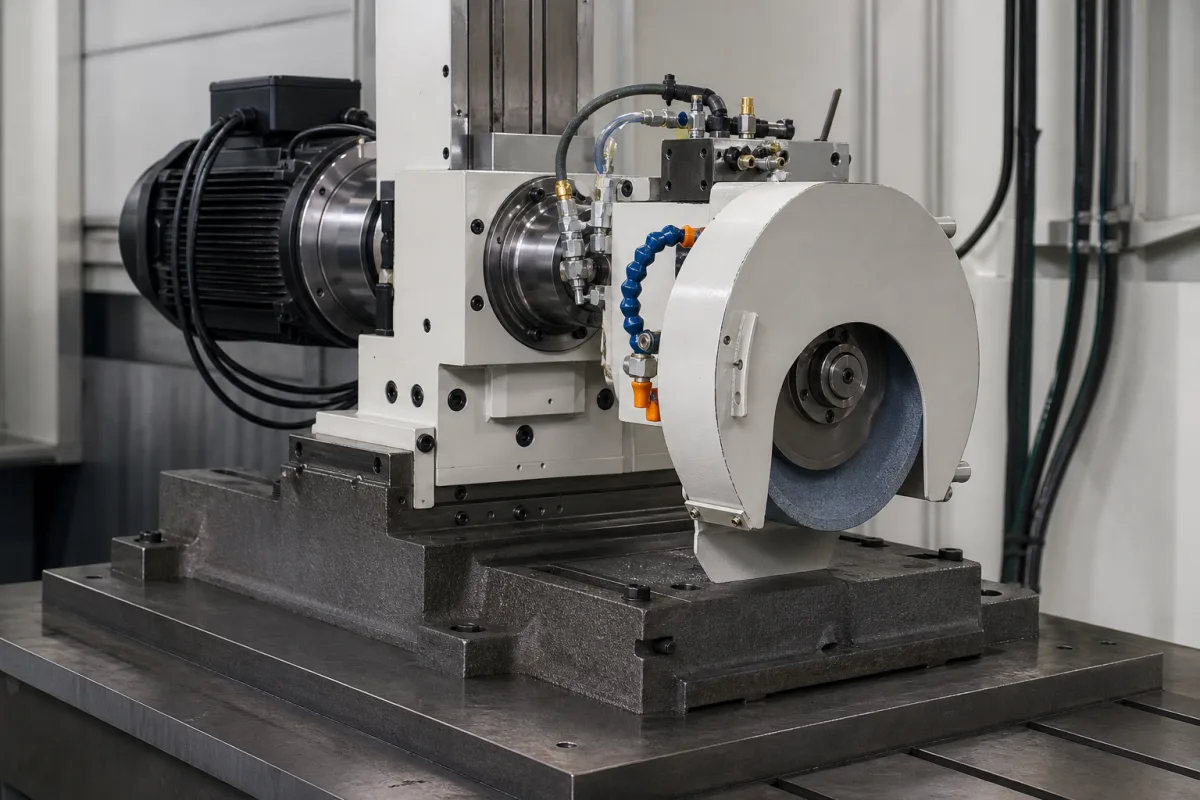
Coolant nozzle system on a grinding wheelhead: jet speed matched to wheel speed, flow per millimetre of width and nozzle placement
The coolant nozzle that rides on a grinding wheelhead · matching jet speed to wheel speed (about 4.5 bar for 30 m/s), 1.5 to 5 L/min per mm of wheel width or 8–10 L/min per kW, a 20° tangential approach, and modular hose nozzles against solid or printed steel ones
Air dragged round by a fast grinding wheel forms a barrier that throws low-pressure coolant aside before it reaches the cut. Whatever the wheel, spindle and guard on a grinding head, the nozzle mounted beside them decides whether coolant gets through that barrier. Three quantities settle it: the jet speed relative to the wheel's surface speed, the flow relative to wheel width or spindle power, and where and at what angle the jet meets the wheel.
The coolant delivery fitted to grinding wheelheads: nozzle types (modular hose, solid steel, coherent-jet, 3D-printed), jet speed and supply pressure, flow rate, nozzle position and angle, and adjustment as the wheel wears. Surface grinding machines as a whole, with tables, travels and guarding, are covered on the Surface grinding machines page; abrasive and superabrasive wheels and their speed and mounting rules on the Grinding wheel page; motorised spindle units on the Spindle assembly page. Resin metering pump and valve sets, covered on the Metering pump/valve set for resin page, and liquid-nitrogen spray headers, covered on their own page, are different products; coolant filtration and central coolant systems are not covered here.
CNFX editorial research · Sources checked October 12, 2026 · 3 sources
Jet speed equal to wheel speed: about 4.5 bar for 30 m/s, 18 bar for 60 m/s
John Webster, writing for SME as president of Cool-Grind Technologies, explains that a boundary layer of air travelling at the wheel's surface speed can deflect coolant from the grinding zone, and that matching jet speed to wheel speed is an effective way through it; since jet speed rises with the square root of pressure, doubling the speed takes four times the pressure. [3]
Editorial calculation from Bernoulli's relation p = ½ρv² for a water-based coolant (ρ ≈ 1,000 kg/m³): a 30 m/s wheel needs about 4.5 bar at the nozzle, 45 m/s about 10 bar and 60 m/s about 18 bar. Saint-Gobain's coherent-jet patent, by the same author, uses a 4.5 bar plenum pressure for a 30 m/s wheel in one example and selects nozzle size at 5 bar for 30 m/s in another. [2]
Webster notes engineers using over 200 psi (1,400 kPa) where 58 psi (406 kPa) would match a 6,000 ft/min wheel, for the wheel-cleaning effect on stringy materials such as medical stainless, Inconel and titanium. [3] The article gives 6,000 ft/min as 18,288 m/min; editorial calculation: 6,000 ft/min is 1,829 m/min, about 30.5 m/s.
UNITED GRINDING traces equal-velocity delivery to H.W. Ott in the 1980s and cites 2022 gear-profile-grinding work by Prof. Karpuschewski at IWT Bremen, at 35 m/s wheel speed and specific removal rates of 7.5 to 25 mm³/mm/s, which found the specific chip volume before dressing highest with equal velocity, and found a jet slower than the wheel more efficient than one faster than it. [1]
Give the supplier the wheel's maximum surface speed and the coolant's specific gravity, and ask for the pump pressure available at the nozzle, not at the pump.
02
Flow per millimetre of wheel width or per kilowatt, and a 20° tangential approach
Measured effectiveness is low: Webster reports that Technical University of Berlin found only 0.4 % of 3.7 L/min/mm applied was effective when grinding silicon nitride with resin-bonded diamond wheels, while the University of Massachusetts measured effective flow of 26–55 % with side shields; other work found specific grinding energy bottomed out near 0.75 L/min/mm for electroplated CBN on 52100 steel. [3]
In the patent's turbine-component example, a 100 mm wide conventional nozzle fed by a 400 L/min, 8 bar pump was replaced by coherent-jet nozzles of 10 mm and 6 mm exit diameter sized for about 136 and 49 L/min at 5 bar; the wheel then needed about 50 % less dressing. [2] Editorial calculation: 136 L/min over the 17 mm grind width of that cut is 8 L/min per mm.
UNITED GRINDING's practical setting method: retract the work, place the nozzle, run the wheel to speed, and open the coolant valve slowly until the jet clings to the wheel. [1]
State wheel width, spindle power and the grinding operation so the nozzle bore, number of nozzles and pump flow can be sized together.
03
Modular hose nozzles, solid steel and 3D-printed nozzles on an NC axis
UNITED GRINDING notes that modular plastic-segment nozzles are easy to set by hand for changing toolroom work but their tips are easily damaged, causing turbulence; stainless segment nozzles last longer, but every joint still adds turbulence and the nozzle can be knocked out of position. For high-performance grinding it describes solid steel nozzles, and 3D-printed stainless nozzles designed by flow simulation that show lower resistance at the same flow; on some of its machines the nozzle has its own NC axis to follow the wheel as dressing reduces its diameter. [1]
The Saint-Gobain patent describes nozzles with exit diameters from 1 mm to 25 mm, and a flow conditioner plate of 3.2 mm holes on 4.8 mm spacing upstream of the outlet that reduced jet dispersion by about 30 % at 15 cm. [2]
Ask whether the nozzle follows the wheel diameter as it is dressed, and how its position is fixed against knocks during setting.
04
Data for a grinding-head coolant nozzle enquiry
Paste it into your enquiry below or into an email to a maker, then replace every bracket.
Wheel: [diameter; width; maximum surface speed; abrasive and bond]
Spindle: [power; operation; removal rate]
Coolant: [type; specific gravity; pump flow and pressure at nozzle]
Nozzle: [type; bore; number; position; angle; NC tracking]
Work: [material; grind width; burn or residual stress limits]
Explore company information and manufacturing capabilities, then discuss the scope of your project with a relevant supplier.
Share this page
Compiled and source-reviewed by the CNFX editorial team.
Each manufacturer above links to the page on that company's own website where the product is listed, with the date we checked it. How we source and review
· Page last updated 13 October 2026
Buyer questions
What pressure is needed for coolant to match a 30 m/s grinding wheel?
About 4.5 bar for a water-based coolant by Bernoulli's relation, the plenum pressure used in a Saint-Gobain coherent-jet example at 30 m/s. [2]
How much coolant flow does a grinding wheel need?
UNITED GRINDING gives 1.5 to 5 L/min per mm of wheel width; Saint-Gobain's patent gives about 4 L/min per mm of contact width or 8–10 L/min per kW of spindle power. [1][2]
Where should the coolant nozzle point?
Above the wheel centre line, with the jet meeting the wheel periphery tangentially at about 20°, according to UNITED GRINDING. [1]
Should the coolant jet be faster than the wheel?
Work cited by UNITED GRINDING found equal velocity best and a jet slower than the wheel more efficient than a faster one. [1]
Sources and what still needs a direct check
Sources checked 2026-10-12. Guidance comes from a grinding-machine maker's technical blog (UNITED GRINDING), a coherent-jet nozzle patent assigned to Saint-Gobain Abrasives, and an SME article by the patent's inventor, who heads a coolant-nozzle company.