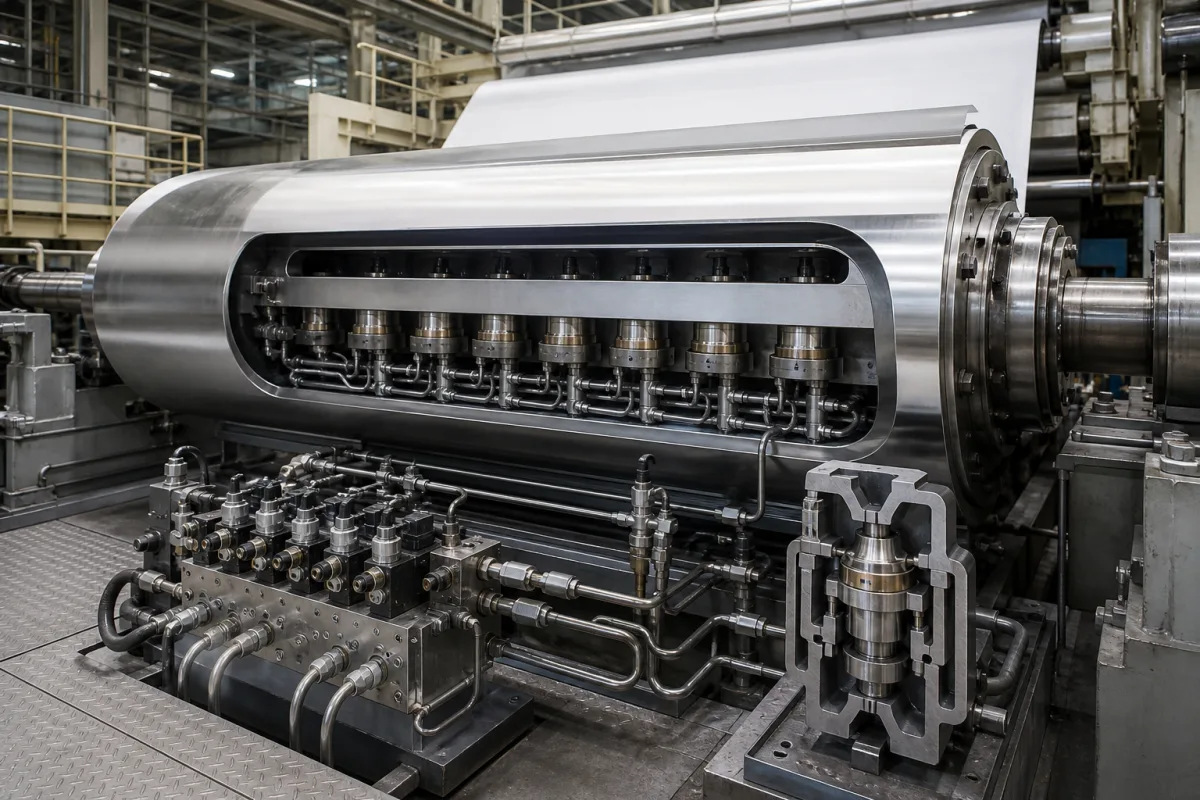
Deflection-compensated roll (swimming and zone-controlled) for calenders
Deflection-compensated rolls for calenders and presses · swimming and zone-controlled rolls, line force, width, speed and temperature
A deflection-compensated roll is a calender or press roll whose rotating shell is supported from inside, by an oil chamber or a row of hydraulic pistons, so that the nip load stays even across the width instead of sagging in the middle. Ask three things first: whether you need a swimming roll that evens the load or a zone-controlled roll that profiles it, what line force, width and speed the nip must carry, and what surface temperature and cover the roll needs.
Deflection-compensated (deflection-controlled) rolls for paper, board, nonwoven and textile calenders and roll presses: swimming rolls, zone-controlled piston rolls and their hydraulic supply. Press-brake crowning and table deflection compensation for sheet-metal bending are covered on the Hydraulic press brake page. Complete calenders and plain rolls without internal support are outside this page.
CNFX editorial research · Sources checked October 12, 2026 · 5 sources
Voith describes two kinds. Its EcoNip rolls are swimming rolls that compensate for the deflection of the mating roll and so give an even line load distribution in the nip. Its Nipco and Nipcorrect rolls are zone-controlled: the roll shell is supported by individual pistons underneath, bundled in zones and supplied with pressurized oil, and the oil pressure in each zone adjusts to hold the required cross-machine line-load profile. [1]
ANDRITZ Küsters offers three deflection-controlled roll technologies for textile calenders: the S-Roll, which it states has been proven over 20,000 times; the Raconip roll, which uses hydrostatic pistons and controls line pressure in two nips independently; and the Xpro roll, which provides profiling over the whole fabric width for technical textiles such as sailcloth. [3]
Valmet states that in its multinip calenders the profiling performance depends on the number of control zones on the deflection-compensated top and bottom rolls. [2] Editorial note: if your aim is only an even nip, a swimming roll may do; if you must correct a caliper or density profile across the web, ask for a zone-controlled roll and for the number and width of its zones.
Give the supplier the line (paper, board, nonwoven or textile), the product and its caliper or density target, nip arrangement and mating roll, working width, maximum and minimum line force, speed, surface temperature, cover type, and the profile correction you need.
02
Size the nip: line force, width, speed and temperature
ANDRITZ Küsters lists its nonwoven calenders at up to 1,250 m/min, up to 5,800 mm width and up to 150 N/mm line force, with more than 600 installed; each neXcal calender carries a deflection-controlled Hot S-Roll with surface temperature up to 275 °C. [4]
Voith gives its paper calendering range as suitable for speeds from 100 to 2,200 m/min and working widths from 2.0 to 11.0 m. [1] At the light end, ANDRITZ states that its PrimeRoll MHV technology holds cross-machine caliper control over the full width at line loads of about 5 N/mm, without external profiling devices. [5]
Editorial calculation: line force times width gives the total nip force the roll must carry. At 150 N/mm across 5,800 mm, that is 150 × 5,800 = 870,000 N, or about 870 kN; at 5 N/mm over the same width it is 29 kN. Give the supplier both the maximum and the minimum line force, since the roll is quoted against both.
03
Check the beam, shell and hydraulic supply
In a zone-controlled roll, Voith describes the shell as supported by individual pistons underneath, supplied with pressurized oil zone by zone. [1]
ANDRITZ Küsters states that all rolls and key components for its nonwoven calenders are manufactured and mechanically tested at its Krefeld facility. [4] Valmet ties stable quality in its multinip calenders to accurate loading, even surface temperatures and stable temperature control of the heating system, together with profiling by deflection-compensated rolls. [2] Editorial note: ask for the hydraulic unit, valve block and pressure range per zone, the oil and its filtration, the shell material and cover, and the test record for the roll you buy.
04
Roll principle, zone count, line-force range and references to request from roll makers
Ask each roll maker for the roll principle, the number of zones, the line-force and speed range, shell and cover, maximum surface temperature, and references on comparable lines.
05
Inner beam, support pistons, rotating shell, cover, zone hydraulics and profile control
Line force, zone oil pressure, surface temperature and profile tolerance for a calender roll
Compensation stroke and zone response time have no published values in the reviewed sources; ask for both if your line changes nip profile during a run.
Field
What it means and published values
Ask the supplier for
Rated Load Capacity (kN)
Line force × width; example up to 150 N/mm on 5,800 mm. [4]
Maximum and minimum line force.
Compensation Stroke (mm)
Shell travel available to close and profile the nip.
Paste it into your enquiry below or into an email to a maker, then replace every bracket.
Line: [paper, board, nonwoven or textile; product]
Nip: [mating roll; arrangement; number of nips]
Load: [maximum and minimum line force]
Width and speed: [working width; speed range]
Temperature: [surface temperature; heating medium]
Profile: [even nip or zoned; zone count]
Cover: [hard, soft or steel]
Documents: [roll test record; hydraulic schematic]
Explore company information and manufacturing capabilities, then discuss the scope of your project with a relevant supplier.
Share this page
Compiled and source-reviewed by the CNFX editorial team.
Each manufacturer above links to the page on that company's own website where the product is listed, with the date we checked it. How we source and review
· Page last updated 13 October 2026
Buyer questions
What is the difference between a swimming roll and a zone-controlled roll?
Voith describes swimming rolls as compensating for the mating roll's deflection to give an even line load, and zone-controlled rolls as a shell on oil-fed pistons grouped in zones that hold a set line-load profile. [1]
What line force can a nonwoven calender roll carry?
ANDRITZ Küsters lists nonwoven calenders up to 150 N/mm line force, 5,800 mm width and 1,250 m/min, with Hot S-Rolls up to 275 °C. [4]
Does the number of zones matter?
Valmet states that profiling performance depends on the number of control zones on the deflection-compensated rolls. [2]
Sources and what still needs a direct check
Sources checked 2026-10-12. Voith, Valmet and ANDRITZ Küsters are calender and roll makers describing their own technology. Their figures are for the ranges named and must be confirmed for the roll you buy.