Industry-Verified Manufacturing Data (2026)

Diverging Section

Based on aggregated insights from multiple verified factory profiles within the CNFX directory, the standard Diverging Section used in the Machinery and Equipment Manufacturing sector typically supports operational capacities ranging from standard industrial configurations to heavy-duty production requirements.

Technical Definition & Core Assembly

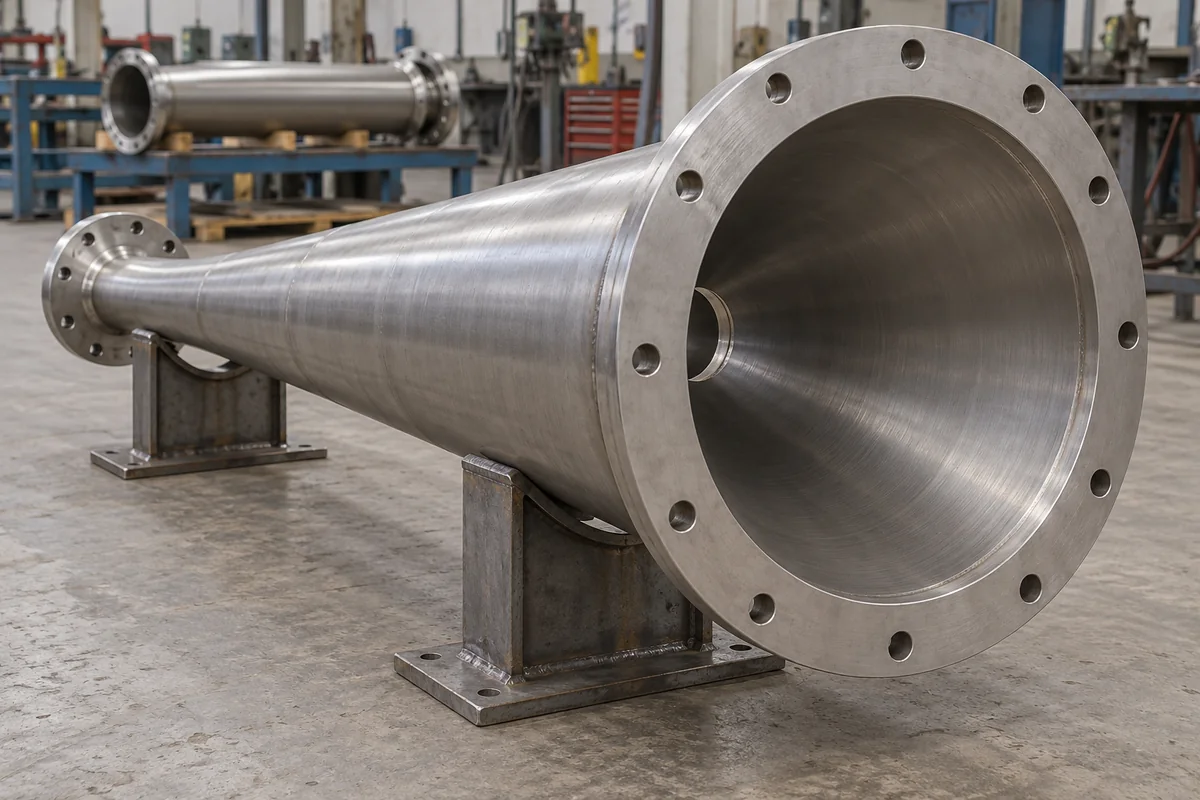
A canonical Diverging Section is characterized by the integration of Conical Wall and Flange or Connection. In industrial production environments, manufacturers listed on CNFX commonly emphasize Stainless Steel construction to support stable, high-cycle operation across diverse manufacturing scenarios.

The diverging section of a Venturi nozzle is the downstream portion where the cross-sectional area increases, causing fluid velocity to decrease and pressure to recover.
Product Specifications

Technical details and manufacturing context for Diverging Section

Definition
In a Venturi nozzle, the diverging section is the conical or gradually expanding segment located after the throat. Its primary function is to decelerate the fluid flow that has accelerated through the converging section and throat, converting kinetic energy back into pressure energy (pressure recovery). This section is critical for minimizing energy losses and ensuring efficient operation in applications like flow measurement, mixing, or spray systems.
Working Principle
The diverging section operates on the Bernoulli principle and conservation of mass. As the flow area increases, the fluid velocity decreases. According to Bernoulli's equation, this decrease in velocity results in an increase in static pressure, recovering a portion of the pressure dropped in the converging section and throat.
Common Materials
Stainless Steel, Carbon Steel, Aluminum, Plastics (e.g., PVC, PTFE)
Technical Parameters
  • Divergence angle. Typically ranges from 5 to 15 degrees to minimize flow separation and pressure loss. A common design uses a 7-degree included angle. (degrees) Standard Spec
Components / BOM
  • Conical Wall
    Forms the expanding flow passage, designed to guide fluid with minimal turbulence and boundary layer separation.
    Material: Stainless Steel
  • Flange or Connection
    Provides a sealed mechanical interface for connecting the Venturi nozzle to downstream piping or equipment.
    Material: Carbon Steel
Engineering Reasoning
0.1-10 bar inlet pressure differential, 0.5-100 m/s fluid velocity
Pressure recovery coefficient (Cp) < 0.7, boundary layer separation at 12° divergence angle threshold
Design Rationale: Boundary layer separation due to adverse pressure gradient exceeding 0.3 Pa/mm, causing flow detachment and energy dissipation
Risk Mitigation (FMEA)
Trigger Inlet flow velocity exceeding 120 m/s at 20°C water
Mode: Cavitation-induced erosion at wall surfaces
Strategy: Surface hardening to 60 HRC minimum, divergence angle optimization to 7° maximum
Trigger Solid particle contamination exceeding 50 ppm by mass
Mode: Abrasive wear at expansion interface
Strategy: Upstream 5-micron filtration, tungsten carbide coating application

Industry Taxonomies & Aliases

Commonly used trade names and technical identifiers for Diverging Section.

Applied To / Applications

This component is essential for the following industrial systems and equipment:

Industrial Ecosystem & Supply Chain DNA

Complementary Systems
Downstream Applications
Specialized Tooling

Application Fit & Sizing Matrix

Operational Limits
pressure: Up to 100 bar (design dependent)
flow rate: 0.1 to 500 L/s (size dependent)
temperature: -50°C to 200°C (dependent on material)
slurry concentration: Up to 30% solids by weight (material dependent)
Media Compatibility
✓ Water and aqueous solutions ✓ Compressed air and gases ✓ Low-viscosity industrial fluids
Unsuitable: Highly abrasive slurries with sharp particles
Sizing Data Required
  • Required flow rate (Q)
  • Upstream pressure (P1)
  • Desired pressure recovery ratio (P2/P1)

Reliability & Engineering Risk Analysis

Failure Mode & Root Cause
Abrasive erosion
Cause: High-velocity flow carrying solid particles causing material wear on internal surfaces
Cavitation
Cause: Pressure drops below vapor pressure causing vapor bubble formation and collapse, leading to pitting and material loss
Maintenance Indicators
  • Visible external leaks or weeping at flange connections
  • Abnormal vibration or audible knocking sounds during operation
Engineering Tips
  • Install upstream filtration to reduce particulate contamination and abrasive wear
  • Maintain proper flow velocities and avoid sudden pressure drops to prevent cavitation damage

Compliance & Manufacturing Standards

Reference Standards
ISO 2768-1: General tolerances for linear and angular dimensions ANSI B4.1: Preferred Limits and Fits for Cylindrical Parts DIN 7168-1: General tolerances for linear and angular dimensions
Manufacturing Precision
  • Bore diameter: +/-0.01mm
  • Surface flatness: 0.05mm
Quality Inspection
  • Coordinate Measuring Machine (CMM) dimensional verification
  • Surface roughness measurement per ISO 4287

Factories Producing Diverging Section

Verified manufacturers with capability to produce this product in China

✓ 94% Supplier Capability Match Found

T Technical Director from United Arab Emirates Jan 26, 2026
★★★★★
"Great transparency on the Diverging Section components. Essential for our Machinery and Equipment Manufacturing supply chain."
Technical Specifications Verified
P Project Engineer from Australia Jan 23, 2026
★★★★☆
"The Diverging Section we sourced perfectly fits our Machinery and Equipment Manufacturing production line requirements. (Delivery took slightly longer than expected, but technical support was excellent.)"
Technical Specifications Verified
S Sourcing Manager from Singapore Jan 20, 2026
★★★★★
"Found 54+ suppliers for Diverging Section on CNFX, but this spec remains the most cost-effective."
Technical Specifications Verified
Verification Protocol

“Feedback is collected from verified sourcing managers during RFQ (Request for Quote) and factory evaluation processes on CNFX. These reports represent historical performance data and technical audit summaries from our B2B manufacturing network.”

13 sourcing managers are analyzing this specification now. Last inquiry for Diverging Section from India (50m ago).

Supply Chain Compatible Machinery & Devices

Heavy-Duty CNC Plasma Cutting Machine

Industrial machine for precision metal cutting using plasma arc technology

Explore Specs →
Automated Assembly Line System

Integrated production system for sequential component assembly operations

Explore Specs →
Automated Powder Coating System

Integrated industrial system for applying dry powder coatings to metal substrates.

Explore Specs →
Centrifugal Pump Impeller

Rotating component that transfers energy to fluid in centrifugal pumps.

Explore Specs →

Frequently Asked Questions

What is the primary function of a diverging section in a Venturi nozzle?

The diverging section increases cross-sectional area downstream, reducing fluid velocity and recovering pressure through controlled expansion in fluid systems.

Which materials are best for corrosive fluid applications in diverging sections?

Stainless steel offers excellent corrosion resistance, while plastics like PTFE and PVC provide chemical inertness for aggressive fluids in industrial environments.

How do I select the right diverging section for my machinery application?

Consider fluid type, pressure requirements, temperature range, and compatibility with existing connections. Consult specifications for conical wall dimensions and flange types.

Can I contact factories directly on CNFX?

CNFX is an open directory, not a transaction platform. Each factory profile provides direct contact information and production details to help you initiate direct inquiries with Chinese suppliers.

Get Quote for Diverging Section

Request technical pricing, lead times, or customized specifications for Diverging Section directly from verified manufacturing units.

Your business information is encrypted and only shared with verified Diverging Section suppliers.

Thank you! Your message has been sent. We'll respond within 1–3 business days.

Need to Manufacture Diverging Section?

Connect with verified factories specializing in this product category

Add Your Factory Contact Us
Previous Product
Distribution Tray/Manifold
Next Product
Diverging Section (Outlet)