Industry-Verified Manufacturing Data (2026)

Door Interlock Switch

Based on aggregated insights from multiple verified factory profiles within the CNFX directory, the standard Door Interlock Switch used in the Machinery and Equipment Manufacturing sector typically supports operational capacities ranging from standard industrial configurations to heavy-duty production requirements.

Technical Definition & Core Assembly

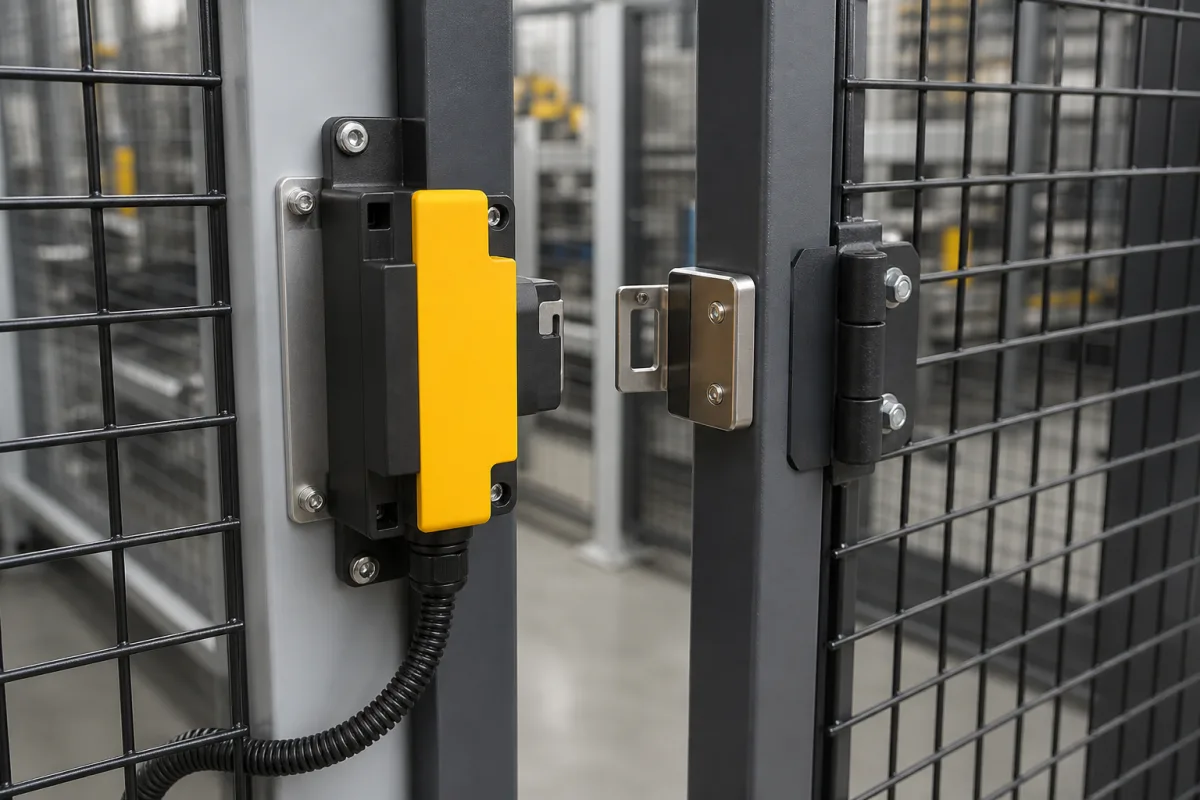
A canonical Door Interlock Switch is characterized by the integration of Actuator Head and Switch Body. In industrial production environments, manufacturers listed on CNFX commonly emphasize Stainless Steel Housing construction to support stable, high-cycle operation across diverse manufacturing scenarios.

A safety device that prevents machinery operation when access doors or guards are open
Product Specifications

Technical details and manufacturing context for Door Interlock Switch

Definition
A critical safety component within Safety Interlock Systems that monitors the position of machine access doors, guards, or panels. It ensures hazardous machinery cannot operate when protective barriers are open, preventing operator exposure to moving parts, electrical hazards, or other dangers. The switch typically interfaces with the machine's control system to interrupt power or prevent startup sequences when triggered.
Working Principle
The switch contains a mechanical actuator or sensor that detects when a door or guard is closed. When properly engaged, it completes an electrical circuit that allows machinery operation. If the door opens or the guard is removed, the circuit breaks, immediately stopping or preventing machine startup. Some versions use magnetic, inductive, or RFID sensing rather than mechanical contact.
Common Materials
Stainless Steel Housing, Copper Contacts, Polycarbonate Actuator
Technical Parameters
  • Actuator travel distance required for proper engagement (mm) Per Request
Components / BOM
  • Actuator Head
    Mechanical interface that engages with door or guard
    Material: Stainless Steel or Polycarbonate
  • Switch Body
    Houses electrical contacts and mounting hardware
    Material: Die-cast Zinc or Stainless Steel
  • Electrical Contacts
    Conduct current when switch is engaged
    Material: Silver-plated Copper
  • Spring Mechanism
    Returns actuator to safe position when disengaged
    Material: Stainless Steel
Engineering Reasoning
0.5-2.5 mm actuator displacement, 24V DC ±10% supply voltage, -25°C to +85°C ambient temperature
Actuator displacement >3.0 mm causes permanent mechanical deformation, supply voltage >28V DC damages internal electronics, ambient temperature >100°C melts thermoplastic housing
Design Rationale: Mechanical fatigue from cyclic loading at >10⁶ cycles causes spring failure, dielectric breakdown at >500V/mm in switch contacts causes arcing, thermal expansion mismatch between stainless steel actuator and ABS housing creates >0.1 mm gap at temperature extremes
Risk Mitigation (FMEA)
Trigger Corrosive atmosphere with >80% relative humidity and chloride concentration >100 ppm
Mode: Contact resistance increases from <0.1 Ω to >10 Ω within 1000 operating cycles
Strategy: Gold-plated contacts (5 μm thickness) with IP67 sealed enclosure using nitrile rubber gaskets
Trigger Mechanical shock >50g acceleration for >2 ms duration during transport or installation
Mode: Internal spring permanent set reduces actuation force from 5N to <1N
Strategy: Shock-absorbing mounting with silicone dampeners having 70 Shore A hardness and vibration isolation >15 Hz natural frequency

Industry Taxonomies & Aliases

Commonly used trade names and technical identifiers for Door Interlock Switch.

Applied To / Applications

This component is essential for the following industrial systems and equipment:

Industrial Ecosystem & Supply Chain DNA

Complementary Systems
Downstream Applications
Specialized Tooling

Application Fit & Sizing Matrix

Operational Limits
pressure: 0 to 1 bar (non-pressurized applications)
other spec: IP67 ingress protection, 10 million mechanical cycles, 500V AC/DC max voltage
temperature: -40°C to +85°C
Media Compatibility
✓ Indoor industrial environments ✓ Machinery with safety guards ✓ Clean manufacturing areas
Unsuitable: High-pressure washdown or corrosive chemical exposure
Sizing Data Required
  • Door/guard opening dimensions
  • Required safety integrity level (SIL/PL)
  • Mounting configuration and actuator type

Reliability & Engineering Risk Analysis

Failure Mode & Root Cause
Contact pitting and oxidation
Cause: Electrical arcing during switch operation, especially under high inductive loads, combined with exposure to moisture or corrosive atmospheres leading to increased contact resistance and eventual failure to conduct.
Mechanical binding or jamming
Cause: Accumulation of dust, debris, or corrosion on the actuator mechanism or pivot points, often exacerbated by misalignment during installation or wear from repeated high-impact operation.
Maintenance Indicators
  • Intermittent or delayed operation of the interlock circuit, indicated by inconsistent machine response or error codes when the door is opened/closed.
  • Visible signs of overheating such as discoloration, melting, or burning smell near the switch housing, or audible arcing/crackling sounds during actuation.
Engineering Tips
  • Install a sealed or IP-rated switch enclosure in environments with dust, moisture, or chemical exposure, and use contact protection devices (e.g., snubber circuits or relays) for inductive loads to minimize arcing.
  • Implement a regular inspection and cleaning schedule for the actuator mechanism and mounting alignment, and verify proper mechanical actuation force to prevent over-travel or impact damage.

Compliance & Manufacturing Standards

Reference Standards
ISO 13849-1: Safety of machinery - Safety-related parts of control systems ANSI/UL 508: Industrial Control Equipment EN 60947-5-1: Low-voltage switchgear and controlgear - Control circuit devices and switching elements
Manufacturing Precision
  • Actuation force: +/-10% of nominal value
  • Electrical contact resistance: <50 mΩ
Quality Inspection
  • Dielectric strength test: 1500V AC for 1 minute
  • Mechanical endurance test: 10,000 operation cycles minimum

Factories Producing Door Interlock Switch

Verified manufacturers with capability to produce this product in China

✓ 98% Supplier Capability Match Found

S Sourcing Manager from Singapore Jan 28, 2026
★★★★★
"Testing the Door Interlock Switch now; the technical reliability results are within 1% of the laboratory datasheet."
Technical Specifications Verified
P Procurement Specialist from Germany Jan 25, 2026
★★★★☆
"Impressive build quality. Especially the technical reliability is very stable during long-term operation. (Delivery took slightly longer than expected, but technical support was excellent.)"
Technical Specifications Verified
T Technical Director from Brazil Jan 22, 2026
★★★★★
"As a professional in the Machinery and Equipment Manufacturing sector, I confirm this Door Interlock Switch meets all ISO standards."
Technical Specifications Verified
Verification Protocol

“Feedback is collected from verified sourcing managers during RFQ (Request for Quote) and factory evaluation processes on CNFX. These reports represent historical performance data and technical audit summaries from our B2B manufacturing network.”

15 sourcing managers are analyzing this specification now. Last inquiry for Door Interlock Switch from Germany (1h ago).

Supply Chain Compatible Machinery & Devices

Automated Assembly Line System

Integrated production system for sequential component assembly operations

Explore Specs →
Automated Powder Coating System

Integrated industrial system for applying dry powder coatings to metal substrates.

Explore Specs →
Centrifugal Pump Impeller

Rotating component that transfers energy to fluid in centrifugal pumps.

Explore Specs →
High-Precision CNC Laser Cutting Machine

Computer-controlled industrial machine using focused laser beams to cut sheet metal with micron-level accuracy.

Explore Specs →

Frequently Asked Questions

What is the purpose of a door interlock switch in machinery?

A door interlock switch is a safety device that prevents machinery from operating when access doors, panels, or guards are open, protecting operators from hazardous moving parts during maintenance or inspection.

What materials are used in this door interlock switch and why?

This switch features a stainless steel housing for corrosion resistance and durability, copper contacts for reliable electrical conductivity, and a polycarbonate actuator for impact resistance and clear visibility of the switch position.

How does the spring mechanism in the door interlock switch work?

The spring mechanism ensures positive contact engagement when the door is closed and automatic disengagement when opened, providing fail-safe operation that interrupts power to machinery controls when access is detected.

Can I contact factories directly on CNFX?

CNFX is an open directory, not a transaction platform. Each factory profile provides direct contact information and production details to help you initiate direct inquiries with Chinese suppliers.

Get Quote for Door Interlock Switch

Request technical pricing, lead times, or customized specifications for Door Interlock Switch directly from verified manufacturing units.

Your business information is encrypted and only shared with verified Door Interlock Switch suppliers.

Thank you! Your message has been sent. We'll respond within 1–3 business days.

Need to Manufacture Door Interlock Switch?

Connect with verified factories specializing in this product category

Add Your Factory Contact Us
Previous Product
Door and Seal
Next Product
Dose Memory Buffer