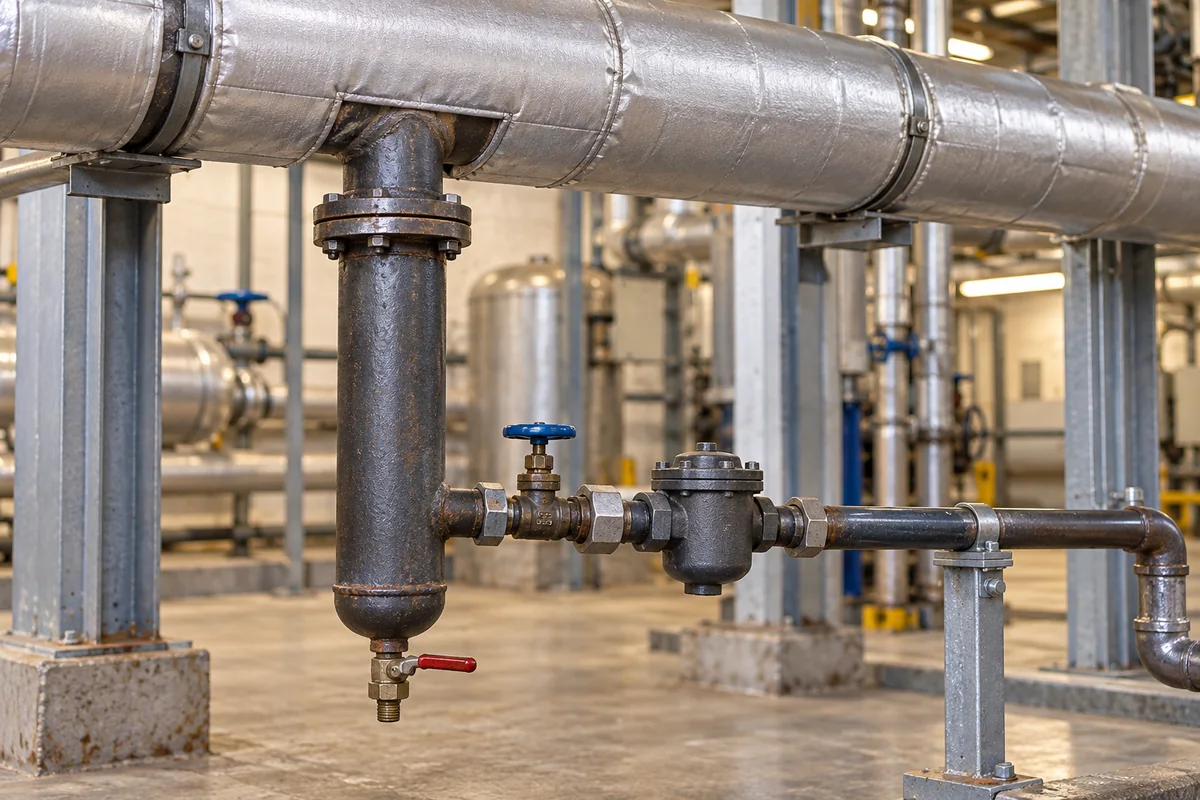
Drip leg on a steam main: sizing the condensate collecting pocket, its mud leg and the trap take-off
The collecting pocket under a steam main, not the trap that drains it · pocket diameter against main size, depth for warm-up, mud leg and spacing along the line
A drip leg is the vertical length of pipe welded to the underside of a steam main where condensate running along the bottom of the pipe falls out of the steam flow and collects before it reaches the trap. The trap itself is a separate device; what the drip leg decides is whether the condensate gets captured at all. Its diameter has to be wide enough that fast-moving water drops into it instead of sliding past, its depth has to hold the slug of water released at start-up and provide head to push it through the trap, and the trap connection has to sit above the bottom so scale settles in a mud leg instead of reaching the trap orifice.
Fabricated condensate collecting pockets (drip legs, drain pockets) on steam distribution mains and branch lines: the pocket pipe, the bottom cap with its blowdown valve, the side take-off to the trap station and the placement of pockets along the main. Steam trap types, trap selection and trap testing are covered on the Steam trap page; flash vessels, receivers and return pumps are covered on the Condensate recovery system with flash steam vessel page. Air-conditioning condensate drain traps are a different product and are outside this page.
CNFX editorial research · Sources checked October 12, 2026 · 3 sources
Pocket diameter against main size in three published rules: Armstrong, TLV and Duke University
TLV explains why the pocket is wider than the trap: trap connections outside heating and process duty range between 15 mm (1/2 in) and 25 mm (1 in), and if the trap pipe is tied straight to a much larger main, fast-flowing condensate can run past the narrow opening instead of dropping into it. [2] Armstrong adds that a drip leg that is too small can create a venturi "piccolo" effect in which pressure drop pulls condensate back out of the leg and the trap. [1] The three rules below agree up to 4 in and then diverge on large mains.
The differences matter on an 8 in main: Armstrong and TLV both list a 4 in (100 mm) pocket, while Duke's campus standard asks for at least 6 in because its floor for pipes over 6 in NPS is 6 in. [1][2][3] TLV itself notes that alternative drip leg sizing may apply by location and names ASHRAE's steam system design guidance as one example, so the governing piping specification for the site has to be named in the order. [2]
Editorial calculation: on a 24 in main the Armstrong pocket is 12 in, half the main; the TLV sample table stops at 200 mm (8 in) for mains of 300 mm and above, which is one third of a 600 mm main.
Pocket depth for supervised and automatic warm-up, and the 20–50 mm mud leg below the trap take-off
Depth is set by start-up. Armstrong's drip leg table for its 401-SH/501-SH superheat traps gives two minimum lengths for each main size, one for supervised warm-up and one for automatic warm-up; the automatic figure is the longer or equal one in every row. [1] TLV adds that the collecting leg is especially important at start-up, when slugs of condensate from warming the pipe or from previously closed valves arrive. [2]
Editorial calculation: a 28 in column of cold water exerts about 1.0 psi (28 ÷ 27.7 in of water per psi), so the automatic warm-up length gives the trap roughly one psi of static head to discharge against before steam pressure has built up in the main.
TLV writes depth as a ratio for small mains, L ≥ 1.5 × d1 for mains up to 100 mm, then as fixed minimums: at least 150 mm (6 in) for 125–200 mm mains, 275 mm (9 in) for 250–300 mm mains and 300 mm (12 in) from 300 mm upward. [2] It places the trap connection 20 to 50 mm (3/4 to 2 in) above the bottom of the pocket so dirt and scale stay in a mud leg, with a blowdown valve on the mud leg cover for removing it, and asks that the pocket hold both the mud leg and the condensate that backs up between trap cycles. [2] Duke University's standard asks for drip legs 12–18 in long unless space prevents it. [3]
Armstrong notes that on superheat and high-pressure, low-load service what little condensate there is “usually forms in drip legs and in the traps themselves,” so adequate drip leg diameter and depth are a condition for its superheat trap to work. [1]
Editorial note: Armstrong's 28 in figure is a minimum length in its table, while TLV's 1.5 × d1 and Duke's 12–18 in are separate rules; state which warm-up mode the main uses and which rule the pocket is fabricated to.
03
Where pockets go on the main: 30–50 m runs, ahead of valves, at risers and at the end of the line
TLV calls for a trap point at least every 30 to 50 m (100 to 160 ft) even on a straight run, at the bottom of risers and drops, immediately ahead of pressure-reducing and control valves, ahead of manual valves that stay closed for long periods and at the end of the main, where an air vent is also needed. [2] It gives steam velocities in distribution piping that can exceed 30 m/s (100 ft/s), which is why condensate that fills the pipe cross-section can be driven as a water-hammer slug. [2]
Duke University's underground steam standard places collecting pockets at intervals no greater than 300 ft and at every steam pipe elevation change, puts a trap station on each drip leg and requires drip legs and trap stations to be reachable through a manhole. [3] Each trap on that system is installed with an upstream isolation valve, a strainer with blowdown valve, a downstream spring-assisted in-line check valve and isolation valve, and unions on either side of the trap. [3] Editorial calculation: 300 ft is about 91 m, so Duke's maximum spacing is nearly twice the upper end of TLV's 30–50 m interval.
TLV also asks for a slope of no less than 1 in 100 and pipe supports close enough that the main does not sag between hangers, since a deflected pipe pools condensate away from the pockets. [2]
04
Data for a drip leg fabrication or retrofit
Paste it into your enquiry below or into an email to a maker, then replace every bracket.
Main: [nominal size; schedule and material; steam pressure and temperature; saturated or superheated]
Pocket: [diameter; length; sizing rule to follow]
Warm-up: [supervised or automatic]
Mud leg: [take-off height above the bottom; blowdown valve size and type on the cap]
Take-off: [connection size and type to the trap station; isolation valve]
Location: [position on the main: run, riser foot, ahead of a control valve, end of main; access]
Explore company information and manufacturing capabilities, then discuss the scope of your project with a relevant supplier.
Share this page
Compiled and source-reviewed by the CNFX editorial team.
Each manufacturer above links to the page on that company's own website where the product is listed, with the date we checked it. How we source and review
· Page last updated 13 October 2026
Buyer questions
Why not connect the trap directly to the bottom of the steam main?
TLV notes trap connections of 15–25 mm are narrow next to a large main, so fast condensate can run past them; a wider pocket lets it drop out. Armstrong warns an undersized leg can create a venturi effect that pulls condensate back out. [2][1]
What drip leg diameter goes on a 12 in steam main?
Armstrong's table and TLV's sample table both give 6 in (150 mm); Duke University's standard asks for at least half the main and not less than 6 in. [1][2][3]
How long should the drip leg be?
Armstrong lists 28 in (710 mm) minimum for automatic warm-up on mains up to 18 in, and 10–36 in for supervised warm-up depending on main size; TLV uses at least 1.5 × pocket diameter on mains up to 100 mm. [1][2]
How far apart should drip legs be?
TLV gives every 30 to 50 m (100 to 160 ft) plus risers, valves and the end of the main; Duke University's standard sets a maximum of 300 ft and a pocket at every elevation change. [2][3]
Sources and what still needs a direct check
Sources checked 2026-10-12. Pocket diameter and warm-up lengths come from Armstrong's 401-SH/501-SH data sheet; take-off height, mud leg and placement from TLV's steam-line guidance; spacing, elevation changes and trap-station make-up from Duke University's construction standard for underground steam.