Industry-Verified Manufacturing Data (2026)

Drive Mechanism (e.g., Ball Screw Nut Housing)

Based on aggregated insights from multiple verified factory profiles within the CNFX directory, the standard Drive Mechanism (e.g., Ball Screw Nut Housing) used in the Machinery and Equipment Manufacturing sector typically supports operational capacities ranging from standard industrial configurations to heavy-duty production requirements.

Technical Definition & Core Assembly

A canonical Drive Mechanism (e.g., Ball Screw Nut Housing) is characterized by the integration of Housing Body and Ball Nut Seat. In industrial production environments, manufacturers listed on CNFX commonly emphasize Cast Iron construction to support stable, high-cycle operation across diverse manufacturing scenarios.

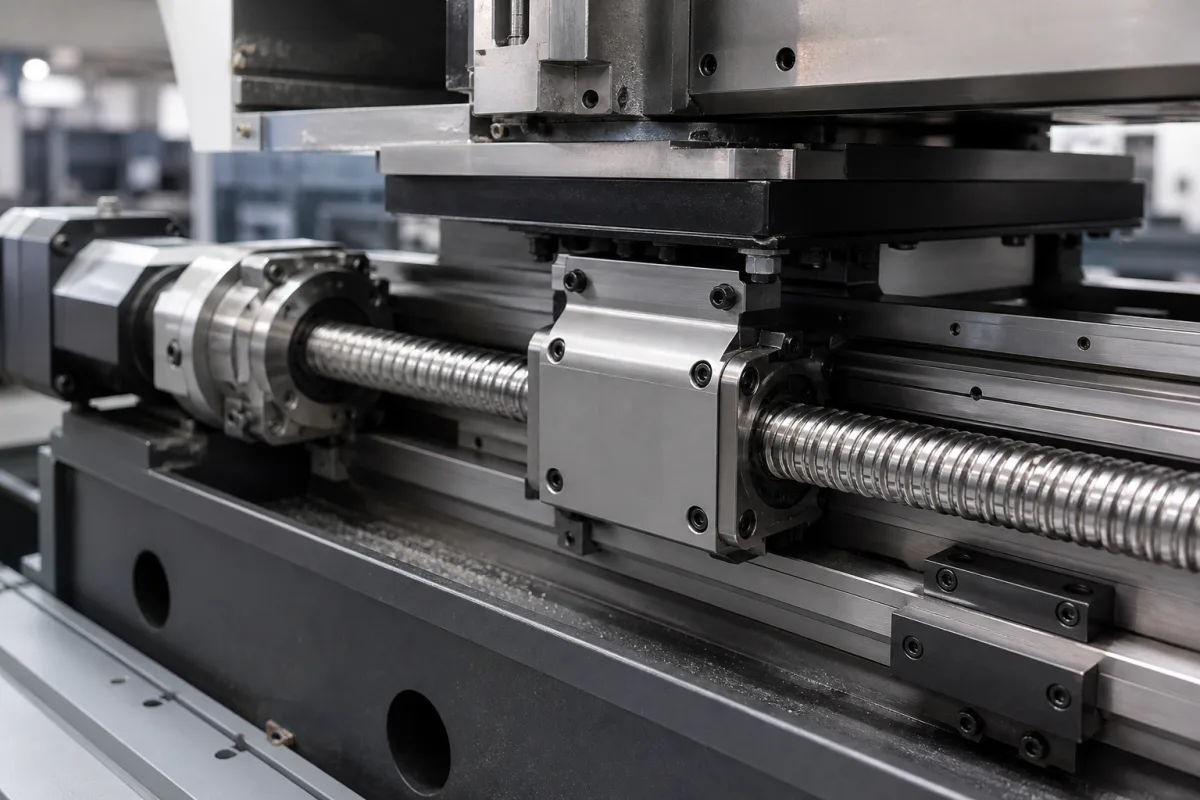
A mechanical assembly that converts rotary motion into precise linear motion to position the cutting tool carriage.
Product Specifications

Technical details and manufacturing context for Drive Mechanism (e.g., Ball Screw Nut Housing)

Definition
The drive mechanism, specifically exemplified by a ball screw nut housing, is a critical component within a cutting tool carriage system. It houses the ball screw nut and provides the structural interface that translates the rotational force from the motor into controlled, high-precision linear movement of the carriage along its axis, enabling accurate tool positioning for machining operations.
Working Principle
A motor rotates the ball screw. The ball nut, constrained within its housing which is fixed to the carriage, converts this rotation into linear motion via recirculating ball bearings, moving the entire cutting tool carriage assembly along the screw's axis with minimal friction and high efficiency.
Common Materials
Cast Iron, Steel, Aluminum Alloy
Technical Parameters
  • Lead (linear travel per screw revolution) and nominal diameter of the ball screw. (mm) Customizable
Components / BOM
  • Housing Body
    Provides the main structural enclosure and mounting points.
    Material: Cast Iron or Steel
  • Ball Nut Seat
    Precisely locates and supports the ball screw nut within the housing.
    Material: Steel
  • Seals / Wipers
    Prevent contamination from entering and retain lubrication within the nut housing.
    Material: Synthetic Rubber or Polyurethane
  • Mounting Flange
    Interface for bolting the assembly to the cutting tool carriage.
    Material: Same as Housing Body
Engineering Reasoning
0.5-2.5 m/s linear velocity, 0.01-0.05 mm positioning accuracy, 20-80°C operating temperature
Ball screw nut preload loss at 0.001 mm backlash, recirculation system failure at 10⁷ cycles, housing deformation at 150 MPa stress
Design Rationale: Hertzian contact fatigue at ball-raceway interface (σ_max = 3.2 GPa), thermal expansion mismatch (Δα = 12×10⁻⁶ K⁻¹), lubricant starvation at 40 μm film thickness
Risk Mitigation (FMEA)
Trigger Contaminant ingress (ISO 4406 Class 18/16/13)
Mode: Abrasive wear at ball screw-nut interface (Ra > 0.8 μm)
Strategy: Integral wiper seals with 0.5 μm filtration, positive pressure purge system at 0.2 bar
Trigger Axial preload relaxation (ΔF = 15% nominal)
Mode: Positioning hysteresis exceeding 5 μm
Strategy: Double-nut preload adjustment mechanism with Belleville washers, laser interferometer calibration at 0.1 μm resolution

Industry Taxonomies & Aliases

Commonly used trade names and technical identifiers for Drive Mechanism (e.g., Ball Screw Nut Housing).

Applied To / Applications

This component is essential for the following industrial systems and equipment:

Industrial Ecosystem & Supply Chain DNA

Complementary Systems
Downstream Applications
Specialized Tooling

Application Fit & Sizing Matrix

Operational Limits
pressure: Max 10 MPa
other spec: Max axial load: 15 kN, Max speed: 3000 rpm
temperature: -20°C to 120°C
Media Compatibility
✓ Lubricating oils ✓ Water-glycol hydraulic fluids ✓ Dry air environments
Unsuitable: Abrasive slurry or high particulate concentration
Sizing Data Required
  • Required linear travel distance
  • Maximum axial load
  • Required positioning accuracy

Reliability & Engineering Risk Analysis

Failure Mode & Root Cause
Backlash and Positioning Inaccuracy
Cause: Wear in ball screw threads or ball recirculation system due to insufficient lubrication, contamination ingress, or excessive axial loads causing ball deformation or track damage.
Ball Screw Seizure or Binding
Cause: Contamination (dust, metal particles) entering the nut housing, leading to ball jamming; or thermal expansion mismatches between screw and housing under high-speed operation causing interference fits.
Maintenance Indicators
  • Audible grinding or clicking noises during operation, indicating ball damage or contamination in the recirculation path.
  • Visible metal flakes or discolored lubricant around the nut housing, suggesting accelerated wear or overheating.
Engineering Tips
  • Implement a strict lubrication regimen with high-quality grease specifically designed for ball screws, ensuring proper seals to prevent contamination ingress.
  • Install protective bellows or covers to shield the screw from environmental contaminants, and regularly check alignment and preload to avoid uneven loading and premature wear.

Compliance & Manufacturing Standards

Reference Standards
ISO 3408-1:2006 (Ball screws - Part 1: Vocabulary and designation) ANSI B5.48-1977 (Ball Screws) DIN 69051-1:2018 (Ball screw drives - Part 1: General characteristics, definitions, designations)
Manufacturing Precision
  • Bore diameter tolerance: +/-0.01mm
  • Lead accuracy: +/-0.005mm per 300mm
Quality Inspection
  • Dimensional accuracy verification using CMM (Coordinate Measuring Machine)
  • Hardness testing of ball screw nut housing material

Factories Producing Drive Mechanism (e.g., Ball Screw Nut Housing)

Verified manufacturers with capability to produce this product in China

✓ 92% Supplier Capability Match Found

T Technical Director from United States Feb 11, 2026
★★★★★
"As a professional in the Machinery and Equipment Manufacturing sector, I confirm this Drive Mechanism (e.g., Ball Screw Nut Housing) meets all ISO standards."
Technical Specifications Verified
P Project Engineer from United Arab Emirates Feb 08, 2026
★★★★☆
"Standard OEM quality for Machinery and Equipment Manufacturing applications. The Drive Mechanism (e.g., Ball Screw Nut Housing) arrived with full certification. (Delivery took slightly longer than expected, but technical support was excellent.)"
Technical Specifications Verified
S Sourcing Manager from Australia Feb 05, 2026
★★★★★
"Great transparency on the Drive Mechanism (e.g., Ball Screw Nut Housing) components. Essential for our Machinery and Equipment Manufacturing supply chain."
Technical Specifications Verified
Verification Protocol

“Feedback is collected from verified sourcing managers during RFQ (Request for Quote) and factory evaluation processes on CNFX. These reports represent historical performance data and technical audit summaries from our B2B manufacturing network.”

11 sourcing managers are analyzing this specification now. Last inquiry for Drive Mechanism (e.g., Ball Screw Nut Housing) from Mexico (1h ago).

Supply Chain Compatible Machinery & Devices

Hydraulic Press

Industrial machine using hydraulic pressure to compress, form, or assemble materials

Explore Specs →
Heavy-Duty CNC Plasma Cutting Machine

Industrial machine for precision metal cutting using plasma arc technology

Explore Specs →
Automated Assembly Line System

Integrated production system for sequential component assembly operations

Explore Specs →
Automated Powder Coating System

Integrated industrial system for applying dry powder coatings to metal substrates.

Explore Specs →

Frequently Asked Questions

What materials are available for the ball screw nut housing?

Our drive mechanism housings are manufactured in cast iron for maximum durability, steel for high-strength applications, and aluminum alloy for lightweight precision machinery requirements.

How does this drive mechanism ensure precise linear motion?

The ball screw nut housing converts rotary motion into linear motion with minimal backlash through precision-ground ball screws and rigid housing construction, achieving positioning accuracy critical for cutting tool operations.

What maintenance is required for the seals and wipers in this assembly?

Regular inspection and replacement of seals and wipers are recommended to prevent contamination and maintain lubrication. The modular BOM design allows easy access to these components without disassembling the entire housing.

Can I contact factories directly on CNFX?

CNFX is an open directory, not a transaction platform. Each factory profile provides direct contact information and production details to help you initiate direct inquiries with Chinese suppliers.

Get Quote for Drive Mechanism (e.g., Ball Screw Nut Housing)

Request technical pricing, lead times, or customized specifications for Drive Mechanism (e.g., Ball Screw Nut Housing) directly from verified manufacturing units.

Your business information is encrypted and only shared with verified Drive Mechanism (e.g., Ball Screw Nut Housing) suppliers.

Thank you! Your message has been sent. We'll respond within 1–3 business days.

Need to Manufacture Drive Mechanism (e.g., Ball Screw Nut Housing)?

Connect with verified factories specializing in this product category

Add Your Factory Contact Us
Previous Product
Drive Mechanism (Actuator)
Next Product
Drive Mechanism (e.g., Ball Screw)