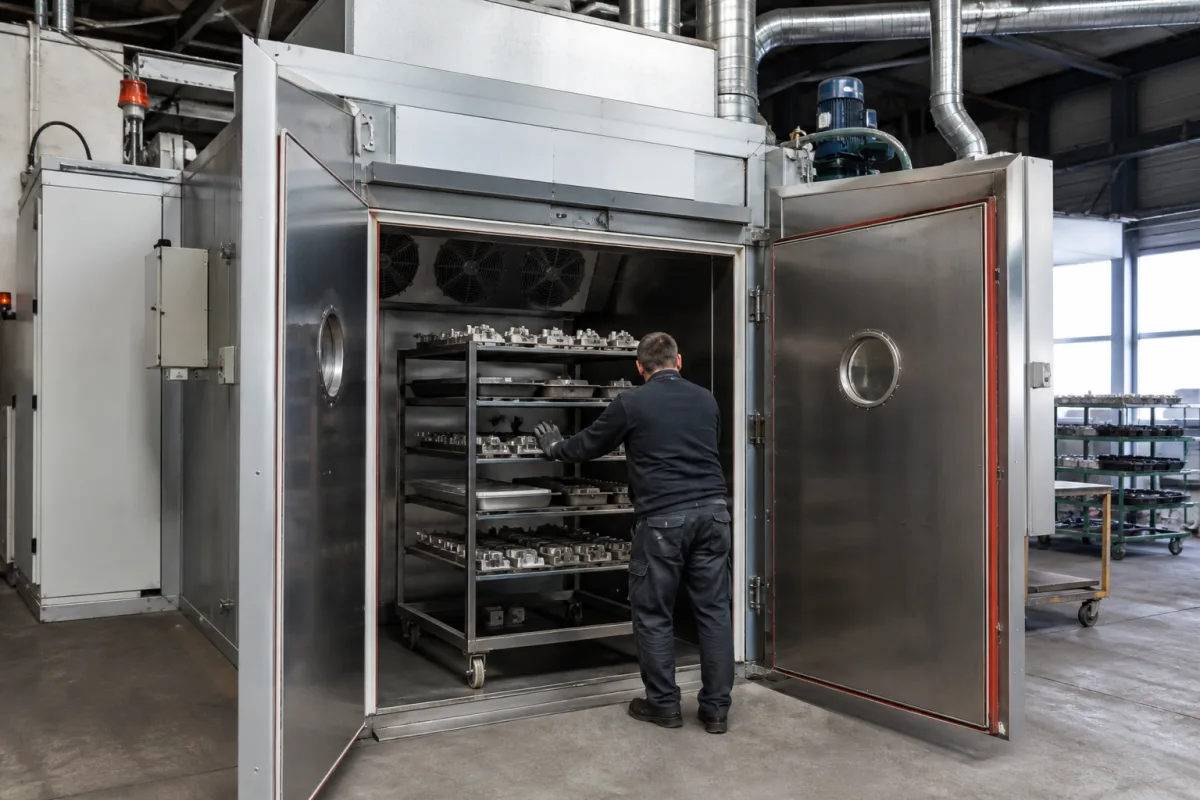
Drying chamber (closed-loop condensation dryer: a rack or trolley chamber fed with heat-pump dehumidified air at 20-90 °C)
Closed-loop condensation drying chambers · heat-pump dehumidification module, 20-90 °C process air, no exhaust or fresh air, rack and trolley loading, blow-off before drying, stain-free drying of washed parts
A drying chamber here is an insulated rack or trolley chamber connected to a dehumidification module: humid air is drawn out, cooled until its water condenses, reheated and blown back in, so the chamber runs without fresh air or exhaust and dries at low temperatures. Ask three things first: what temperature the parts or products tolerate, how much water they bring in and how fast it must go, and how the air is routed through the loaded trolley.
Condensation (heat-pump dehumidification) drying chambers and cabinet dryers with a closed air loop, for washed or coated parts and for food, at roughly 20-90 °C. Hot-air walk-in and truck-in drying ovens with exhaust and make-up air are covered on the Walk-in and truck-in drying oven for racked parts page; pharmaceutical freeze dryers are covered on the Pharmaceutical freeze dryer (lyophilizer) page; plastic centrifugal dryers and refrigeration racks for cold stores are outside this page.
CNFX editorial research · Sources checked October 12, 2026 · 3 sources
Inside the loop: precooler, air cooler, condensate drain and reheater
Harter's Airgenex brochure sets out the loop in seven steps: humid air is extracted from the drying chamber into the dehumidification module; a precooler cools it first, which "largely reduces the power consumption of the compressor"; the moisture precipitates on the air cooler fins and leaves through the condensate collector and drain; a preheater rewarms the cooled, dry air "with no external energy input"; an air heater brings it to process temperature; and the process air fan returns the dry, unsaturated air to the chamber. It describes drying "in a closed system; there is no interchange with ambient air and, thus, no dependence from the climate", at temperatures "variable between 20 °C and 90 °C". [1]
Harter's food-drying brochure adds that the dry air from the module mixes in the chamber with a controllable main recirculation air that passes over or through the products for uniform drying, with optional vertical or horizontal routing through the trolley, and lists F7 to F9 air filters on the module. It gives 20-75 °C for food, with temperatures up to 100 °C selectable, so the stated range depends on the application brochure; confirm the range for your product with the maker. [2]
Give the dryer maker the product and its maximum temperature, wet load per batch (water or rinse carried in), required drying time, part geometry and pockets that hold water, rack or trolley size and number, available floor space, power and cooling water, any blow-off step, cleanroom or hygiene requirements, and whether the condensate needs treatment.
02
Racks, blow-off and drying time for washed parts
Oberfläche (mo magazine) reports that Harter's condensation drying uses "extremely dry and unsaturated air" in an air-closed system at 20-90 °C, for batch or continuous operation, and gives one example in which components are first blown off without compressed air at 60 °C and then "completely dried within five minutes". [3] Harter's brochure lists chamber, rack, basket, cabinet, barrel and conveyor configurations and uses non-compressed-air blowing "for special applications, as a preliminary stage to drying proper". [1]
Harter runs trial drying in its own pilot station to set temperature, time, humidity, air speed and airflow for a product before design. [1] Its food brochure shows a stainless steel (1.4301) rack trolley with castors and tabulates container counts and useful volume per trolley. [2]
03
Chamber, dehumidification module, recirculation fan and condensate line
Part
Role
State in the order
Drying chamber
Holds racks or trolleys; main recirculation inside. [2]
Explore company information and manufacturing capabilities, then discuss the scope of your project with a relevant supplier.
Share this page
Compiled and source-reviewed by the CNFX editorial team.
Each manufacturer above links to the page on that company's own website where the product is listed, with the date we checked it. How we source and review
· Page last updated 13 October 2026
Buyer questions
How is a condensation drying chamber different from a hot-air drying oven?
It dries in a closed loop with dehumidified air and no exhaust; hot-air walk-in ovens with exhaust and make-up air are on the Walk-in and truck-in drying oven page. [1]
What temperature does it run at?
Harter gives 20-90 °C for its Airgenex parts dryers and 20-75 °C, up to 100 °C, in its food brochure. [1][2]
Where does the water go?
It condenses on the air cooler fins in the dehumidification module and leaves through the condensate drain. [1]
How fast can washed parts dry?
One reported example dried parts within five minutes after a blow-off at 60 °C. [3]
Sources and what still needs a direct check
Sources checked 2026-10-12. Harter publishes its Airgenex parts-drying brochure and a food-drying brochure; mo magazine (oberflaeche.de) reported a Harter drying example.