Industry-Verified Manufacturing Data (2026)

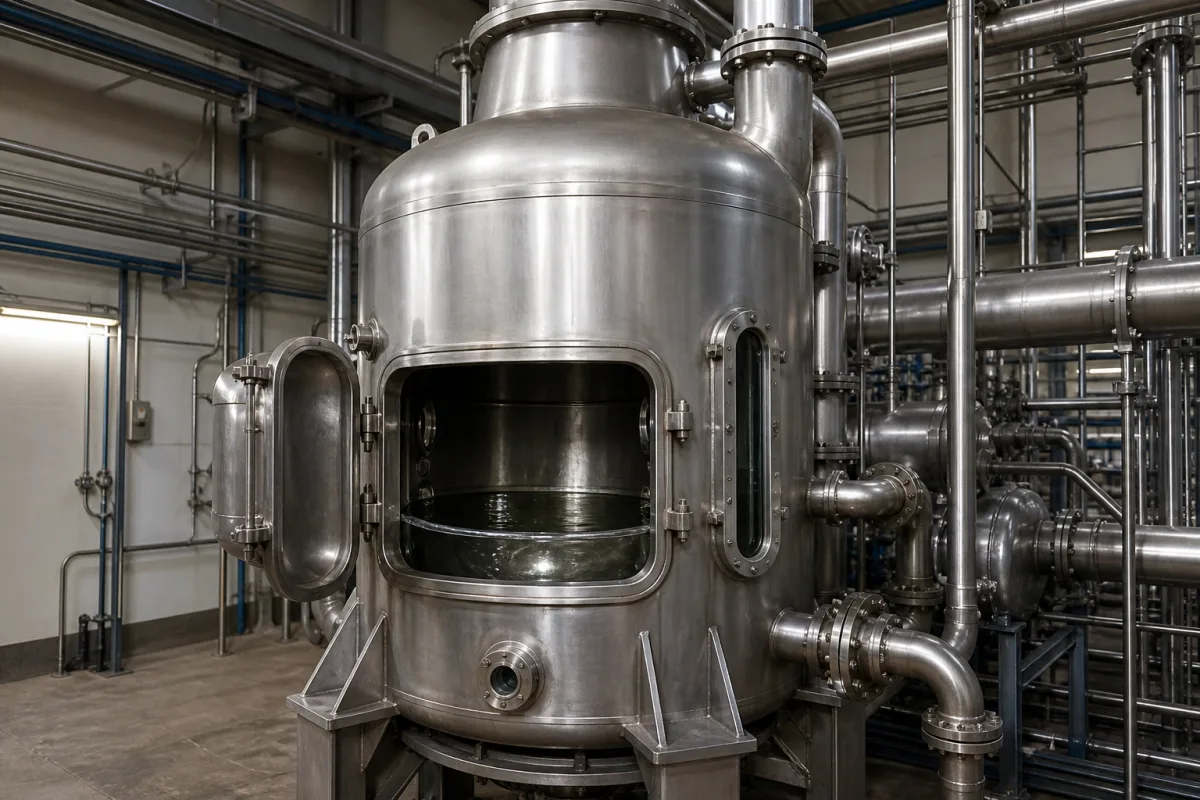
Evaporator Body/Vessel

Based on aggregated insights from multiple verified factory profiles within the CNFX directory, the standard Evaporator Body/Vessel used in the Machinery and Equipment Manufacturing sector typically supports operational capacities ranging from standard industrial configurations to heavy-duty production requirements.

Technical Definition & Core Assembly

A canonical Evaporator Body/Vessel is characterized by the integration of Shell Plate and Dished Ends. In industrial production environments, manufacturers listed on CNFX commonly emphasize Stainless Steel 316L construction to support stable, high-cycle operation across diverse manufacturing scenarios.

The main pressure vessel that contains the liquid to be concentrated under vacuum conditions in an evaporator system.
Product Specifications

Technical details and manufacturing context for Evaporator Body/Vessel

Definition
The evaporator body/vessel is the primary containment structure in a multi-stage vacuum evaporator train, designed to withstand vacuum pressure while housing the liquid feed, heating surfaces, and vapor separation mechanisms. It provides the controlled environment where evaporation occurs through heat transfer and pressure reduction.
Working Principle
The vessel maintains a vacuum environment to lower the boiling point of the liquid inside. Heat is transferred through internal surfaces (like tubes or plates) to evaporate water or solvents, while the vacuum system removes vapor, allowing continuous concentration of the remaining liquid.
Common Materials
Stainless Steel 316L, Duplex Stainless Steel, Nickel Alloys
Technical Parameters
  • Diameter and height of the cylindrical vessel section (mm) Standard Spec
Components / BOM
  • Shell Plate
    Forms the main cylindrical body providing structural integrity and containment
    Material: Stainless Steel
  • Dished Ends
    Hemispherical or elliptical ends that distribute pressure stresses
    Material: Stainless Steel
  • Manway
    Access opening for inspection, maintenance, and cleaning
    Material: Stainless Steel with Seal
  • Nozzles and Connections
    Inlets for feed, outlets for concentrate and vapor, instrument connections
    Material: Stainless Steel
  • Support Skirt/Legs
    Structural supports that transfer vessel weight to foundation
    Material: Carbon Steel or Stainless Steel
Engineering Reasoning
0.1-1.5 bar absolute pressure, 40-120°C temperature
Yield stress of 250 MPa for 316L stainless steel at 120°C, corresponding to 15 bar internal pressure
Design Rationale: Von Mises stress exceeding material yield strength due to pressure differential across vessel walls, governed by thin-walled pressure vessel equation: σ = (P·r)/(2·t) where P=pressure, r=radius, t=wall thickness
Risk Mitigation (FMEA)
Trigger Vacuum pump failure causing pressure rise to 2 bar absolute
Mode: Vessel wall deformation exceeding 0.2% strain limit
Strategy: Dual redundant vacuum pumps with pressure interlock at 1.8 bar
Trigger Thermal cycling between 40°C and 120°C at 10 cycles/hour
Mode: Fatigue crack initiation at weld seams after 10^5 cycles
Strategy: Post-weld heat treatment to 1050°C followed by rapid quenching to reduce residual stresses below 100 MPa

Industry Taxonomies & Aliases

Commonly used trade names and technical identifiers for Evaporator Body/Vessel.

Applied To / Applications

This component is essential for the following industrial systems and equipment:

Industrial Ecosystem & Supply Chain DNA

Complementary Systems
Downstream Applications
Specialized Tooling

Application Fit & Sizing Matrix

Operational Limits
pressure: Full vacuum to 10 bar (typical), up to 25 bar with reinforced design
flow rate: 5-500 m³/hr (process dependent)
temperature: -20°C to 200°C (typical), up to 300°C with special materials
slurry concentration: Up to 40% solids by weight (typical), higher with agitation
Media Compatibility
✓ Food/beverage syrups ✓ Pharmaceutical concentrates ✓ Chemical process solutions
Unsuitable: Highly corrosive chlorides at elevated temperatures
Sizing Data Required
  • Required evaporation capacity (kg/hr)
  • Inlet feed concentration (% solids)
  • Operating vacuum/pressure conditions

Reliability & Engineering Risk Analysis

Failure Mode & Root Cause
Stress corrosion cracking
Cause: Combination of tensile stress from internal pressure/thermal cycling and corrosive environment from process fluids, often accelerated by chlorides or sulfides in the medium.
Localized pitting corrosion
Cause: Concentration cells formed by deposits, scale, or stagnant zones on internal surfaces, leading to accelerated metal loss in specific areas, often exacerbated by high chloride content or microbiological activity.
Maintenance Indicators
  • Visible weeping or leakage at welds or shell seams, indicating through-wall defects
  • Abnormal vibration or audible 'cracking' noises during thermal cycles, suggesting stress-related issues or internal component failure
Engineering Tips
  • Implement regular internal inspections using advanced NDT methods like phased array ultrasonic testing to detect early-stage cracking and wall thinning before failure occurs
  • Maintain strict water chemistry control and implement proper chemical treatment programs to minimize scaling and corrosive conditions, combined with routine cleaning to prevent deposit accumulation

Compliance & Manufacturing Standards

Reference Standards
ISO 9001:2015 - Quality Management Systems ASME BPVC Section VIII - Rules for Construction of Pressure Vessels PED 2014/68/EU - Pressure Equipment Directive
Manufacturing Precision
  • Bore Diameter: +/-0.05mm
  • Flatness of Flange Faces: 0.1mm per 300mm diameter
Quality Inspection
  • Hydrostatic Pressure Test
  • Liquid Penetrant Testing (PT)

Factories Producing Evaporator Body/Vessel

Verified manufacturers with capability to produce this product in China

✓ 95% Supplier Capability Match Found

S Sourcing Manager from Brazil Feb 13, 2026
★★★★★
"Great transparency on the Evaporator Body/Vessel components. Essential for our Machinery and Equipment Manufacturing supply chain."
Technical Specifications Verified
P Procurement Specialist from Canada Feb 10, 2026
★★★★☆
"The Evaporator Body/Vessel we sourced perfectly fits our Machinery and Equipment Manufacturing production line requirements. (Delivery took slightly longer than expected, but technical support was excellent.)"
Technical Specifications Verified
T Technical Director from United States Feb 07, 2026
★★★★★
"Found 46+ suppliers for Evaporator Body/Vessel on CNFX, but this spec remains the most cost-effective."
Technical Specifications Verified
Verification Protocol

“Feedback is collected from verified sourcing managers during RFQ (Request for Quote) and factory evaluation processes on CNFX. These reports represent historical performance data and technical audit summaries from our B2B manufacturing network.”

9 sourcing managers are analyzing this specification now. Last inquiry for Evaporator Body/Vessel from Vietnam (1h ago).

Supply Chain Compatible Machinery & Devices

Heavy-Duty CNC Plasma Cutting Machine

Industrial machine for precision metal cutting using plasma arc technology

Explore Specs →
Automated Assembly Line System

Integrated production system for sequential component assembly operations

Explore Specs →
Automated Powder Coating System

Integrated industrial system for applying dry powder coatings to metal substrates.

Explore Specs →
Centrifugal Pump Impeller

Rotating component that transfers energy to fluid in centrifugal pumps.

Explore Specs →

Frequently Asked Questions

What materials are recommended for corrosive applications in evaporator vessels?

For highly corrosive environments, Nickel Alloys like Hastelloy or Inconel are recommended, while Duplex Stainless Steel offers excellent chloride resistance for moderate conditions.

What are the key components in an evaporator vessel BOM?

Essential components include Dished Ends for pressure distribution, Shell Plate for the main body, Nozzles for connections, Manway for access, and Support Skirt/Legs for structural stability.

Why is vacuum operation important in evaporator vessels?

Vacuum operation lowers the boiling point of liquids, enabling energy-efficient concentration at lower temperatures, which is crucial for heat-sensitive products and reducing thermal degradation.

Can I contact factories directly on CNFX?

CNFX is an open directory, not a transaction platform. Each factory profile provides direct contact information and production details to help you initiate direct inquiries with Chinese suppliers.

Get Quote for Evaporator Body/Vessel

Request technical pricing, lead times, or customized specifications for Evaporator Body/Vessel directly from verified manufacturing units.

Your business information is encrypted and only shared with verified Evaporator Body/Vessel suppliers.

Thank you! Your message has been sent. We'll respond within 1–3 business days.

Need to Manufacture Evaporator Body/Vessel?

Connect with verified factories specializing in this product category

Add Your Factory Contact Us
Previous Product
Evaporator / Process Heat Exchanger
Next Product
Evaporator Coil