Industry-Verified Manufacturing Data (2026)

Feeder Magazine

Based on aggregated insights from multiple verified factory profiles within the CNFX directory, the standard Feeder Magazine used in the Machinery and Equipment Manufacturing sector typically supports operational capacities ranging from standard industrial configurations to heavy-duty production requirements.

Technical Definition & Core Assembly

A canonical Feeder Magazine is characterized by the integration of Sheet Separator and Level Sensor. In industrial production environments, manufacturers listed on CNFX commonly emphasize Galvanized steel construction to support stable, high-cycle operation across diverse manufacturing scenarios.

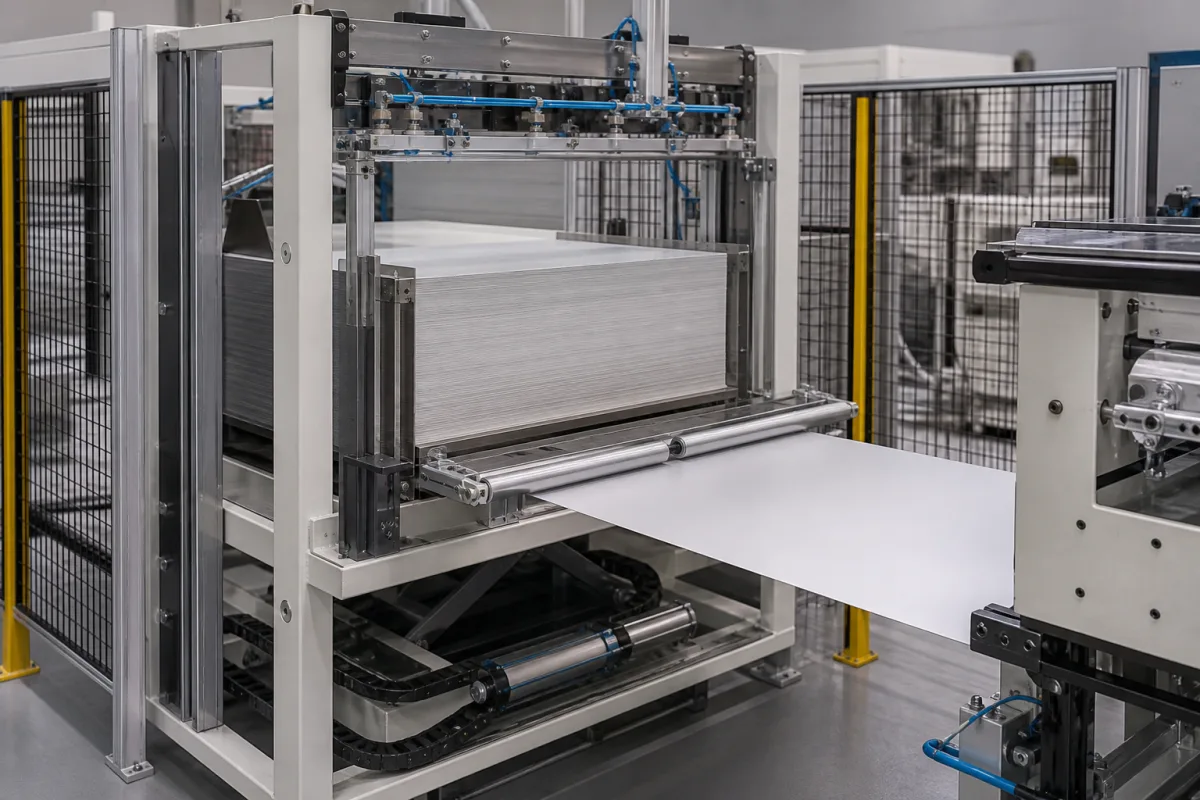
A storage and feeding component within lamination systems that holds and supplies sheets or materials to the feeding mechanism.
Product Specifications

Technical details and manufacturing context for Feeder Magazine

Definition
The Feeder Magazine is an integral part of the Lamination Feeding and Stacking Module, serving as the primary storage and supply unit for laminating sheets or other materials. It maintains organized material inventory and ensures controlled, sequential delivery to downstream feeding mechanisms for precise lamination processes.
Working Principle
The magazine stores stacked materials in an organized manner, typically using gravity-fed or mechanically-assisted systems to present individual sheets to the feeding mechanism. It may incorporate sensors to monitor material levels and ensure continuous operation without jams or misfeeds.
Common Materials
Galvanized steel, Aluminum alloy, Engineering plastics
Technical Parameters
  • Maximum sheet size capacity (width × length) (mm) Per Request
Components / BOM
  • Sheet Separator
    Ensures single sheet feeding by separating individual sheets from the stack
    Material: Polyurethane or rubber
  • Level Sensor
    Monitors material level in the magazine and triggers refill alerts
    Material: Stainless steel housing with optical/ultrasonic components
  • Guide Rails
    Maintains proper sheet alignment and prevents jamming during feeding
    Material: Anodized aluminum
Engineering Reasoning
0.5-2.5 MPa (5-25 bar) hydraulic pressure, 0.1-1.0 m/s feed velocity
Material yield strength exceeded at 310 MPa (AISI 304 stainless steel), hydraulic pressure >3.0 MPa causes seal extrusion, feed velocity >1.2 m/s induces sheet buckling
Design Rationale: High-cycle fatigue from cyclic loading at 0.5-2 Hz operating frequency, Coulomb friction wear at sheet-metal interfaces (μ=0.15-0.25), hydraulic fluid degradation at >60°C reducing viscosity below 32 cSt
Risk Mitigation (FMEA)
Trigger Hydraulic fluid contamination exceeding ISO 4406 18/16/13 cleanliness level
Mode: Spool valve stiction causing 150-300 ms feed delay
Strategy: Install 10 μm absolute filtration with differential pressure monitoring at 0.3 bar threshold
Trigger Sheet material thickness variation exceeding ±0.05 mm tolerance
Mode: Stack height sensor miscalibration inducing 2-5 mm positional error
Strategy: Implement laser triangulation measurement with 0.01 mm resolution and real-time PID adjustment

Industry Taxonomies & Aliases

Commonly used trade names and technical identifiers for Feeder Magazine.

Applied To / Applications

This component is essential for the following industrial systems and equipment:

Industrial Ecosystem & Supply Chain DNA

Complementary Systems
Downstream Applications
Specialized Tooling

Application Fit & Sizing Matrix

Operational Limits
pressure: Atmospheric to 0.5 bar gauge
other spec: Sheet thickness: 0.05-2.0 mm, Sheet size: 100-1000 mm width, 100-1500 mm length
temperature: Ambient to 80°C (176°F)
Media Compatibility
✓ Paper sheets ✓ Polymer films ✓ Metal foils
Unsuitable: Abrasive slurries or wet materials
Sizing Data Required
  • Maximum sheet dimensions (width x length)
  • Required feed rate (sheets per minute)
  • Material thickness and stack height capacity

Reliability & Engineering Risk Analysis

Failure Mode & Root Cause
Material jamming or misfeeding
Cause: Wear or misalignment of feed components (rollers, guides, sensors) leading to inconsistent material flow, often due to abrasive material contact, improper tension, or contamination buildup.
Drive system failure (mechanical or electrical)
Cause: Overloading, fatigue, or overheating of motors, gears, or belts, typically from continuous high-cycle operation, lack of lubrication, or electrical issues like voltage spikes or controller malfunctions.
Maintenance Indicators
  • Irregular or inconsistent feeding rhythm (audible skipping, stuttering, or pauses)
  • Visible wear, debris accumulation, or unusual vibrations in the feed mechanism or drive assembly
Engineering Tips
  • Implement routine cleaning and inspection schedules to remove contaminants and check for component wear, especially in high-contact areas like guides and rollers.
  • Use condition monitoring (e.g., vibration analysis, thermal imaging) on drive components and calibrate sensors regularly to preempt failures and maintain precise feed control.

Compliance & Manufacturing Standards

Reference Standards
ISO 9001:2015 Quality Management Systems ANSI B65.1 Printing, Publishing, and Converting Equipment Safety Requirements CE Marking (Machinery Directive 2006/42/EC)
Manufacturing Precision
  • Sheet Feed Alignment: +/-0.5mm
  • Media Thickness Variation: +/-0.1mm
Quality Inspection
  • Dimensional Accuracy Verification
  • Cycle Testing for Durability

Factories Producing Feeder Magazine

Verified manufacturers with capability to produce this product in China

✓ 97% Supplier Capability Match Found

P Project Engineer from Canada Jan 01, 2026
★★★★★
"Testing the Feeder Magazine now; the technical reliability results are within 1% of the laboratory datasheet."
Technical Specifications Verified
S Sourcing Manager from United States Dec 29, 2025
★★★★★
"Impressive build quality. Especially the technical reliability is very stable during long-term operation."
Technical Specifications Verified
P Procurement Specialist from United Arab Emirates Dec 26, 2025
★★★★★
"As a professional in the Machinery and Equipment Manufacturing sector, I confirm this Feeder Magazine meets all ISO standards."
Technical Specifications Verified
Verification Protocol

“Feedback is collected from verified sourcing managers during RFQ (Request for Quote) and factory evaluation processes on CNFX. These reports represent historical performance data and technical audit summaries from our B2B manufacturing network.”

9 sourcing managers are analyzing this specification now. Last inquiry for Feeder Magazine from Thailand (1h ago).

Supply Chain Compatible Machinery & Devices

Automated Assembly Line System

Integrated production system for sequential component assembly operations

Explore Specs →
Automated Powder Coating System

Integrated industrial system for applying dry powder coatings to metal substrates.

Explore Specs →
Centrifugal Pump Impeller

Rotating component that transfers energy to fluid in centrifugal pumps.

Explore Specs →
High-Precision CNC Laser Cutting Machine

Computer-controlled industrial machine using focused laser beams to cut sheet metal with micron-level accuracy.

Explore Specs →

Frequently Asked Questions

What materials are used in feeder magazines for durability?

Feeder magazines are typically constructed from galvanized steel for corrosion resistance, aluminum alloy for lightweight strength, or engineering plastics for reduced friction and noise.

How does a feeder magazine improve lamination system efficiency?

It ensures continuous material supply with components like guide rails for alignment, level sensors to monitor stock, and sheet separators to prevent jams, reducing downtime.

Can feeder magazines handle different sheet sizes and materials?

Yes, they are designed with adjustable guide rails and separators to accommodate various sheet dimensions and materials, from paper to plastics, in lamination processes.

Can I contact factories directly on CNFX?

CNFX is an open directory, not a transaction platform. Each factory profile provides direct contact information and production details to help you initiate direct inquiries with Chinese suppliers.

Get Quote for Feeder Magazine

Request technical pricing, lead times, or customized specifications for Feeder Magazine directly from verified manufacturing units.

Your business information is encrypted and only shared with verified Feeder Magazine suppliers.

Thank you! Your message has been sent. We'll respond within 1–3 business days.

Need to Manufacture Feeder Magazine?

Connect with verified factories specializing in this product category

Add Your Factory Contact Us
Previous Product
Feeder
Next Product
Feeder Mechanism