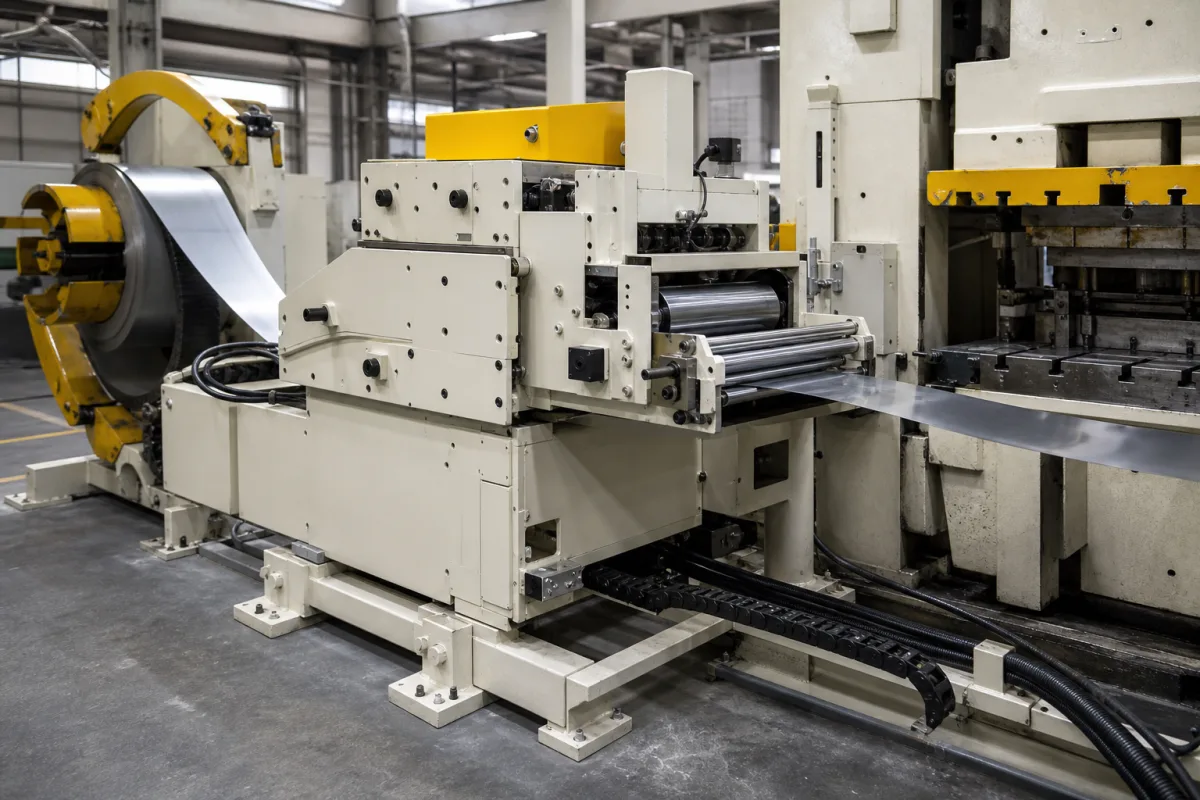
In the illustrated compact line the strip comes off a coil, passes through a bank of offset straightening rolls and a pair of feed rolls in one frame, and goes straight into the die. The feed rolls set the progression; the straightening rolls decide whether the strip arriving at the die is flat. Coil set, the curve the strip keeps from being wound, has to be bent out by making the metal yield, and how well that works depends on the rolls' number, diameter and spacing against the strip's thickness and strength.
Covers the straightening section of press straightener-feeders: coil set and residual stress, why straightening needs yielding, roll number, diameter and spacing, width–thickness capacity ratings and material strength. Feed window, pilot release and feed accuracy of servo roll feeds are on Servo Feeder (4988); looped versus close-coupled coil lines and decoilers on Coil Feeding System (3410). Vibratory bowl feeders share the word feeder but are outside this page.
CNFX editorial research · Sources checked October 13, 2026 · 3 sources
Coil set must be bent out by yielding, not just pressed flat
Mróz and colleagues at Częstochowa University of Technology studied a five-roll pre-leveler for 3 mm × 1,500 mm hot-rolled S235JR strip unwound from coil, using 3D laser scans of the real strip shape in FEM simulations (Materials, 2024).
The practical consequence is that a straightener is sized for the strip's yield behaviour, not only its thickness: rolls that bend a strong strip less than its yield curvature push it flat between them and let it spring back as soon as it leaves (editorial reading).
Their 200 mm rolls on 3 mm strip are a diameter about 67 times the thickness, against 25–37.5 times for the 3 in rolls of the press straightener below (Editorial calculation).
Finding
Mróz et al.
What comes off the coil
Waviness and non-uniform residual stress across and along the strip, partly 'coil memory' from rolling and winding
What straightening must do
Impose a permanent strain that takes the material into yield; yielding homogenises the initial stress state and relaxes residual stress
Roll settings
Literature they review finds an infinite number of entry and exit intermesh combinations that give zero residual curvature; larger entry intermesh removes initial residual stress but adds rolling residual stress
Their machine
Five-roll pre-leveler, rolls 200 mm diameter at 250 mm spacing, insertion rolls 250 mm; four intermesh variants simulated
When it fails
With waviness whose pitch matches the roll spacing, flexures were too small and some areas did not yield; effectiveness depends on the strip profile and the number, spacing and diameter of the rolls
The study concerns one hot-rolled grade and one pre-leveler; press straightener-feeders work thinner strip with smaller rolls.
02
One combination machine's data: 7 straightening rolls of 3 in, 5 in feed rolls
A Coe Press servo roll feed straightener combination, model CPFS-305-72, as listed by Nidec Press & Automation, shows what a straightener-feeder datasheet states.
The three capacity lines show how the rating moves: going from 72 to 60 in wide (17% narrower) allows 50% thicker strip. In bending terms the 60 in × 0.120 in line carries 1.9 times the width × thickness² of the 72 in × 0.080 in line (Editorial calculation), so the ratings are not a single bending-moment limit; the maker's basis for each line is worth asking.
The roll diameter is 37.5 times the thinnest rated strip and 25 times the thickest (Editorial calculation). Durant notes that thin material, light-gauge steel or aluminium under 0.060 in, needs smaller rolls with tighter spacing, and thick high-strength material larger rolls and a heavier frame.
Item
Coe CPFS-305-72
Straightening rolls
Seven, 3 in diameter; individual upper roll adjustment by screw jacks
Backup
Double-row upper and lower breaker-roll backup rollers
Feed rolls
Upper and lower, 5 in diameter, matte chrome
Pinch rolls
Air-operated entrance and exit
Capacity
0.080 in at 72 in wide; 0.100 in at 66 in; 0.120 in at 60 in
Other
Self-centring entrance edge guide; cabinet base with ±4 in height adjustment; three-roll entrance catenary support
The listing is a used-machine record; confirm ratings and the material grade they assume with the maker.
03
Specifying the straightener for your strip
Durant Tool's guide to choosing a coil straightener lists the factors to match to the line.
Durant's speed example turns into a feed-length limit: 40 ft/min at 60 strokes/min is 8 in of strip per stroke on average (Editorial calculation), before allowing for the share of each stroke in which the feed can move.
Read together with the Mróz study, the yield-strength line is the one that decides: a straightener that cannot yield the strongest grade on the line will pass it through with its coil set intact (editorial reading).
Factor
What Durant says to check
Thickness
Sets the number and size of straightening rolls
Width
Sets the minimum working width; running strip wider than the rolls gives edge waves and uneven correction; aim for the widest strip to sit mid-range, not at the limit
Yield strength
Machines rated for mild steel may not fully correct stainless or high-tensile alloys; check the yield-strength rating with the thickness range; harder material needs more roll pressure and a heavier frame
Roll count
A basic unit has 7 rolls; a precision straightener for close-tolerance work has 11 or more
Speed
Match line speed to the press: a press at 60 strokes/min fed by a straightener limited to 40 ft/min is a bottleneck
Size
Undersized does not remove coil set; oversized adds cost and floor space
Durant's guidance is general selection advice from a straightener supplier; the machine maker's capacity chart governs.
04
What to give a straightener-feeder supplier
Paste it into your enquiry below or into an email to a maker, then replace every bracket.
Give strip thickness and width ranges, material grades with yield and tensile strength, coil weight and inside and outside diameters, required flatness, press speed and feed length, and surface requirements. Ask for the straightening roll number, diameter and spacing, backup support, roll adjustment method, capacity chart by width, thickness and yield strength, feed roll diameter and finish, line speed, and how coil set and crossbow are checked at commissioning.
Explore company information and manufacturing capabilities, then discuss the scope of your project with a relevant supplier.
Share this page
Compiled and source-reviewed by the CNFX editorial team.
Each manufacturer above links to the page on that company's own website where the product is listed, with the date we checked it. How we source and review
· Page last updated 13 October 2026
Buyer questions
Why does a straightener have to make the strip yield?
Mróz and colleagues found that straightening must impose a permanent strain into yield to homogenise the coil's residual stress; where flexures were too small, areas of the strip did not yield and were not corrected. [1]
How many straightening rolls are needed?
Durant describes a basic unit with 7 rolls and precision straighteners with 11 or more; the Coe CPFS-305-72 combination has seven 3 in rolls. [2][3]
Why does a straightener's rated thickness fall with width?
The Coe CPFS-305-72 is rated 0.080 in at 72 in, 0.100 in at 66 in and 0.120 in at 60 in wide; the ratings do not follow one bending limit (Editorial calculation), so ask the maker for the basis. [3]
Can a mild-steel straightener run stainless?
Durant warns that machines rated for mild steel may not fully correct stainless or high-tensile alloys, and advises checking the yield-strength rating. [2]
Sources and what still needs a direct check
Sources checked 2026-10-13. A 2024 open-access FEM study of strip leveling, a straightener supplier's selection guide, and a used-machine record of a Coe Press straightener-feeder.