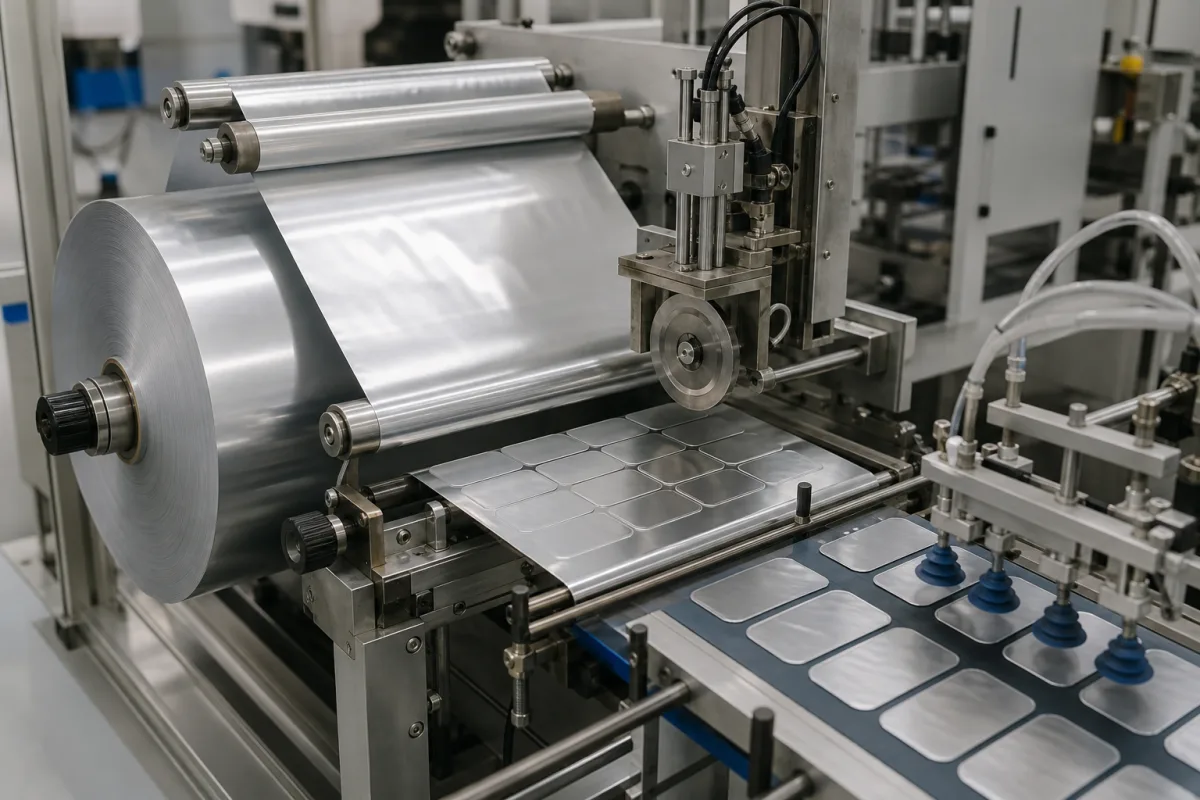
Reel-fed lid dispensing and cutting unit for cup filling and sealing machines: lids from the reel, skeleton waste and keeping the lid on the cup
The unit on a cup filling and sealing machine that takes sealable lids from a reel instead of a magazine of die-cut lids, cuts them free and puts them on the cups before the heat-sealing station — reel size, skeleton waste, lid gauge and why the punch is kept away from the sealing heat
Yoghurt, cheese and dessert cups are closed with a sealable lid, which reaches the filling machine in one of two ways: as a stack of die-cut lids loaded into a magazine, or on a reel that a unit beside the machine unwinds, cuts and places. The unit pictured does the second job: a reel of foil with the lid outlines embossed in it runs under a rotary knife, and suction cups lift the cut lids onto the line. What a buyer has to settle is how many lids a reel holds, how much material is left as skeleton, what the lid is made of and how a light lid stays put on the cup until it is sealed.
Lid dispensing and cutting units on cup filling and sealing machines for dairy and similar foods that feed sealable lids from a reel, cut or separate them and place them on cups ahead of the heat-sealing station, compared with magazines of die-cut lids. Screw-capping machines and their heads are covered on the High-speed rotary bottle capping machine page; crown, roll-on and cork closures on the Automated bottle capping machine page; gas flushing and lid sealing of modified atmosphere packs on the Gas-flush and lid-sealing station page. Heated sealing tools are covered on the Sealing head for cup and tray lidding machines page. Induction cap liners and thermoform-fill-seal lines are outside this page.
CNFX editorial research · Sources checked October 13, 2026 · 5 sources
Lids from a reel: 40,000 lids per reel, skeleton waste and 23–36 µm lid material
Primoreels, which supplies both reel-fed lid dispensing units and the lids for them, gives the numbers that set a reel system against a magazine of die-cut lids. Its dispensing units are tailor-made for the filling machine, run as stand-alone units with their own touch-screen controls, and can be fitted to old or new fillers. [1]
Primoreels contrasts its reels with die-cut lids that are fed into the filling machine by hand, and states that the skeleton waste is removed at its own production unit, so the filler is left with only the cardboard core and the bag the reel came in. [1] Editorial calculation: even a perfect square grid of Ø95 mm lids, each in a 95 mm square, leaves 1 − π/4 ≈ 21.5 % of the material as skeleton, which is why the waste figure depends on whether the lids are cut out at the filler or before the reel arrives.
For machine output, Serac gives its NEO cup filler 1,500 to 12,000 cups per hour, with dispensing of aluminium foil capsules from a magazine as a standard function. [2] Editorial calculation: a reel of 40,000 lids would last about 3.3 hours at 12,000 cups per hour and about 27 hours at 1,500, against the refilling of a magazine of die-cut lids.
Aluminium is the other lid material. Constantia Flexibles offers its HotfillCover as an aluminium die-cut lid or as reel-fed lidding, embossed or unembossed, with a coextrusion coating for sealing on PP cups and bottles over sealing temperatures of 200 to 280 °C. [3] In an interview Constantia's Xavier Bonamour said coextrusion coating replaced earlier varnish seal layers, lets cups be sealed at a lower temperature and allows thinner aluminium, with material savings of up to 50 % claimed for its Die Cut 2020 lid. [4]
Metallised PET, 23 µm or 36 µm for larger cup formats [1]
Skeleton waste, Ø95 mm cups
Up to 56 % in rollstock; less than 20 % with lids on reels [1]
Lid treatment
UV-C on the food-contact underside immediately before sealing; pulsed light option for up to log 4 reduction [1]
Ask for lids per reel at your lid size, the skeleton waste left at the filler, the reel change time and the lid materials and gauges the unit can cut and place.
02
From cutter to sealer: why thin lids shift and how the punch is protected from heat
Schüpbach's European patent application EP 0 039 660 A1 explains why the lid cutter and the sealer sit at different stations: to keep the high-precision punching tool away from the heat radiated by the sealing tool, lids are punched at one station and travel with the cup to a separate sealing station. [5]
That works only while the lid does not move on the cup on the way. The patent states that cost pressure pushes lid makers to very thin, light materials such as heavily rolled aluminium or aluminium-laminated nylon films, and that such lids can be shifted by a draught or by heat. It names curling of the lid edges as a further cause, because a curled rim leaves very little friction on the cup edge. [5]
Its answer is to tack the lid to the cup at a point while still at the punching station, using a tacking device and an ejector mounted coaxially inside the punch, so that lid and cup cannot move relative to each other before sealing. The lid material is described as coated on its underside with a thermoplastic for hot sealing to the cup rim in a later station. [5]
Editorial note: the same question applies to a reel unit that cuts lids and places them by suction cups, as in the photograph — how the cut lid is held in register on the cup until the sealing head closes it. [5][1]
Ask how far the cutter is from the sealing head, how the placed lid is held on the cup until sealing, and how lid curl or static is handled with thin material.
03
Information for a reel-fed lid unit
Paste it into your enquiry below or into an email to a maker, then replace every bracket.
Filler: [make and model; lanes; cups per hour]
Lid: [shape and size; material and gauge; embossed or flat; heat-seal coating]
Reel: [lids per reel; reel weight; change time]
Transfer: [cutting method; placing by suction cups; holding the lid until sealing]
Hygiene: [UV-C or pulsed light treatment of the lid underside]
Explore company information and manufacturing capabilities, then discuss the scope of your project with a relevant supplier.
Share this page
Compiled and source-reviewed by the CNFX editorial team.
Each manufacturer above links to the page on that company's own website where the product is listed, with the date we checked it. How we source and review
· Page last updated 13 October 2026
Buyer questions
How many lids does a lid reel hold?
Primoreels states up to 40,000 sealable lids on a reel weighing 10–12 kg, mounted in less than 1 minute. [1]
How much material is wasted cutting round lids?
Primoreels says rollstock leaves up to 56 % waste for Ø95 mm cups and its lids on reels less than 20 %. [1]
Why are lids punched away from the sealing station?
Schüpbach's EP 0 039 660 A1 says the high-precision punch is kept away from the heat radiated by the sealing tool. [5]
What sealing temperature do aluminium cup lids need?
Constantia gives its HotfillCover die-cut or reel-fed aluminium lid a sealing range of 200 to 280 °C on PP cups. [3]
Sources and what still needs a direct check
Sources checked 2026-10-13. Reel and waste figures come from Primoreels; cup filler output from Serac; aluminium lid sealing and coatings from Constantia Flexibles; the punch-to-sealer transfer from a Schüpbach European patent application.