Industry-Verified Manufacturing Data (2026)

Force & Position Control System

Based on aggregated insights from multiple verified factory profiles within the CNFX directory, the standard Force & Position Control System used in the Machinery and Equipment Manufacturing sector typically supports operational capacities ranging from standard industrial configurations to heavy-duty production requirements.

Technical Definition & Core Assembly

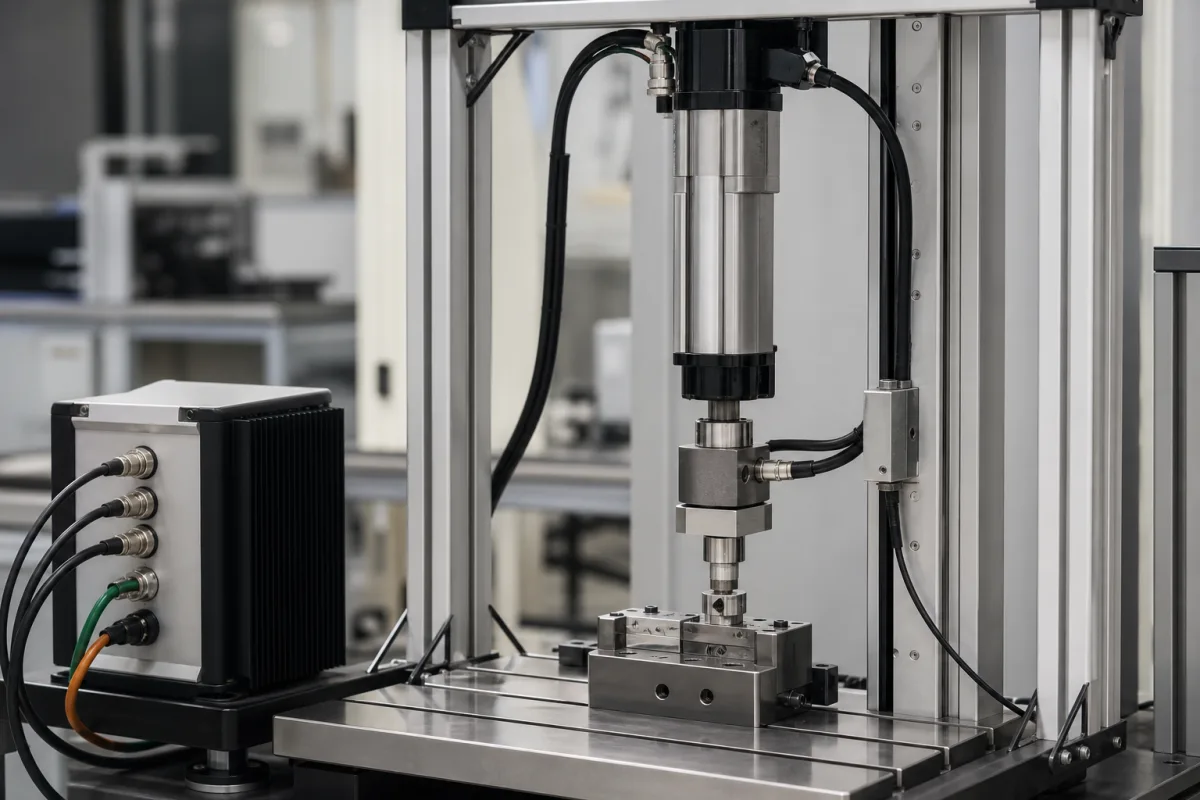
A canonical Force & Position Control System is characterized by the integration of Force Sensor/Load Cell and Position Encoder. In industrial production environments, manufacturers listed on CNFX commonly emphasize Electronic components (PCBs, sensors) construction to support stable, high-cycle operation across diverse manufacturing scenarios.

A control system that precisely regulates both applied force and positional accuracy during pressing operations.
Product Specifications

Technical details and manufacturing context for Force & Position Control System

Definition
A critical subsystem within the Precision Pressing Station that monitors and adjusts both the force exerted by the press and the precise position of the pressing tool or workpiece. It ensures consistent quality by maintaining exact force profiles and positional tolerances throughout the pressing cycle, compensating for material variations and tool wear.
Working Principle
The system typically uses load cells or force sensors to measure applied force and encoders or linear position sensors to measure displacement. A programmable logic controller (PLC) or dedicated motion controller processes these signals and adjusts servo motors, hydraulic valves, or pneumatic actuators to maintain the desired force and position setpoints according to a predefined program.
Common Materials
Electronic components (PCBs, sensors), Structural metal (aluminum/steel housing), Wiring and connectors
Technical Parameters
  • Maximum controllable force range (e.g., 0-5000 N) and positional resolution/accuracy (e.g., ±0.01 mm). (N & mm) Customizable
Components / BOM
  • Force Sensor/Load Cell
    Measures the actual force being applied during the pressing operation.
    Material: Stainless steel (strain gauge housing)
  • Position Encoder
    Measures the linear or rotational displacement of the press ram or tool.
    Material: Aluminum/glass (encoder disk), electronics
  • Control Unit (PLC/Motion Controller)
    Processes sensor data, runs control algorithms, and outputs commands to actuators.
    Material: Plastic/steel (enclosure), electronic components
  • Servo Drive/Actuator Interface
    Amplifies control signals to drive the servo motor, hydraulic servo valve, or pneumatic regulator that adjusts force and position.
    Material: Aluminum (heat sink), electronic components
Engineering Reasoning
0.1-100 kN force, ±0.01 mm positional accuracy
Force overshoot beyond 110 kN or positional deviation exceeding ±0.1 mm
Design Rationale: Servo motor torque saturation at 120 Nm combined with ball screw backlash exceeding 5 μm causes loss of closed-loop control stability
Risk Mitigation (FMEA)
Trigger Hydraulic fluid contamination with particles >10 μm
Mode: Servo valve spool seizure at 0.5 mm displacement
Strategy: Install 3 μm absolute filtration with pressure differential monitoring at 0.3 bar threshold
Trigger Encoder signal loss for >10 ms duration
Mode: PID controller integral windup causing 15% force overshoot
Strategy: Implement dual redundant encoders with majority voting logic and 5 ms watchdog timer

Industry Taxonomies & Aliases

Commonly used trade names and technical identifiers for Force & Position Control System.

Applied To / Applications

This component is essential for the following industrial systems and equipment:

Industrial Ecosystem & Supply Chain DNA

Complementary Systems
Downstream Applications
Specialized Tooling

Application Fit & Sizing Matrix

Operational Limits
pressure: Up to 100 MPa (1000 bar) maximum system pressure
other spec: Position accuracy: ±0.01 mm, Force resolution: 0.1% FS, Control bandwidth: 100 Hz
temperature: 0°C to 50°C (operating), -10°C to 60°C (storage)
Media Compatibility
✓ Hydraulic fluids (mineral oil, HFC, HFD) ✓ Industrial lubricants ✓ Clean dry air (pneumatic systems)
Unsuitable: Corrosive chemical environments (acids, strong solvents)
Sizing Data Required
  • Maximum required force (kN)
  • Required positional accuracy (mm)
  • Operating cycle frequency (Hz)

Reliability & Engineering Risk Analysis

Failure Mode & Root Cause
Position Sensor Drift
Cause: Environmental contamination, thermal cycling, or electrical noise leading to inaccurate feedback signals.
Actuator Force Degradation
Cause: Mechanical wear, hydraulic fluid contamination, or pneumatic seal failure reducing force output.
Maintenance Indicators
  • Erratic or jerky motion during operation
  • Unusual audible vibrations or grinding noises from the actuator
Engineering Tips
  • Implement regular calibration cycles and environmental sealing for sensors to maintain accuracy.
  • Use filtered fluids and scheduled seal replacements to prevent actuator contamination and wear.

Compliance & Manufacturing Standards

Reference Standards
ISO 13849-1: Safety of machinery - Safety-related parts of control systems ANSI/ASME B5.54: Methods for Performance Evaluation of Computer Numerically Controlled Machining Centers DIN EN 61800-7-201: Adjustable speed electrical power drive systems - Part 7-201: Generic interface and use of profiles for power drive systems - Profile type 1 specification
Manufacturing Precision
  • Positional Accuracy: +/-0.005mm
  • Repeatability: +/-0.002mm
Quality Inspection
  • Dynamic Performance Test (frequency response analysis)
  • Static Force Calibration (using traceable load cells)

Factories Producing Force & Position Control System

Verified manufacturers with capability to produce this product in China

✓ 95% Supplier Capability Match Found

P Procurement Specialist from Brazil Feb 20, 2026
★★★★★
"Reliable performance in harsh Machinery and Equipment Manufacturing environments. No issues with the Force & Position Control System so far."
Technical Specifications Verified
T Technical Director from Canada Feb 17, 2026
★★★★★
"Testing the Force & Position Control System now; the technical reliability results are within 1% of the laboratory datasheet."
Technical Specifications Verified
P Project Engineer from United States Feb 14, 2026
★★★★★
"Impressive build quality. Especially the technical reliability is very stable during long-term operation."
Technical Specifications Verified
Verification Protocol

“Feedback is collected from verified sourcing managers during RFQ (Request for Quote) and factory evaluation processes on CNFX. These reports represent historical performance data and technical audit summaries from our B2B manufacturing network.”

17 sourcing managers are analyzing this specification now. Last inquiry for Force & Position Control System from Thailand (38m ago).

Supply Chain Compatible Machinery & Devices

Hydraulic Press

Industrial machine using hydraulic pressure to compress, form, or assemble materials

Explore Specs →
Heavy-Duty CNC Plasma Cutting Machine

Industrial machine for precision metal cutting using plasma arc technology

Explore Specs →
Automated Assembly Line System

Integrated production system for sequential component assembly operations

Explore Specs →
Automated Powder Coating System

Integrated industrial system for applying dry powder coatings to metal substrates.

Explore Specs →

Frequently Asked Questions

What industries benefit most from this force and position control system?

This system is ideal for machinery and equipment manufacturing, particularly in applications requiring precise pressing operations such as assembly, stamping, forming, and testing where both force regulation and positional accuracy are critical.

How does the system maintain both force and position accuracy simultaneously?

The system integrates force sensors/load cells and position encoders with a control unit (PLC/motion controller) that processes real-time feedback, adjusting servo drives or actuators to maintain precise force application while achieving accurate positional targets during pressing cycles.

What are the key components included in the BOM for this control system?

The bill of materials includes a force sensor/load cell for measuring applied force, a position encoder for tracking movement, a control unit (PLC or motion controller) for processing, and a servo drive/actuator interface for executing precise adjustments based on control signals.

Can I contact factories directly on CNFX?

CNFX is an open directory, not a transaction platform. Each factory profile provides direct contact information and production details to help you initiate direct inquiries with Chinese suppliers.

Get Quote for Force & Position Control System

Request technical pricing, lead times, or customized specifications for Force & Position Control System directly from verified manufacturing units.

Your business information is encrypted and only shared with verified Force & Position Control System suppliers.

Thank you! Your message has been sent. We'll respond within 1–3 business days.

Need to Manufacture Force & Position Control System?

Connect with verified factories specializing in this product category

Add Your Factory Contact Us
Previous Product
FOPS Canopy/Overhead Guard
Next Product
Force Actuator