Industry-Verified Manufacturing Data (2026)

Gas Seal Assembly

Based on aggregated insights from multiple verified factory profiles within the CNFX directory, the standard Gas Seal Assembly used in the Machinery and Equipment Manufacturing sector typically supports operational capacities ranging from standard industrial configurations to heavy-duty production requirements.

Technical Definition & Core Assembly

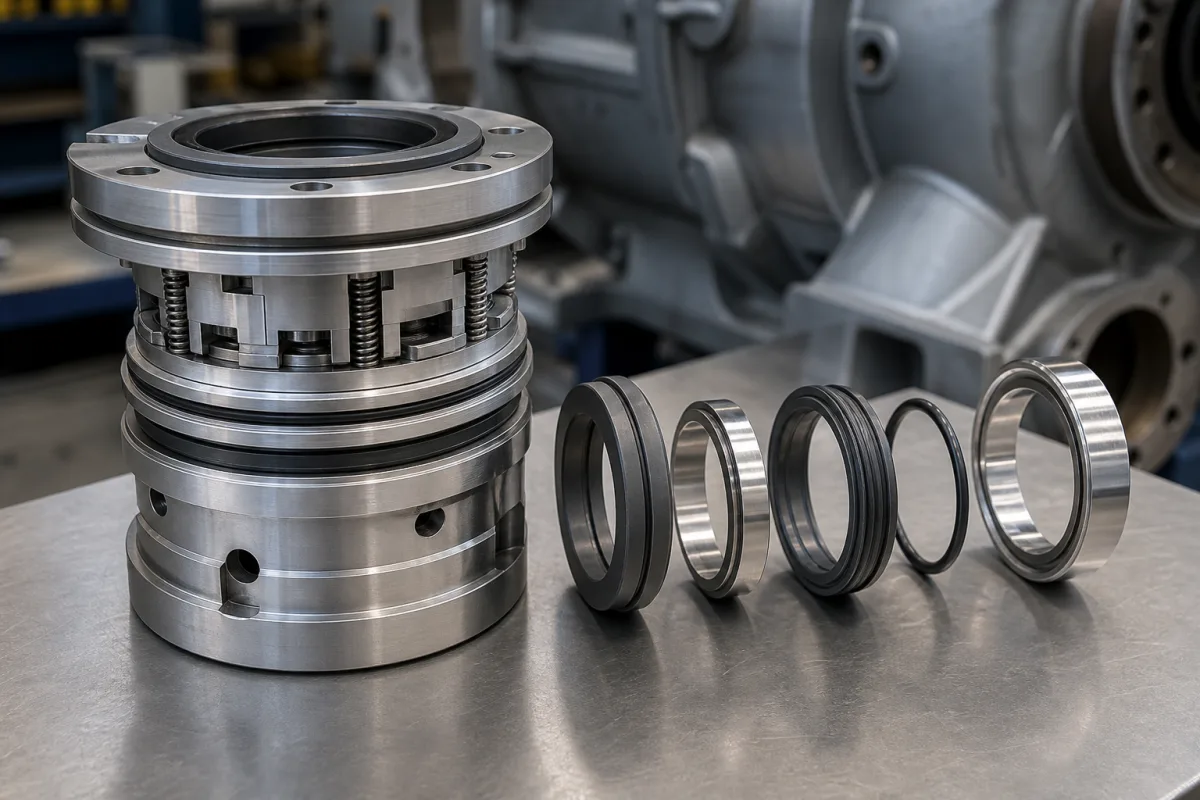
A canonical Gas Seal Assembly is characterized by the integration of Primary Seal Ring and Secondary Seal (O-ring/Gasket). In industrial production environments, manufacturers listed on CNFX commonly emphasize Carbon Graphite construction to support stable, high-cycle operation across diverse manufacturing scenarios.

A critical sealing component within a rotary gas injector that prevents gas leakage between rotating and stationary parts.
Product Specifications

Technical details and manufacturing context for Gas Seal Assembly

Definition
The Gas Seal Assembly is an essential sub-assembly of the Rotary Gas Injector, specifically designed to maintain a hermetic seal at the interface between the rotating shaft and stationary housing. It ensures controlled gas flow into the injection system while preventing unwanted leakage, contamination, or pressure loss that could compromise operational efficiency and safety.
Working Principle
The assembly typically employs mechanical face seals, labyrinth seals, or lip seals that create a tight barrier through precise mating surfaces, spring loading, or controlled clearance gaps. It operates by maintaining continuous contact or minimal clearance between rotating and stationary elements, often utilizing sealing materials compatible with the injected gas and operating environment to withstand pressure differentials, rotational speeds, and thermal variations.
Common Materials
Carbon Graphite, Stainless Steel, Elastomers (e.g., Viton, EPDM), Ceramics
Technical Parameters
  • Seal face diameter or critical sealing dimensions (mm) Per Request
Components / BOM
  • Primary Seal Ring
    Forms the main sealing surface against the rotating element
    Material: Carbon Graphite or Silicon Carbide
  • Secondary Seal (O-ring/Gasket)
    Provides static sealing between seal housing and stationary components
    Material: Elastomer (Viton, EPDM) or PTFE
  • Spring Mechanism
    Maintains consistent contact pressure on the seal faces
    Material: Stainless Steel
  • Seal Housing
    Holds and aligns all seal components within the injector assembly
    Material: Stainless Steel or Aluminum Alloy
Engineering Reasoning
0.1-15 MPa differential pressure, -40°C to 200°C operating temperature
Seal face contact pressure exceeds 25 MPa, leading to plastic deformation; or seal gap exceeds 5 μm, causing leakage rate >0.1 L/min at 10 MPa
Design Rationale: Thermoelastic instability at seal faces when frictional heat generation exceeds 150 W/mm², causing thermal distortion and loss of sealing geometry
Risk Mitigation (FMEA)
Trigger Abrasive particle ingress >10 μm diameter at concentration >100 ppm
Mode: Seal face scoring and increased leakage rate exceeding 0.5 L/min
Strategy: Upstream filtration with 5 μm absolute rating and magnetic particle traps
Trigger Rotor axial vibration amplitude >50 μm at frequencies >100 Hz
Mode: Dynamic misalignment causing intermittent contact and seal face overheating >300°C
Strategy: Active magnetic bearing system with <10 μm axial position control and vibration damping

Industry Taxonomies & Aliases

Commonly used trade names and technical identifiers for Gas Seal Assembly.

Applied To / Applications

This component is essential for the following industrial systems and equipment:

Industrial Ecosystem & Supply Chain DNA

Complementary Systems
Downstream Applications
Specialized Tooling

Application Fit & Sizing Matrix

Operational Limits
pressure: Up to 100 bar (static), 50 bar (dynamic)
flow rate: 0-5 m/s shaft surface speed
temperature: -40°C to 200°C
slurry concentration: ≤5% solids by weight, particle size <50 μm
Media Compatibility
✓ Natural gas / methane ✓ Inert gases (N2, Ar) ✓ Hydrogen (dry)
Unsuitable: Chlorinated hydrocarbons (causes elastomer degradation)
Sizing Data Required
  • Shaft diameter (mm)
  • Operating pressure differential (bar)
  • Rotational speed (RPM)

Reliability & Engineering Risk Analysis

Failure Mode & Root Cause
Dynamic Face Distortion
Cause: Thermal gradients from process fluid temperature fluctuations or improper cooling, causing uneven thermal expansion and loss of seal face flatness.
Secondary Seal Hardening/Cracking
Cause: Exposure to high temperatures beyond O-ring/elastomer rating, chemical incompatibility with process media, or aging from prolonged static operation.
Maintenance Indicators
  • Abnormal increase in seal gas consumption or vent/buffer pressure fluctuations indicating leakage
  • High-pitched squealing or grinding noise from the seal area during operation
Engineering Tips
  • Implement real-time monitoring of seal gas differential pressure and temperature to detect early degradation trends
  • Ensure proper alignment and runout of seal faces during installation using dial indicators, and verify clean, dry seal gas supply with appropriate filtration

Compliance & Manufacturing Standards

Reference Standards
ISO 10438: Petroleum, petrochemical and natural gas industries - Mechanical seals ANSI/API 682: Shaft Sealing Systems for Centrifugal and Rotary Pumps DIN 24960: Mechanical seals; dimensions, nominal pressures, materials
Manufacturing Precision
  • Shaft Diameter: +/-0.01mm
  • Seal Face Flatness: 0.0005mm
Quality Inspection
  • Helium Leak Test
  • Surface Roughness Measurement

Factories Producing Gas Seal Assembly

Verified manufacturers with capability to produce this product in China

✓ 96% Supplier Capability Match Found

P Procurement Specialist from Australia Feb 12, 2026
★★★★★
"Standard OEM quality for Machinery and Equipment Manufacturing applications. The Gas Seal Assembly arrived with full certification."
Technical Specifications Verified
T Technical Director from Singapore Feb 09, 2026
★★★★★
"Great transparency on the Gas Seal Assembly components. Essential for our Machinery and Equipment Manufacturing supply chain."
Technical Specifications Verified
P Project Engineer from Germany Feb 06, 2026
★★★★★
"The Gas Seal Assembly we sourced perfectly fits our Machinery and Equipment Manufacturing production line requirements."
Technical Specifications Verified
Verification Protocol

“Feedback is collected from verified sourcing managers during RFQ (Request for Quote) and factory evaluation processes on CNFX. These reports represent historical performance data and technical audit summaries from our B2B manufacturing network.”

15 sourcing managers are analyzing this specification now. Last inquiry for Gas Seal Assembly from Turkey (1h ago).

Supply Chain Compatible Machinery & Devices

Automated Assembly Line System

Integrated production system for sequential component assembly operations

Explore Specs →
Automated Powder Coating System

Integrated industrial system for applying dry powder coatings to metal substrates.

Explore Specs →
Centrifugal Pump Impeller

Rotating component that transfers energy to fluid in centrifugal pumps.

Explore Specs →
High-Precision CNC Laser Cutting Machine

Computer-controlled industrial machine using focused laser beams to cut sheet metal with micron-level accuracy.

Explore Specs →

Frequently Asked Questions

What materials are used in this gas seal assembly for optimal performance?

Our gas seal assembly utilizes carbon graphite for the primary seal ring, stainless steel for the housing, and high-grade elastomers like Viton or EPDM for secondary seals, ensuring durability and leak prevention in demanding industrial environments.

How does this seal assembly prevent gas leakage in rotary gas injectors?

The assembly creates a reliable barrier between rotating and stationary parts through its multi-component design, including a primary seal ring, secondary O-ring/gasket, spring mechanism for consistent pressure, and precision housing to maintain alignment and sealing integrity.

What industries commonly use this type of gas seal assembly?

This gas seal assembly is critical in machinery and equipment manufacturing, particularly for applications involving rotary gas injectors in sectors like chemical processing, power generation, oil and gas, and industrial manufacturing where gas containment is essential.

Can I contact factories directly on CNFX?

CNFX is an open directory, not a transaction platform. Each factory profile provides direct contact information and production details to help you initiate direct inquiries with Chinese suppliers.

Get Quote for Gas Seal Assembly

Request technical pricing, lead times, or customized specifications for Gas Seal Assembly directly from verified manufacturing units.

Your business information is encrypted and only shared with verified Gas Seal Assembly suppliers.

Thank you! Your message has been sent. We'll respond within 1–3 business days.

Need to Manufacture Gas Seal Assembly?

Connect with verified factories specializing in this product category

Add Your Factory Contact Us
Previous Product
Gas Inlet Manifold
Next Product
Gas Valve