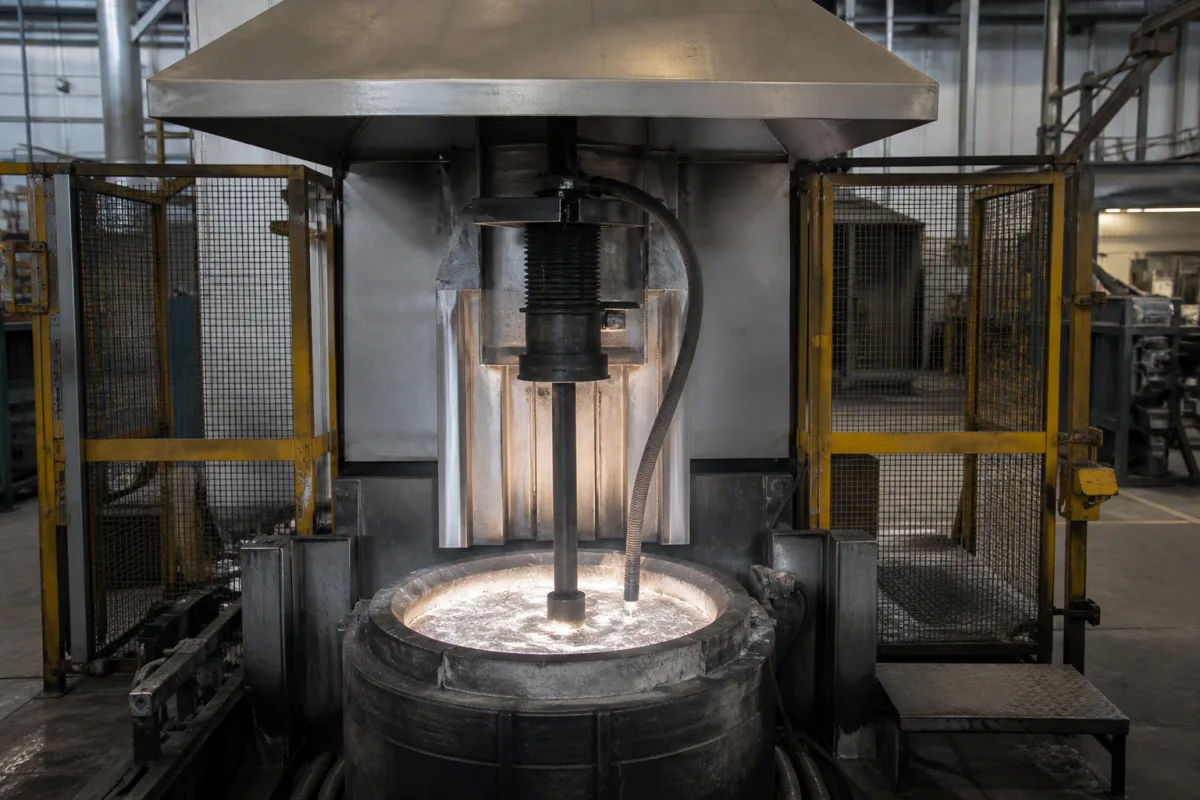
Rotary gas injector (degassing shaft and rotor) for molten aluminium: graphite or silicon carbide, wear at the metal line, and life in cycles
The rotating shaft and rotor that carry nitrogen or argon into molten aluminium, treated as the wearing part it is · about 300 cycles for graphite rotors against 800 for silicon carbide in two foundry reports, shafts thinning at the metal line within two weeks, and the preheat, purge and cleaning routine that sets life
The rotary gas injector is the part of a degasser that sits in the melt: a hollow shaft carrying inert gas down to a slotted rotor head that shears it into fine bubbles. It is also the part that wears out, by oxidation where the shaft crosses the metal surface, by flux attack and by erosion of the head, and when the head loses its shape the gas dispersion and the degassing result go with it.
The immersed shaft and rotor (gas injector) of rotary degassing and fluxing units for molten aluminium alloys: graphite, treated graphite and silicon carbide materials, rotor head shape, shaft sleeves and seals, wear and oxidation, service life in cycles, and handling routines. Rotary degassing units as a whole, rotor speed and gas flow sizing, density index testing and in-line versus box degassers are covered on the Molten aluminium degassing system page; gas metering to rotors on the Gas control system for molten metal treatment page; steel vacuum degassing on the Vacuum induction degassing unit page.
CNFX editorial research · Sources checked October 13, 2026 · 4 sources
Graphite against silicon carbide: about 300 cycles against 800 in two foundry reports, and why head shape matters
Foseco's article on Molten Metal Systems rotors reports that at Hayes-Lemmerz South Africa, a wheel plant degassing at 600 rpm with a 240 s cycle, impregnated graphite rotors had to be replaced after about 300 cycles even without flux additions, two to three days of production, while silicon carbide rotors were changed after 800 cycles that included 100 g flux additions. As the graphite rotors wore, their head geometry distorted and nitrogen dispersal suffered. [1]
Morgan Advanced Materials, announcing its one-piece isostatically pressed silicon carbide rotor in 2014, gave more than 800 cycles in a heavy fluxing application against an average of 300 for comparable graphite products, shaft lengths up to 1.2 m, a six-vane head designed to reduce bubble size, and a clay-graphite anti-vortex plate to limit the swirl that re-entrains hydrogen and oxides. It reported lower oxidation than graphite at operating temperature and higher melt densities over time. [2]
Editorial calculation: at 240 s per cycle, 300 cycles is 72,000 s or 20 h of rotor time and 800 cycles about 53 h. At Aluminium Squeeze Casters, 588 cycles in 98 h of degassing works out to 10 minutes per cycle. [1]
Ask for rotor life as cycles and degassing hours under stated rpm, cycle time and flux use, and whether the head design is checked for wear between changes.
02
The shaft at the metal line: twice the oxidation resistance, fibre sleeves, and 12 shaft-and-rotor sets a year cut to 4
Pyrotek makes its degassing shafts and rotors from ZX-grade graphite, which it states has twice the oxidation resistance of standard graphite through an in-house treatment, and offers graphite-coated ceramic fibre paper seals between shaft and degasser that it says allow almost no creep relaxation, reducing re-tightening. [3]
In a Pyrotek case from a European high-pressure die caster degassing continuously, standard graphite shafts wore thin at the metal line and broke after two weeks. A side-by-side trial with shafts wrapped in a reinforced fibreglass (RFM) sleeve led the caster to calculate that shaft and rotor sets per machine could fall from 12 to 4 a year, a potential saving of nearly US$25,000 across its 9 machines. [4] Editorial calculation: 12 − 4 = 8 fewer sets per machine, 72 fewer across 9 machines.
Ask which graphite grade or ceramic the shaft is made from, whether it is sleeved at the metal line, and what seal sits between shaft and drive.
03
Preheat, gas on before immersion, purge on the way out: a squeeze caster's routine for the injector
Aluminium Squeeze Casters, which replaced machined graphite rotors that suffered frequent shaft failures, describes its daily procedure: the probe is preheated for 5 minutes held over metal at 850 °C to avoid thermal shock; nitrogen is turned on at 15 l/min before immersion so the gas channels do not block; rotation starts at 386 rpm once submerged; gas keeps flowing as the probe is withdrawn to blow out aluminium; and after cooling slightly the probe is wire-brushed and periodically coated so metal and dross do not stick. [1]
Write the preheat time, gas-on and gas-off points, rotation speed and cleaning and coating interval into the operating instruction for each degasser.
04
What to send for a rotary gas injector (shaft and rotor)
Paste it into your enquiry below or into an email to a maker, then replace every bracket.
Degasser: [make and model; shaft coupling; immersion depth]
Melt: [alloy; temperature; batch or continuous; flux use]
Duty: [rpm; gas and flow; cycle time; cycles per day]
Material: [graphite grade; treated graphite; silicon carbide]
Shaft: [length; sleeve at metal line; seal]
Life: [current life in cycles or hours; failure mode]
Explore company information and manufacturing capabilities, then discuss the scope of your project with a relevant supplier.
Share this page
Compiled and source-reviewed by the CNFX editorial team.
Each manufacturer above links to the page on that company's own website where the product is listed, with the date we checked it. How we source and review
· Page last updated 13 October 2026
Buyer questions
How long does a graphite degassing rotor last?
At one wheel plant running 600 rpm and 240 s cycles, impregnated graphite rotors lasted about 300 cycles; Morgan gives 300 cycles as an average for comparable graphite products. [1][2]
Do silicon carbide rotors last longer?
Two reports give 800 cycles for silicon carbide rotors, against about 300 for graphite, including use with flux. [1][2]
Why do degassing shafts break?
In a Pyrotek case, shafts in continuous degassing wore thin at the metal line and broke within two weeks; fibre-sleeved shafts cut annual sets from 12 to 4 per machine. [4]
Should gas flow before the rotor enters the melt?
One caster turns nitrogen on at 15 l/min before immersion so the channels do not block, and keeps it flowing as the probe is withdrawn. [1]
Sources and what still needs a direct check
Sources checked 2026-10-13. Rotor life and handling come from a Foseco technical article on Molten Metal Systems rotors and a 2014 Morgan Advanced Materials announcement; graphite grade, seals and sleeved shafts from Pyrotek's product page and case study.