Industry-Verified Manufacturing Data (2026)

Heating Element / Plate

Based on aggregated insights from multiple verified factory profiles within the CNFX directory, the standard Heating Element / Plate used in the Machinery and Equipment Manufacturing sector typically supports operational capacities ranging from standard industrial configurations to heavy-duty production requirements.

Technical Definition & Core Assembly

A canonical Heating Element / Plate is characterized by the integration of Resistance Wire and Insulation Layer. In industrial production environments, manufacturers listed on CNFX commonly emphasize Nichrome alloy construction to support stable, high-cycle operation across diverse manufacturing scenarios.

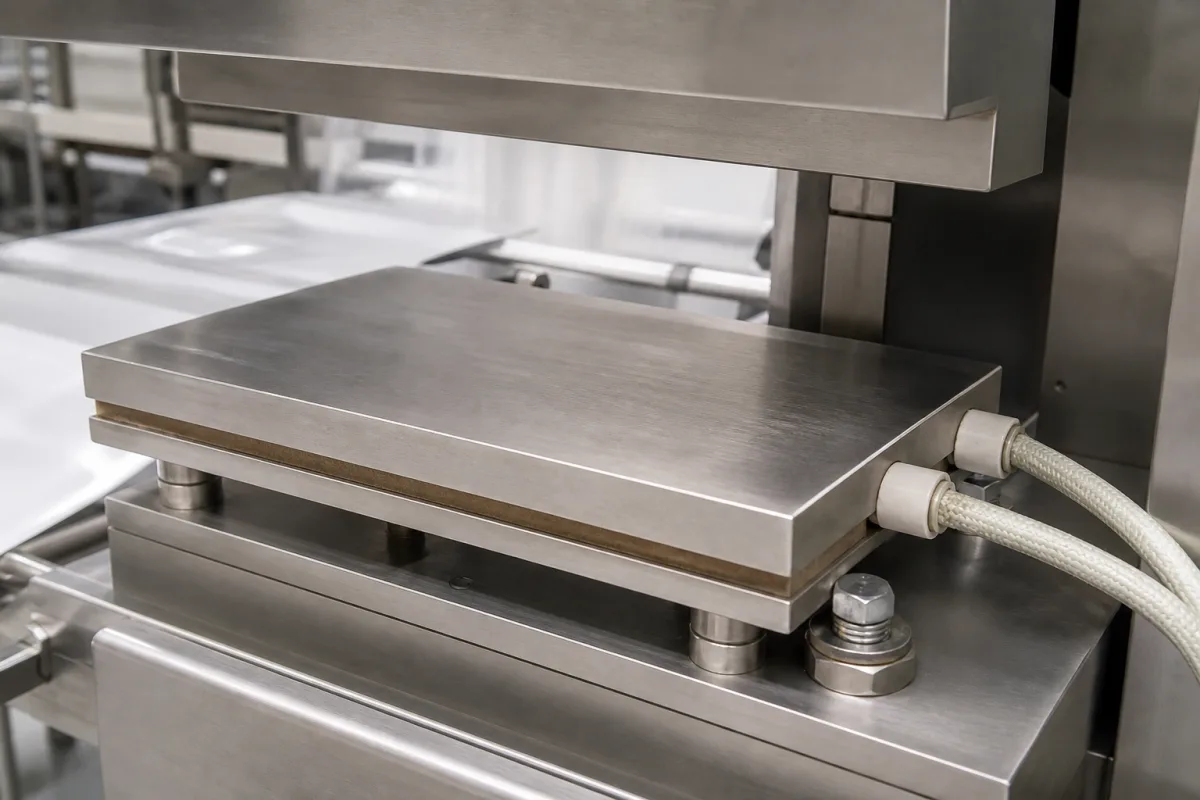
A component that generates and transfers heat to facilitate sealing processes in packaging machinery.
Product Specifications

Technical details and manufacturing context for Heating Element / Plate

Definition
The heating element/plate is a critical component within the Sealing Head Assembly of packaging equipment, responsible for providing controlled thermal energy to melt and bond thermoplastic materials during sealing operations. It ensures consistent heat distribution across the sealing surface for reliable package closures.
Working Principle
Electrical resistance heating converts electrical energy into thermal energy when current passes through the element. The generated heat is then conducted through the plate structure to the sealing surface, maintaining precise temperature control for optimal material bonding.
Common Materials
Nichrome alloy, Stainless steel, Ceramic insulation
Technical Parameters
  • Dimensions of the heating surface area (mm) Customizable
Components / BOM
  • Resistance Wire
    Primary heating element that converts electrical energy to heat
    Material: Nichrome alloy
  • Insulation Layer
    Prevents heat loss and electrical leakage
    Material: Ceramic or mica
  • Protective Casing
    Structural support and heat distribution
    Material: Stainless steel
  • Terminal Connections
    Electrical interface for power supply
    Material: Copper alloy
Engineering Reasoning
150-450°C surface temperature, 220-480V AC input, 500-5000W power rating
650°C element temperature (nichrome oxidation threshold), 550V voltage (insulation breakdown), 6000W continuous load (thermal runaway)
Design Rationale: Nichrome wire oxidation at >650°C forming non-conductive Cr2O3 layer, polymer insulation pyrolysis at >200°C, differential thermal expansion causing microcracks at ΔT>300°C
Risk Mitigation (FMEA)
Trigger PID controller integral windup causing 600°C overshoot
Mode: Polyimide insulation carbonization creating 10kΩ leakage path
Strategy: Anti-windup PID with 550°C hardware limit switch and 5°C/s ramp rate limiting
Trigger 100μm alumina ceramic substrate delamination from 304 stainless steel plate
Mode: Thermal contact resistance increase from 0.001 to 0.1 m²K/W
Strategy: Active brazing with Ag-28Cu-2Ti filler metal and 0.5mm compliance layer

Industry Taxonomies & Aliases

Commonly used trade names and technical identifiers for Heating Element / Plate.

Applied To / Applications

This component is essential for the following industrial systems and equipment:

Industrial Ecosystem & Supply Chain DNA

Complementary Systems
Downstream Applications
Specialized Tooling

Application Fit & Sizing Matrix

Operational Limits
pressure: Up to 10 bar (145 psi) for standard designs, higher with reinforced construction
temperature: Typically 150°C to 400°C, with specialized units up to 600°C
power density: 2-15 W/cm² depending on heating technology
response time: 30-120 seconds to reach setpoint temperature
surface flatness: ≤0.05 mm/m for uniform heat transfer
Media Compatibility
✓ Polymer films (PP, PE, PET) ✓ Thermoplastic adhesives ✓ Food-grade packaging materials
Unsuitable: Corrosive chemical environments or abrasive particulate slurries
Sizing Data Required
  • Required sealing temperature and uniformity tolerance
  • Packaging material thermal properties and thickness
  • Production line speed and dwell time requirements

Reliability & Engineering Risk Analysis

Failure Mode & Root Cause
Thermal fatigue cracking
Cause: Repeated heating and cooling cycles causing expansion/contraction stresses, leading to micro-cracks in the heating element material, especially at connection points or material transitions.
Electrical insulation breakdown
Cause: Moisture ingress, contamination buildup, or overheating degrading the dielectric properties of insulation materials, resulting in short circuits or ground faults.
Maintenance Indicators
  • Visible hot spots or discoloration patterns on the heating plate surface indicating uneven heating or impending failure
  • Audible arcing, buzzing, or popping sounds from the heating element during operation signaling electrical faults or loose connections
Engineering Tips
  • Implement controlled startup/shutdown procedures with gradual temperature ramping to minimize thermal shock and stress on heating elements
  • Establish regular infrared thermography inspections to detect abnormal temperature patterns and address hot spots before catastrophic failure occurs

Compliance & Manufacturing Standards

Reference Standards
ISO 9001:2015 (Quality Management Systems) IEC 60335-1 (Household and Similar Electrical Appliances - Safety) ASTM B895-16 (Standard Specification for Precipitation Hardening Nickel Alloys)
Manufacturing Precision
  • Flatness: ≤0.1mm per 300mm length
  • Resistance: ±5% of nominal value at 20°C
Quality Inspection
  • Insulation Resistance Test (≥100 MΩ at 500V DC)
  • Thermal Imaging Test (uniform temperature distribution verification)

Factories Producing Heating Element / Plate

Verified manufacturers with capability to produce this product in China

✓ 94% Supplier Capability Match Found

T Technical Director from United Arab Emirates Feb 11, 2026
★★★★★
"As a professional in the Machinery and Equipment Manufacturing sector, I confirm this Heating Element / Plate meets all ISO standards."
Technical Specifications Verified
P Project Engineer from Australia Feb 08, 2026
★★★★☆
"Standard OEM quality for Machinery and Equipment Manufacturing applications. The Heating Element / Plate arrived with full certification. (Delivery took slightly longer than expected, but technical support was excellent.)"
Technical Specifications Verified
S Sourcing Manager from Singapore Feb 05, 2026
★★★★★
"Great transparency on the Heating Element / Plate components. Essential for our Machinery and Equipment Manufacturing supply chain."
Technical Specifications Verified
Verification Protocol

“Feedback is collected from verified sourcing managers during RFQ (Request for Quote) and factory evaluation processes on CNFX. These reports represent historical performance data and technical audit summaries from our B2B manufacturing network.”

14 sourcing managers are analyzing this specification now. Last inquiry for Heating Element / Plate from Mexico (37m ago).

Supply Chain Compatible Machinery & Devices

Hydraulic Press

Industrial machine using hydraulic pressure to compress, form, or assemble materials

Explore Specs →
Heavy-Duty CNC Plasma Cutting Machine

Industrial machine for precision metal cutting using plasma arc technology

Explore Specs →
Automated Assembly Line System

Integrated production system for sequential component assembly operations

Explore Specs →
Automated Powder Coating System

Integrated industrial system for applying dry powder coatings to metal substrates.

Explore Specs →

Frequently Asked Questions

What materials are used in this heating element/plate for durability?

This heating element is constructed with a Nichrome alloy resistance wire for efficient heat generation, stainless steel protective casing for corrosion resistance, and ceramic insulation for thermal management and safety.

How does this heating component facilitate sealing in packaging machinery?

The heating element generates consistent, controlled heat that is transferred to the sealing surfaces of packaging machinery, enabling precise melting and bonding of materials like plastics and films for secure package seals.

What are the key specifications to consider when selecting this heating plate?

Key specifications include power rating (wattage), operating temperature range, voltage requirements, dimensions to fit your machinery, and thermal response time to ensure compatibility with your packaging process speed.

Can I contact factories directly on CNFX?

CNFX is an open directory, not a transaction platform. Each factory profile provides direct contact information and production details to help you initiate direct inquiries with Chinese suppliers.

Get Quote for Heating Element / Plate

Request technical pricing, lead times, or customized specifications for Heating Element / Plate directly from verified manufacturing units.

Your business information is encrypted and only shared with verified Heating Element / Plate suppliers.

Thank you! Your message has been sent. We'll respond within 1–3 business days.

Need to Manufacture Heating Element / Plate?

Connect with verified factories specializing in this product category

Add Your Factory Contact Us
Previous Product
Heating Element & Control System
Next Product
Heating Element Assembly