Industry-Verified Manufacturing Data (2026)

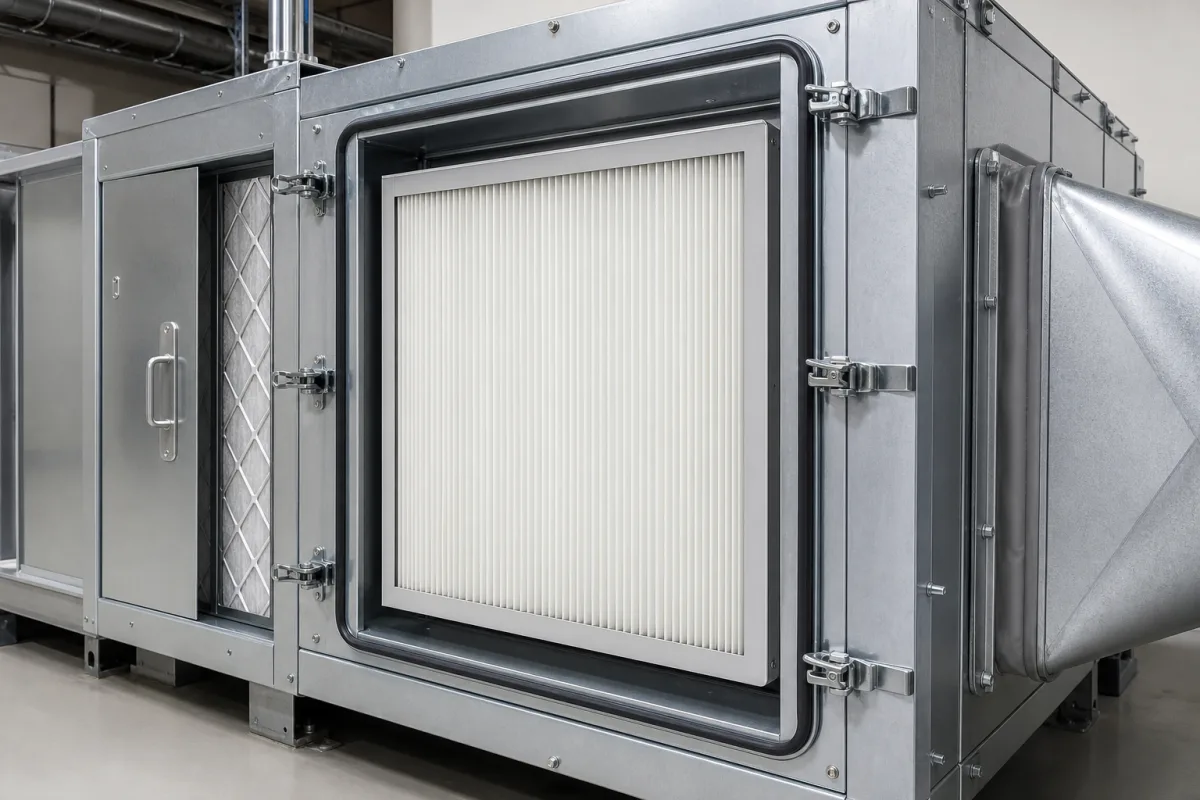
HEPA/ULPA Filter Unit

Based on aggregated insights from multiple verified factory profiles within the CNFX directory, the standard HEPA/ULPA Filter Unit used in the Machinery and Equipment Manufacturing sector typically supports operational capacities ranging from standard industrial configurations to heavy-duty production requirements.

Technical Definition & Core Assembly

A canonical HEPA/ULPA Filter Unit is characterized by the integration of Filter Media and Frame. In industrial production environments, manufacturers listed on CNFX commonly emphasize Glass fiber media construction to support stable, high-cycle operation across diverse manufacturing scenarios.

A filtration component that removes airborne particles from air streams within dust containment systems.
Product Specifications

Technical details and manufacturing context for HEPA/ULPA Filter Unit

Definition
A critical component within Dust Containment Systems, the HEPA/ULPA Filter Unit is responsible for the final stage of air purification. It captures and retains microscopic dust, particulate matter, and other contaminants from the air passing through the system, ensuring clean air exhaust and maintaining the required cleanliness levels in controlled environments.
Working Principle
Air is forced through a dense, pleated filter media composed of fine glass fibers or other synthetic materials. Particles are captured via a combination of interception, impaction, and diffusion mechanisms. HEPA filters remove at least 99.97% of particles ≥0.3 microns, while ULPA filters remove at least 99.999% of particles ≥0.12 microns.
Common Materials
Glass fiber media, Aluminum or galvanized steel frame, Polyurethane or silicone sealant, Polypropylene or aluminum separator
Technical Parameters
  • Nominal dimensions (Length x Width x Depth) of the filter frame. (mm) Standard Spec
Components / BOM
  • Filter Media
    The pleated sheet that physically captures and retains airborne particles.
    Material: Glass fiber or synthetic microfiber
  • Frame
    Provides structural integrity, seals the edges, and allows for secure mounting within the housing.
    Material: Aluminum, galvanized steel, or stainless steel
  • Gasket/Seal
    Creates an airtight seal between the filter frame and the system housing to prevent bypass leakage.
    Material: Polyurethane, closed-cell neoprene, or silicone
Engineering Reasoning
0.5-2.5 m/s face velocity, 100-1000 Pa pressure drop
Particle penetration exceeds 0.003% for HEPA (≥0.3 μm particles) or 0.001% for ULPA (≥0.12 μm particles) at rated flow
Design Rationale: Filter media fiber displacement under differential pressure exceeding 1250 Pa, causing bypass channels exceeding 5 μm width
Risk Mitigation (FMEA)
Trigger Moisture absorption exceeding 3% by mass in glass fiber media
Mode: Media swelling increases pressure drop to 1500 Pa at rated flow
Strategy: Hydrophobic coating with contact angle >110° on filter fibers
Trigger Vibration amplitude exceeding 50 μm at 60 Hz from fan imbalance
Mode: Gasket seal compression loss creates 0.5 mm bypass gap
Strategy: Integral vibration isolators with 85% transmissibility reduction at 60-120 Hz

Industry Taxonomies & Aliases

Commonly used trade names and technical identifiers for HEPA/ULPA Filter Unit.

Applied To / Applications

This component is essential for the following industrial systems and equipment:

Industrial Ecosystem & Supply Chain DNA

Complementary Systems
Downstream Applications
Specialized Tooling

Application Fit & Sizing Matrix

Operational Limits
pressure: Max 500 Pa differential pressure
flow rate: 0.1 to 2.0 m³/s per filter unit
temperature: -20°C to 80°C
particle efficiency: HEPA: 99.97% @ 0.3μm, ULPA: 99.999% @ 0.12μm
Media Compatibility
✓ Cleanroom HVAC systems ✓ Pharmaceutical manufacturing environments ✓ Electronics assembly clean zones
Unsuitable: High moisture environments with condensation or liquid droplets
Sizing Data Required
  • Required air volume flow rate (m³/h)
  • System pressure drop constraints (Pa)
  • Required filtration efficiency class (HEPA/ULPA grade)

Reliability & Engineering Risk Analysis

Failure Mode & Root Cause
Filter Media Degradation
Cause: Excessive particulate loading beyond design capacity, chemical exposure to incompatible substances, or mechanical stress from improper handling/installation leading to media tears or delamination.
Seal Integrity Failure
Cause: Gasket material degradation due to aging, temperature cycling, or chemical attack; improper installation causing misalignment or compression issues; or frame distortion from physical impact or structural stress.
Maintenance Indicators
  • Significant increase in pressure drop across the filter unit (exceeding manufacturer's recommended differential pressure limit)
  • Visible particle shedding downstream of the filter or audible air leakage around the filter housing/seals
Engineering Tips
  • Implement regular differential pressure monitoring with automated alerts to trigger maintenance before catastrophic failure occurs
  • Establish strict handling and installation protocols including proper gasket lubrication, torque specifications for clamping mechanisms, and verification of housing integrity before filter installation

Compliance & Manufacturing Standards

Reference Standards
ISO 29463: High-efficiency filters and filter media for removing particles in air ANSI/ASHRAE 52.2: Method of Testing General Ventilation Air-Cleaning Devices for Removal Efficiency by Particle Size DIN EN 1822: High efficiency air filters (EPA, HEPA and ULPA)
Manufacturing Precision
  • Frame Squareness: +/-0.5 mm per meter
  • Filter Media Thickness: +/-10% of nominal value
Quality Inspection
  • Particle Penetration Test (MPPS method)
  • Pressure Drop Test at rated airflow

Factories Producing HEPA/ULPA Filter Unit

Verified manufacturers with capability to produce this product in China

✓ 97% Supplier Capability Match Found

S Sourcing Manager from Canada Jan 20, 2026
★★★★★
"The technical documentation for this HEPA/ULPA Filter Unit is very thorough, especially regarding technical reliability."
Technical Specifications Verified
P Procurement Specialist from United States Jan 17, 2026
★★★★☆
"Reliable performance in harsh Machinery and Equipment Manufacturing environments. No issues with the HEPA/ULPA Filter Unit so far. (Delivery took slightly longer than expected, but technical support was excellent.)"
Technical Specifications Verified
T Technical Director from United Arab Emirates Jan 14, 2026
★★★★★
"Testing the HEPA/ULPA Filter Unit now; the technical reliability results are within 1% of the laboratory datasheet."
Technical Specifications Verified
Verification Protocol

“Feedback is collected from verified sourcing managers during RFQ (Request for Quote) and factory evaluation processes on CNFX. These reports represent historical performance data and technical audit summaries from our B2B manufacturing network.”

18 sourcing managers are analyzing this specification now. Last inquiry for HEPA/ULPA Filter Unit from Poland (1h ago).

Supply Chain Compatible Machinery & Devices

Heavy-Duty CNC Plasma Cutting Machine

Industrial machine for precision metal cutting using plasma arc technology

Explore Specs →
Automated Assembly Line System

Integrated production system for sequential component assembly operations

Explore Specs →
Automated Powder Coating System

Integrated industrial system for applying dry powder coatings to metal substrates.

Explore Specs →
Centrifugal Pump Impeller

Rotating component that transfers energy to fluid in centrifugal pumps.

Explore Specs →

Frequently Asked Questions

What is the difference between HEPA and ULPA filter units?

HEPA filters capture 99.97% of particles at 0.3 microns, while ULPA filters capture 99.999% at 0.12 microns, offering higher efficiency for ultra-clean environments in machinery manufacturing.

How often should HEPA/ULPA filter units be replaced in dust containment systems?

Replacement frequency depends on usage and air quality, typically every 1-3 years. Monitor pressure drop across the filter; a significant increase indicates reduced efficiency and need for replacement.

What materials are used in these filter units and why?

Glass fiber media provides high particle capture efficiency, aluminum or galvanized steel frames offer durability, polyurethane/silicone sealants ensure airtight sealing, and polypropylene/aluminum separators maintain media pleat spacing for optimal airflow.

Can I contact factories directly on CNFX?

CNFX is an open directory, not a transaction platform. Each factory profile provides direct contact information and production details to help you initiate direct inquiries with Chinese suppliers.

Get Quote for HEPA/ULPA Filter Unit

Request technical pricing, lead times, or customized specifications for HEPA/ULPA Filter Unit directly from verified manufacturing units.

Your business information is encrypted and only shared with verified HEPA/ULPA Filter Unit suppliers.

Thank you! Your message has been sent. We'll respond within 1–3 business days.

Need to Manufacture HEPA/ULPA Filter Unit?

Connect with verified factories specializing in this product category

Add Your Factory Contact Us
Previous Product
HEPA/ULPA Filter Housing
Next Product
Hermetic Sealing Head