Linear motion · Load rating basis (50 km or 100 km), rated life, shaft hardness and fit, radial clearance, standard vs high-capacity designs, temperature limits
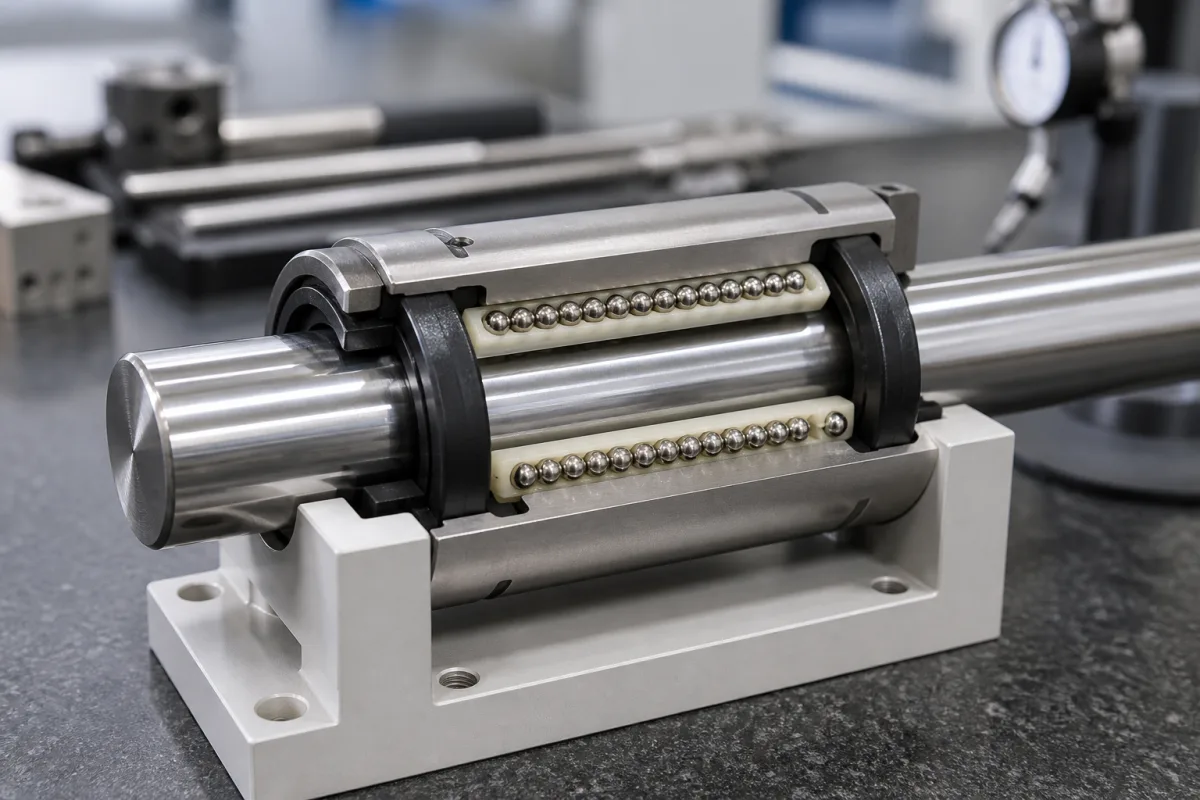
A linear ball bushing is a sleeve with recirculating ball rows that runs on a hardened round shaft to give low-friction straight-line motion. Ask three things first: the basic dynamic load rating and the life basis it is quoted on, the shaft hardness and tolerance it needs, and the load, speed, stroke and mounting arrangement it will see.
Linear ball bushings (linear ball bearings) and their housings for round shafts, open and closed types. Profile-rail linear guides, ball splines, plain polymer bushings and ball screws are outside this page.
CNFX editorial research · Sources checked October 12, 2026 · 4 sources
THK's selection guide defines the linear bushing's nominal life as L10 = (C/Pc)³ × 50 km, where C is the basic dynamic load rating and Pc the calculated load, and notes that the formula may not apply when the stroke is no more than twice the nut length. Ratings quoted for a 100 km life convert as C100 = C50 ÷ 1.26 under ISO 14728-1. The modified life is L10m = (α × C/Pc)³ × 50 km with α = fH × fT × fC ÷ fW. Service life in hours is Lh = L10 × 10³ ÷ (2 × stroke in m × reciprocations per minute × 60). [1]
THK's load factor fW is 1 to 1.2 for faint vibration at speeds up to 0.25 m/s, 1.2 to 1.5 for weak, 1.5 to 2 for medium, and 2 to 3.5 for strong vibration or impact above 2 m/s. [1]
Editorial calculation: with an illustrative C = 1,000 N and Pc = 200 N, L10 = 5³ × 50 = 6,250 km; at a 0.3 m stroke and 20 reciprocations per minute that is about 8,700 hours. With fW = 1.5 the life falls to about 1,850 km, or 2,570 hours. A rating of 1,000 N quoted on a 50 km basis equals about 794 N on a 100 km basis. [1] Ask each supplier which life basis its C value uses.
NB's slide bush catalogue uses the same 50 km form, L = (fH · fT · fC / fW · C / P)³ · 50, with life in hours Lh = L · 10³ / (2 · ℓs · n1 · 60). [2] Bosch Rexroth's linear bushing tables instead state that dynamic load ratings are based on a total travel of 100,000 m and that the C values are multiplied by 1.26 when based on 50,000 m. [3][4]
Editorial calculation: Rexroth's standard 20 mm bushing has C = 1,170 N (minimum value) on the 100,000 m basis. At P = 200 N, (1,170/200)³ × 100 km ≈ 20,000 km; converting first, 1,170 × 1.26 ≈ 1,474 N on the 50 km basis, and (1,474/200)³ × 50 km also gives about 20,000 km. The life is the same; only the quoted C differs, which is why a 50 km rating looks 26% higher than a 100 km rating for the same bushing. [3][1]
Give the supplier the load and its direction, moments, speed, stroke and cycle rate, required life, shaft diameter, tolerance and hardness, number of bushings per shaft and their spacing, open or closed type, seals, lubrication, temperature and housing.
02
Check shaft hardness, ball-row orientation and contact
THK says the raceway must be 58–64 HRC for full load capacity; below that both dynamic and static ratings fall by the hardness factor fH, which its chart shows dropping to about 0.5 at 50 HRC. Because a linear bushing's balls run directly on the shaft, ask for the shaft's hardness as well as the bushing's. Above 100 °C a temperature factor applies and above 80 °C a type with metal retainer plates should be used. [1]
Ratings in tables assume one ball row directly under the load; with two rows sharing the load, THK's multipliers range from 1.25 × C to 1.46 × C depending on the number of rows. When two or more bushings are mounted in close contact, multiply C and C0 by the contact factor: 0.81 for 2, 0.72 for 3, 0.66 for 4 and 0.61 for 5. [1]
Editorial calculation: since life varies with the cube of the rating, fH = 0.5 reduces life to 0.5³ = 12.5% of the full-hardness value. [1]
NB's notes on shaft selection recommend a hardness of 58 HRC or more and a surface roughness below Ra 0.4, and warn that the parallelism of two or more shafts strongly affects motion and life. Its normal choice is a clearance fit for the shaft, with a transition fit for higher accuracy; for its RBW type it names a g6 shaft for the clearance fit and h6 for the transition fit, and H7 for the housing when a flange bush uses its outer cylinder as the pilot. [2]
Rexroth shows how the fit sets radial clearance: for its Super a bushing on a 20 mm h6 shaft the clearance is +11 to +43 µm in an H7 bore, −7 to +25 µm in K7 and −14 to +18 µm in M7. For its standard bushing it recommends an H6 or H7 housing bore and determines radial clearance statistically from bore and shaft tolerances. [4][3]
Open types: NB states that when the load acts constantly toward the opening, fewer ball rows carry it, and its Table C-8 reduces the basic static load rating to between 0.35C and 0.64C depending on size (3-row steel-retainer types excluded); Rexroth gives open-type ratings for the main load direction only. [2][4]
03
Compare standard and high-capacity designs in the same envelope
Bosch Rexroth's 2015 linear bushing catalogue (R999000488) lists, for a 20 mm shaft, a standard closed bushing (R0600) and a Super a closed bushing (R0670) with the same outer diameter of 32 mm and length of 45 mm. [3][4]
The standard bushing has a hardened and machined outer sleeve, a steel ball retainer (POM or PA for shafts of 3 to 10 mm) and 5 ball rows at 20 mm; it lists C = 1,170–1,390 N and C0 = 860–1,250 N, and weighs 0.100 kg. [3]
The Super a bushing has a PA or POM outer sleeve and retainer carrying hardened steel bearing plates with machined ball grooves, compensates misalignment up to 30′ and has 6 ball rows at 20 mm; it lists C = 2,020–2,470 N and C0 = 1,050–1,340 N, and weighs 0.061 kg. At 50 mm the two designs list C = 8,260–8,740 N and 12,060–14,730 N respectively. [3][4]
Editorial calculation: at the same load the Super a's minimum C of 2,020 N is 1.73 times the standard's 1,170 N, which by the cube law gives about 5.1 times the rated life, at 61% of the weight. Check the rating basis and the load direction before comparing across makers. [3][4]
NB groups its slide bushes by retainer arrangement: with the single type as 1, its comparison table lists dynamic ratings up to 1.6, static ratings up to 2 and allowable static moment up to about 21 for multi-retainer types, and it recommends double or triple types where a moment load applies. Its GM series uses resin sub-parts for a weight reduction of 30–50% against the SM series. [2]
04
Match materials, temperature, seals and lubrication
NB makes the standard slide bush outer cylinder from bearing steel and the anti-corrosion type from martensitic stainless steel, with steel (stainless for anti-corrosion) or resin retainers. Its operating temperature table gives −20 to 110 °C for steel with a steel retainer, −20 to 80 °C with a resin retainer, and −20 to 140 °C for stainless steel with a steel retainer, falling to 120 °C with a seal. [2]
This matches THK's advice to use metal retainer plates above 80 °C. [1][2]
Seals: NB uses nitrile rubber seals, offers fluororubber seals for SM sizes 6 to 30 for high temperature, and a double-lip seal (outer lip against particles, inner lip against grease leakage) for SM(S) 6 to 30 with somewhat higher seal resistance. Rexroth's standard bushings without wiper seals allow higher temperatures from 12 mm shaft diameter. [2][3]
Lubrication: NB ships slide bushes with anti-rust oil, asks for cleaning before lubrication, and recommends lithium soap-based grease with periodic relubrication. Rexroth's Super a bushings come without initial lubrication. [2][4]
05
Linear bearings sold beside guides, screws and shafts
Limon, Asia Fon, ALM, VXO and LinRail list linear ball bearings or bushings alongside linear guides, ball screws, shafts and linear modules.
Compare their listings on rated C with its life basis, ball rows, retainer material and fit, as set out above. [3][2]
06
Sleeve, ball rows, retainer and the shaft as raceway
The shaft sits in this list because the balls run directly on it: its hardness, not only the bushing's, decides whether the catalogue rating holds. [1]
Part
Role
Fix in the order
Outer sleeve
Carries ball tracks and load; bearing steel, stainless or plastic with steel plates. [2][4]
Type: closed, open, adjustable.
Ball rows
Rows facing the load set the rating; 5 or 6 rows at 20 mm in two designs. [1][3][4]
Number of rows.
Retainer
Guides recirculating balls; metal above 80 °C. [1][2]
Retainer material.
Shaft
Raceway; 58–64 HRC for full rating, Ra below 0.4. [1][2]
Hardness, tolerance, finish.
Seals
Keep out contamination; nitrile or fluororubber. [2]
Before quoting: rating basis, housing fit and radial clearance
Read the dynamic load rating row together with its life basis: the same bushing shows a C value 26% higher on the 50 km basis than on the 100 km basis, so two quotes can differ on paper without differing in life. [1][3]
Field
What it means and published values
Ask the supplier for
Bore diameter (mm)
Shaft diameter; g6 or h6 shaft in one maker's fits. [2]
Bore and tolerance.
Outer diameter (mm)
Housing fit; 32 mm for a 20 mm shaft in two designs. [3][4]
OD and tolerance.
Length (mm)
Nut length; life formula limit at strokes ≤2× length. [1]
Length.
Dynamic load rating (N)
C; state 50 or 100 km basis; ×1.26 from 100 to 50 km. [1][3]
C and its basis.
Static load rating (N)
C0; also reduced by hardness and in open types. [1][2]
C0.
Operating temperature range (°C)
Metal retainer above 80 °C; −20 to 110 °C steel/steel in one catalogue. [1][2]
Range.
Tolerance grade
Accuracy class.
Grade.
Radial clearance (mm)
+11 to +43 µm (h6/H7) to −14 to +18 µm (h6/M7) for one 20 mm bushing. [4]
Explore company information and manufacturing capabilities, then discuss the scope of your project with a relevant supplier.
Share this page
Compiled and source-reviewed by the CNFX editorial team.
Each manufacturer above links to the page on that company's own website where the product is listed, with the date we checked it. How we source and review
· Page last updated 13 October 2026
Buyer questions
How long will a linear ball bushing last?
THK gives L10 = (C/Pc)³ × 50 km, modified by hardness, temperature, contact and load factors; convert to hours from stroke and cycle rate. [1]
Why does shaft hardness matter?
The shaft is the raceway; below 58 HRC ratings fall, to about half at 50 HRC, which cuts life to about one eighth. [1]
Are load ratings comparable between suppliers?
Only on the same basis: a C quoted for 50 km equals C ÷ 1.26 on a 100 km basis. [1]
Can a higher-capacity bushing fit the same housing?
In one catalogue, yes: Rexroth lists its standard and Super a bushings for a 20 mm shaft at 32 mm outside diameter and 45 mm length, with C of 1,170–1,390 N and 2,020–2,470 N. [3][4]
What shaft does a linear ball bushing need?
NB recommends 58 HRC or more and roughness below Ra 0.4; THK gives 58–64 HRC for full load capacity. [2][1]
Sources and what still needs a direct check
Sources checked 2026-10-12. THK, NB and Bosch Rexroth are linear motion component makers; their catalogues describe their own products and methods, and THK references ISO 14728-1 for rating conversion. Rexroth and NB pages are catalogue copies hosted by distributors.