Industry-Verified Manufacturing Data (2026)

Hoist Unit

Based on aggregated insights from multiple verified factory profiles within the CNFX directory, the standard Hoist Unit used in the Machinery and Equipment Manufacturing sector typically supports operational capacities ranging from standard industrial configurations to heavy-duty production requirements.

Technical Definition & Core Assembly

A canonical Hoist Unit is characterized by the integration of Hoist Motor and Gearbox / Reduction Gear. In industrial production environments, manufacturers listed on CNFX commonly emphasize Alloy Steel construction to support stable, high-cycle operation across diverse manufacturing scenarios.

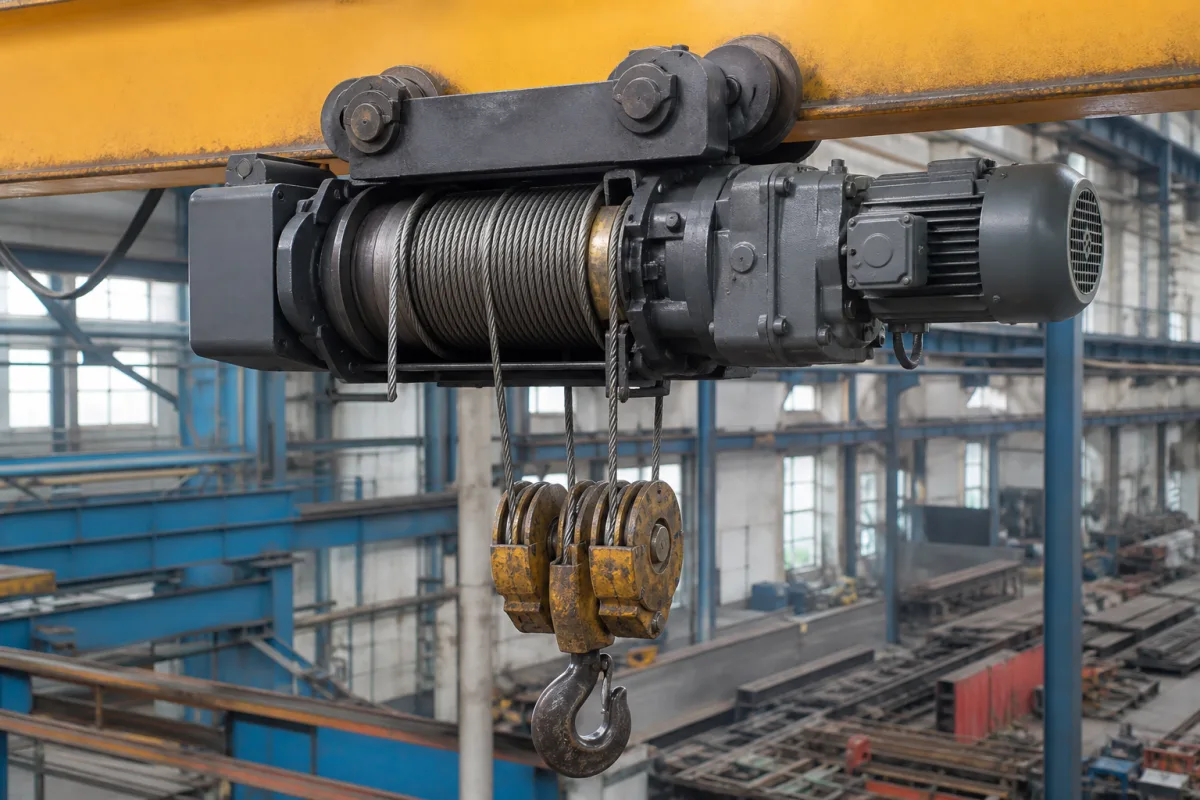
The core lifting mechanism within a material handling crane that provides vertical movement capability.
Product Specifications

Technical details and manufacturing context for Hoist Unit

Definition
A hoist unit is the essential mechanical assembly within a material handling crane responsible for lifting, lowering, and suspending loads. It typically consists of a motor, gearbox, drum or spool, wire rope or chain, and a hook or lifting attachment. As a critical part of the crane, it directly determines the lifting capacity, speed, and precision of the load-handling operation.
Working Principle
An electric or hydraulic motor provides rotational power, which is transmitted and reduced through a gearbox to a drum. The drum winds or unwinds a wire rope or chain, causing the attached hook block to raise or lower the load. Braking systems are integrated to control descent and hold loads securely in position.
Common Materials
Alloy Steel, High-Strength Wire Rope
Technical Parameters
  • Rated lifting capacity of the hoist unit. (kg) Per Request
Components / BOM
  • Hoist Motor
    Provides the primary rotational power for lifting and lowering operations.
    Material: Electrical Steel, Copper Windings
  • Gearbox / Reduction Gear
    Reduces the high-speed, low-torque output of the motor to a low-speed, high-torque output suitable for lifting heavy loads.
    Material: Alloy Steel (Gears), Cast Iron (Housing)
  • Drum or Sheave
    The cylindrical component around which the wire rope or chain is wound to raise or lower the load.
    Material: Alloy Steel
  • Wire Rope / Chain
    The flexible tensile member that connects the drum to the hook block and directly supports the load.
    Material: High-Carbon Steel Wire, Alloy Steel (Links)
  • Hook Block
    The assembly at the end of the rope/chain, consisting of the hook, swivel, and sheaves, to which the load is attached.
    Material: Forged Alloy Steel
  • Braking System
    Mechanically or electrically engages to control the descent of a load and hold it securely in a stopped position.
    Material: Friction Material, Steel
Engineering Reasoning
0.5-25 m/min lifting speed, 1-50 kN lifting capacity, -20°C to +60°C ambient temperature
Wire rope stress exceeds 1570 MPa yield strength, gear tooth bending stress surpasses 400 MPa fatigue limit, motor winding temperature exceeds 155°C insulation class F limit
Design Rationale: Wire rope failure occurs due to cumulative fatigue damage from cyclic bending over sheaves following Miner's rule, gear tooth pitting initiates when Hertzian contact stress exceeds 1200 MPa surface endurance limit, motor insulation breakdown follows Arrhenius law where lifetime halves per 10°C above rated temperature
Risk Mitigation (FMEA)
Trigger Asynchronous motor phase imbalance exceeding 5% voltage differential
Mode: Motor winding overheating leading to insulation breakdown at 155°C
Strategy: Embedded thermal sensors with Class B insulation and phase monitoring relay triggering shutdown at 130°C
Trigger Wire rope overspooling causing 3+ layer cross-winding on drum
Mode: Localized crushing stress exceeding 1800 MPa causing core wire fracture
Strategy: Absolute encoder with 0.1° resolution on drum shaft and software limit switch preventing >95% drum capacity utilization

Industry Taxonomies & Aliases

Commonly used trade names and technical identifiers for Hoist Unit.

Applied To / Applications

This component is essential for the following industrial systems and equipment:

Industrial Ecosystem & Supply Chain DNA

Complementary Systems
Downstream Applications
Specialized Tooling

Application Fit & Sizing Matrix

Operational Limits
pressure: Atmospheric to 10 bar
other spec: Max Load Capacity: 1-50 tons, Duty Cycle: Up to 60%
temperature: -20°C to +80°C
Media Compatibility
✓ General Manufacturing Materials ✓ Construction Components ✓ Warehouse Goods
Unsuitable: Corrosive Chemical Environments
Sizing Data Required
  • Maximum Load Weight (tons)
  • Required Lift Height (meters)
  • Operating Duty Cycle (%)

Reliability & Engineering Risk Analysis

Failure Mode & Root Cause
Wire rope degradation
Cause: Fatigue from cyclic loading, corrosion due to environmental exposure, or improper spooling causing kinks and abrasion against drum flanges.
Brake system failure
Cause: Worn brake pads or linings from frequent use, contamination by oil or grease, or misalignment leading to insufficient braking torque.
Maintenance Indicators
  • Unusual grinding or squealing noises during operation, indicating potential gear, bearing, or brake issues.
  • Excessive vibration or erratic movement of the load, suggesting misalignment, worn components, or structural looseness.
Engineering Tips
  • Implement a routine lubrication schedule using manufacturer-specified lubricants for gears, bearings, and wire ropes to reduce friction and prevent corrosion.
  • Conduct regular visual and non-destructive testing (e.g., magnetic particle inspection) on critical components like hooks, wire ropes, and structural welds to detect early signs of wear or cracks.

Compliance & Manufacturing Standards

Reference Standards
ISO 4309:2010 - Cranes - Wire ropes - Care, maintenance, installation, examination and discard ANSI/ASME B30.16 - Overhead Hoists (Underhung) DIN 15020-1:1974 - Cranes; principles relating to rope drives; calculation and construction
Manufacturing Precision
  • Wire rope diameter tolerance: +/- 1% of nominal diameter
  • Hook throat opening tolerance: +/- 5% of nominal dimension
Quality Inspection
  • Load test to 125% of rated capacity
  • Non-destructive testing (NDT) of critical welds and components

Factories Producing Hoist Unit

Verified manufacturers with capability to produce this product in China

✓ 95% Supplier Capability Match Found

T Technical Director from Brazil Feb 15, 2026
★★★★★
"Standard OEM quality for Machinery and Equipment Manufacturing applications. The Hoist Unit arrived with full certification."
Technical Specifications Verified
P Project Engineer from Canada Feb 12, 2026
★★★★☆
"Great transparency on the Hoist Unit components. Essential for our Machinery and Equipment Manufacturing supply chain. (Delivery took slightly longer than expected, but technical support was excellent.)"
Technical Specifications Verified
S Sourcing Manager from United States Feb 09, 2026
★★★★★
"The Hoist Unit we sourced perfectly fits our Machinery and Equipment Manufacturing production line requirements."
Technical Specifications Verified
Verification Protocol

“Feedback is collected from verified sourcing managers during RFQ (Request for Quote) and factory evaluation processes on CNFX. These reports represent historical performance data and technical audit summaries from our B2B manufacturing network.”

7 sourcing managers are analyzing this specification now. Last inquiry for Hoist Unit from India (1h ago).

Supply Chain Compatible Machinery & Devices

Automated Assembly Line System

Integrated production system for sequential component assembly operations

Explore Specs →
Automated Powder Coating System

Integrated industrial system for applying dry powder coatings to metal substrates.

Explore Specs →
Centrifugal Pump Impeller

Rotating component that transfers energy to fluid in centrifugal pumps.

Explore Specs →
High-Precision CNC Laser Cutting Machine

Computer-controlled industrial machine using focused laser beams to cut sheet metal with micron-level accuracy.

Explore Specs →

Frequently Asked Questions

What materials are used in the construction of this hoist unit?

This hoist unit is constructed from durable alloy steel components and utilizes high-strength wire rope for reliable lifting performance in industrial applications.

What are the main components included in the hoist unit BOM?

The bill of materials includes a hoist motor, gearbox/reduction gear, drum or sheave, wire rope/chain, hook block, and braking system for complete lifting functionality.

What types of cranes is this hoist unit designed for?

This hoist unit serves as the core lifting mechanism for material handling cranes across various industrial applications, providing essential vertical movement capability.

Can I contact factories directly on CNFX?

CNFX is an open directory, not a transaction platform. Each factory profile provides direct contact information and production details to help you initiate direct inquiries with Chinese suppliers.

Get Quote for Hoist Unit

Request technical pricing, lead times, or customized specifications for Hoist Unit directly from verified manufacturing units.

Your business information is encrypted and only shared with verified Hoist Unit suppliers.

Thank you! Your message has been sent. We'll respond within 1–3 business days.

Need to Manufacture Hoist Unit?

Connect with verified factories specializing in this product category

Add Your Factory Contact Us
Previous Product
Hoist Motor
Next Product
Hoist Winch