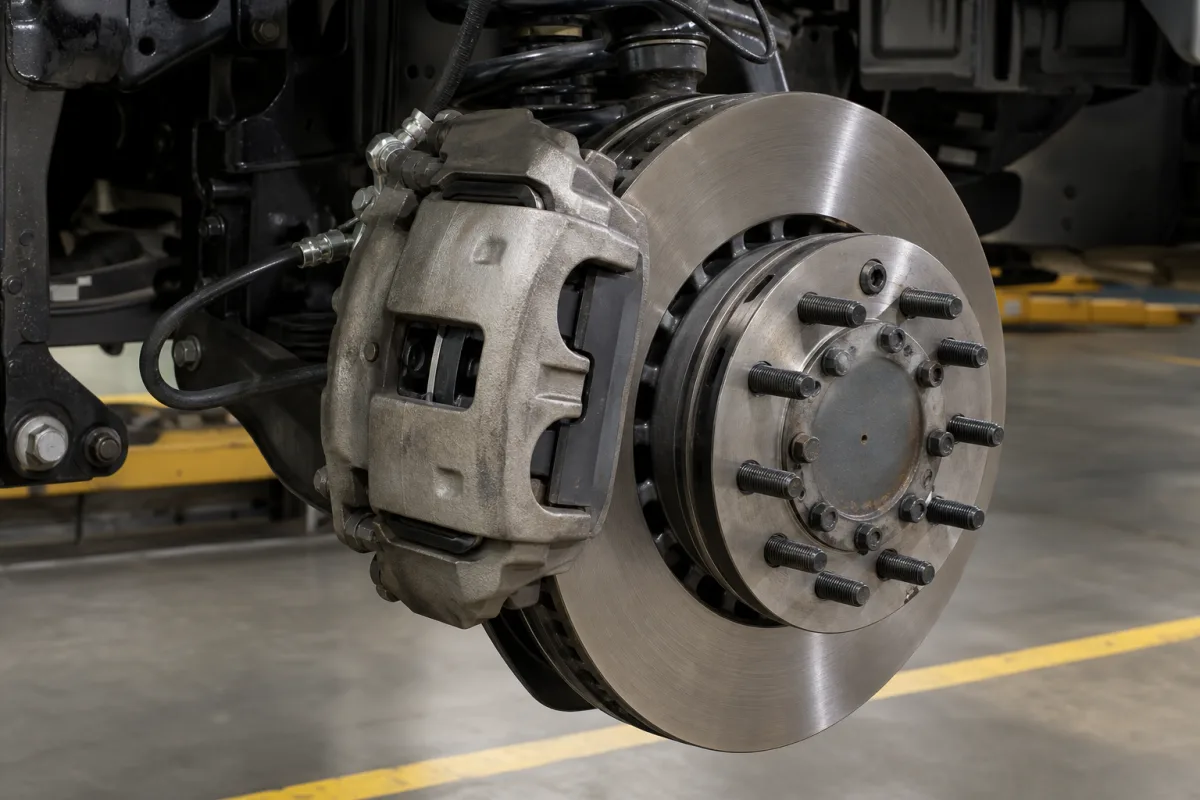
Air braking system for heavy trucks, truck tractors and buses
Air brake systems for heavy trucks, tractors and buses · FMVSS No. 121 stopping distances, drum, disc or hybrid foundation brakes, compressor and reservoir sizing, FMCSA roadside performance
On a heavy truck, tractor or bus the braking system is compressed air: a compressor and reservoirs store it, valves send it to a brake chamber at each wheel, and the chamber applies a drum or disc foundation brake, with an antilock system modulating the pressure. The system has to be specified as a whole because the US standard tests the whole vehicle: the stopping distance from 60 mph, how fast air reaches the chambers, and how much air is stored. Decide the vehicle class and the stopping-distance column it falls in, then the foundation brakes on steer and drive axles, then the air supply.
Complete air brake systems for heavy trucks, truck tractors and buses (compressor, reservoirs, valves, brake chambers, drum or air disc foundation brakes and antilock control) and the vehicle-level performance they must meet. Hydraulic disc brake calipers for cars, light trucks and motorcycles are covered on the Brake caliper page; pads, discs and drums sold as parts, railway and marine brakes, forklift brakes and hydraulic accumulators are outside this page.
CNFX editorial research · Sources checked October 12, 2026 · 3 sources
Stopping distance from 60 mph by vehicle class under FMVSS No. 121
FMVSS No. 121 measures stopping distance from the first movement of the service brake control, and Table II sets a different limit for each vehicle class and load condition. [1]
The 250 ft tractor limit dates from NHTSA's 2009 final rule, which cut the maximum stopping distance for loaded heavy truck tractors from 355 ft, describing it as a 30 percent reduction for approximately 99 percent of the fleet, and set 310 ft for a small number of very heavy severe-service tractors. [2] Editorial calculation: 250 ÷ 355 ≈ 0.70, a 30% cut; the metric figures above use 1 ft = 0.3048 m.
The rule set compliance by August 1, 2011 for three-axle tractors with a GVWR of 59,600 lb or less and by August 1, 2013 for two-axle tractors and those above 59,600 lb. NHTSA estimated about 227 lives saved and 300 serious injuries prevented each year once the fleet was equipped. [2]
Tell the supplier the vehicle type (bus, single-unit truck or tractor), number of axles, GVWR and axle ratings, the market and standard it must certify to, and whether it tows air-braked trailers.
02
Enhanced S-cam drums, air disc brakes or a hybrid on steer and drive axles
NHTSA named three ways to meet the shorter stopping distances: enhanced drum brakes, air disc brakes, or hybrid disc/drum systems. Its testing indicated that standard three-axle tractors can likely meet 250 ft with enhanced drums at steer and drive positions, while two-axle and severe-service tractors would likely need disc brakes at all wheel positions. [2]
Freightliner, commenting on the rule, put disc brakes at $1,627 for a three-axle and $963 for a two-axle tractor, against $222 for drums on a three-axle tractor, figures NHTSA called very similar to its own. [2] Editorial calculation: $1,475 ÷ $211 ≈ 7, so all-disc cost about seven times the drum upgrade in NHTSA's 2009 estimate. Because standard three-axle tractors make up roughly 82 percent of tractors, NHTSA put the average incremental cost at $413 per tractor. [2] These are 2009 cost estimates for meeting the rule, not current prices; ask suppliers for prices and for the stopping-distance test report of the exact brake combination on a comparable vehicle.
Option
NHTSA cost estimate
What NHTSA reported about performance
Enhanced drum brakes, all positions
$85 per steer axle, $65 per drive axle; $211 per tractor incremental [2]
Likely sufficient for standard three-axle tractors; wider 16.5 × 8 in or 16.5 × 8.625 in drive drums are thought to add thermal capacity [2]
In one dynamometer comparison, lost 24% of maximum effectiveness when stopped from 70 mph, against 42% for an S-cam drum; with torque similar to a drum at low pressure, no brake-balance problem expected on a drive axle [2]
Hybrid disc/drum
No separate figure in the cost discussion reviewed
Named as a compliance option; NHTSA notes a drive axle can carry an enhanced S-cam drum instead of a disc, as in a hybrid or all-drum layout [2]
03
Compressor build-up time, reservoir volume and 0.45 s chamber timing
FMVSS No. 121 requires the compressor to raise supply and service reservoirs from 85 psi to 100 psi, at the engine's maximum recommended speed, within (actual reservoir capacity × 25) ÷ required reservoir capacity seconds. Governor cut-in must be at least 85 psi on buses and 100 psi on trucks. [1]
The combined volume of all service and supply reservoirs must be at least 12 times the combined volume of all service brake chambers. Starting from 100 psi in the service reservoir, air pressure in each brake chamber must reach 60 psi within 0.45 s of the first movement of the service brake control on trucks and buses, 0.50 s on trailers that tow air-braked vehicles and 0.60 s on other trailers. [1] Editorial calculation: with reservoirs exactly at the required capacity the compressor time limit is 25 s; doubling the reservoir volume doubles the allowed time to 50 s, so the compressor must still fill the larger volume at the same rate.
Each truck tractor built on or after March 1, 1997 and each single-unit vehicle built on or after March 1, 1998 must have an antilock brake system directly controlling the wheels of at least one front and one rear axle, with no more than three wheels per modulator on a tractor, and a driver warning lamp for ABS malfunctions. [1]
04
Roadside brake performance at 20 mph under FMCSA 49 CFR 393.52
Once in service, a commercial motor vehicle must still meet FMCSA's brake performance table in any load condition found on a public highway, tested from 20 mph on a level, dry, smooth surface within a 12-foot lane. [3]
FMCSA explains that the braking-force percentages are the decelerations divided by 32.2 ft/s² (for example 21 ÷ 32.2 = 65.2%), and that the 20 to 40 ft range of stopping distances reflects the time to apply the brakes and build up brake force, which is greatest for combinations of commercial vehicles. [3] Editorial calculation: 14 ÷ 32.2 ≈ 0.435, the 43.5% braking force required of heavy trucks. Vehicles over 10,000 lb may instead be checked for braking force and stopping distance on a performance-based brake tester. [3]
Vehicle type (49 CFR 393.52)
Braking force, % of weight
Deceleration (ft/s²)
Service stop from 20 mph (ft)
Emergency stop from 20 mph (ft)
Passenger vehicles up to 10 seats on a car chassis
Explore company information and manufacturing capabilities, then discuss the scope of your project with a relevant supplier.
Share this page
Compiled and source-reviewed by the CNFX editorial team.
Each manufacturer above links to the page on that company's own website where the product is listed, with the date we checked it. How we source and review
· Page last updated 13 October 2026
Buyer questions
How quickly must a loaded truck tractor stop from 60 mph in the US?
Within 250 ft for loaded two-axle tractors and three- or four-axle tractors up to 70,000 or 85,000 lb GVWR under FMVSS No. 121, or 310 ft for heavier three-axle and four-axle tractors; the 2009 rule cut the limit from 355 ft. [1][2]
Do heavy trucks need air disc brakes to meet the stopping distance?
Not always; NHTSA's testing indicated standard three-axle tractors can likely meet 250 ft with enhanced drums, while two-axle and severe-service tractors would likely need disc brakes at all wheel positions. [2]
What braking force must a heavy truck show at roadside?
49 CFR 393.52 requires 43.5% of gross weight, 14 ft/s² deceleration and a stop from 20 mph within 35 or 40 ft depending on vehicle type. [3]
Sources and what still needs a direct check
Sources checked 2026-10-12. FMVSS No. 121 is NHTSA's standard for air brake systems; the 2009 Federal Register final rule gives NHTSA's test findings and cost estimates for meeting it; 49 CFR 393.52 is FMCSA's in-service brake performance rule.