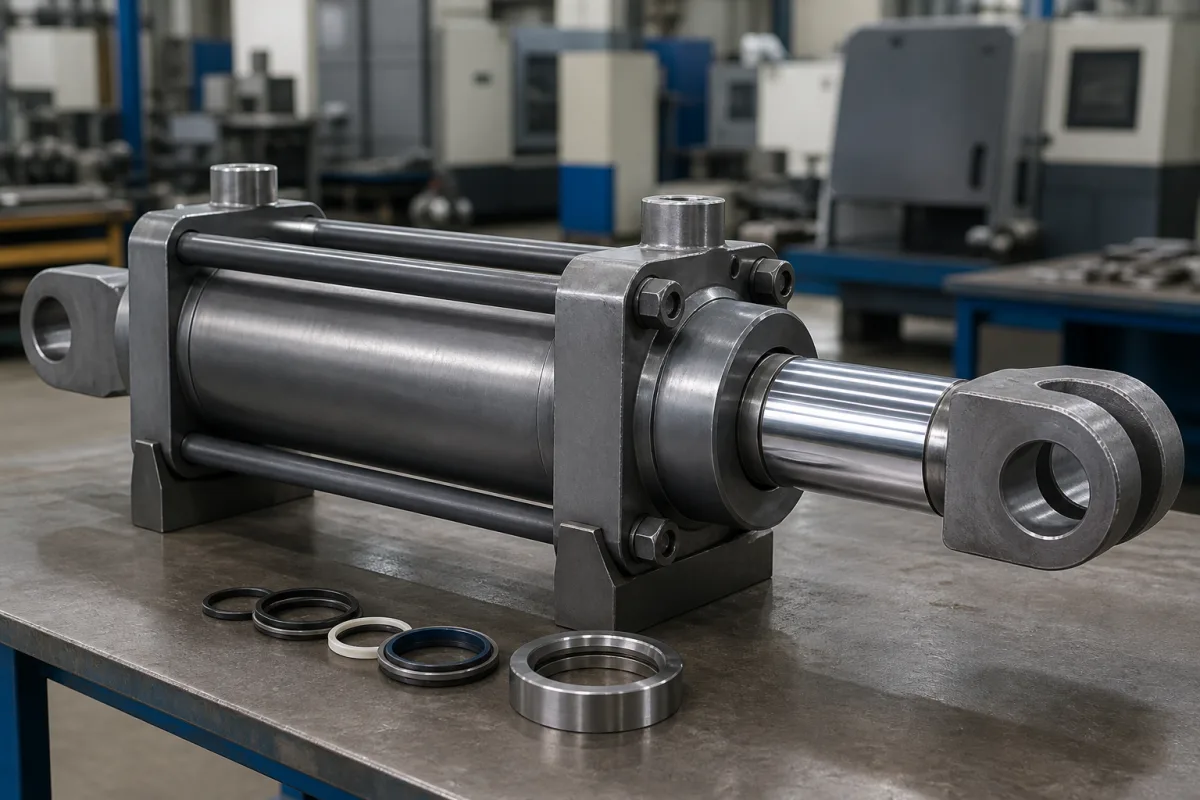
Hydraulic ram assembly as a resealable ISO 6020-2 tie-rod cylinder: the rod gland, seal kits and clevis mounting of a 160 bar double-acting ram
ISO 6020-2 compact tie-rod cylinders, 160 bar nominal · rod gland cartridges and seal kits by rod diameter, seal systems from 0.5 to 4 m/s, clevis mounting with a stroke factor of 2 or 4, cushioning and fluid cleanliness
The ram in the picture is a square-head tie-rod cylinder with a clevis at each end and its seals laid out beside it. Built to the ISO 6020-2 compact series, it can be swapped for another maker's cylinder of the same bore, rod and mounting, and it is designed to be opened up: the gland at the rod end comes out with its seals, and kits are sold by rod and bore size. What to settle before ordering is the seal system for the speed, temperature and fluid, how the clevis mounting affects the rod size, and how the ram will be resealed.
Double-acting single-rod hydraulic cylinders of the ISO 6020-2 (DIN 24554) compact series, 16 MPa (160 bar) nominal, bores of 25 to 200 mm, with tie-rod construction and clevis, eye, foot, flange or trunnion mountings: seal systems, rod gland cartridges and seal kits, buckling checks for pivot-mounted rams, cushioning and fluid requirements. Low-pressure NFPA tie-rod cylinders for 750–1,500 psi and air-over-oil circuits are covered on the Low-pressure hydraulic tie-rod cylinder page; single-acting rams on the Hydraulic ram page; double-acting single-rod cylinders of other designs on the Hydraulic cylinder page; piston seals and wear rings alone on the Piston assembly for hydraulic cylinders page; excavator boom cylinders on the Hydraulic cylinder assembly for excavator booms page; press main cylinders with prefill valves on the Main cylinder for hydraulic presses page; press brake Y1/Y2 beams on the Press brake ram page; and rolling-mill screwdown rams on the Hydraulic screwdown cylinder page. Complete hydraulic presses are covered on the Hydraulic press page.
CNFX editorial research · Sources checked October 13, 2026 · 3 sources
Choosing the seal system and the gland kit that will reseal the ram
Atos offers its CK cylinders (ISO 6020-2) with five seal systems and states that the choice depends on speed, operating frequency, fluid type and temperature, and that all seals, static and dynamic, must be periodically replaced using spare kits. [1]
Parker's HMI series (also ISO 6020/2) puts the rod seals in a detachable gland that, the catalogue states, can be removed with its seals without dismantling the cylinder. The standard gland pairs a serrated polyurethane lipseal, rated up to 0.5 m/s, with a double-lip wiper; a low-friction gland uses two PTFE stepped seals with the same wiper type. Standard piston seals hold a load in position and run to 0.5 m/s; low-friction PTFE piston seals run to 1 m/s but are not suitable for holding a load in a fixed position. [3]
Parker lists its service parts by rod diameter: a gland service cartridge kit (the gland/bearing cartridge with wiper, lipseal and O-rings) and a seals-only gland service kit for rods of 12, 14, 18, 22, 28, 36, 45, 56, 70, 90, 110 and 140 mm, each also in a low-friction version, and piston service kits by bore from 25 to 200 mm in standard, LoadMaster and low-friction seals. [3] Atos asks for the bore, rod diameter and seal system in its seal spare-part code. [1]
A gland drain, Parker notes, relieves oil that collects between the gland seals on long-stroke cylinders, on cylinders with constant back pressure, or where the extend speed is more than twice the retract speed; a transparent tube to the reservoir then shows when the gland needs servicing. [3]
State the rod and piston speeds, the fluid and its temperature range, whether the ram must hold a load in position, and ask for the gland and piston kit part numbers to be listed with the cylinder.
02
Clevis-to-clevis mounting: why the rod is sized as if it were two or four strokes long
Atos and Parker size the rod of a pushing cylinder the same way: the fully extended cylinder is treated as a bar of rod diameter, the stroke is multiplied by a stroke factor that depends on the mounting and the rod-end connection, and the rod diameter is read from a chart against the push force. [2][3]
Parker recommends fixed clevis styles for movement in a single plane and a spherical bearing style where the cylinder moves in more than one plane, and its LoadMaster piston, with extra heavy-duty wear rings, for long-stroke cylinders, especially when pivot mounted. [3]
Editorial calculation: Atos gives a 63 mm bore a push area of 31.2 cm², so at the 160 bar nominal pressure it pushes about 31.2 × 160 × 10 = 49,900 N, or 49.9 kN. Mounted clevis to clevis with a 400 mm stroke and a rigidly guided pivoted rod end, the buckling check uses an ideal length of 2.0 × 400 = 800 mm; with a rod end that is not rigidly guided it becomes 4.0 × 400 = 1,600 mm, and the minimum rod diameter is read from the maker's chart at that length and force. The stroke is an assumed example. [2]
Mounting and rod end
Atos stroke factor
Parker stroke factor
Rear clevis or eye (Atos C, D, S; Parker B, BB), rod end pivoted and rigidly guided
Give the mounting style at each end, whether the rod end is guided, the push force and the stroke, and ask the supplier to show the buckling check for the rod offered.
03
Pressure rating, cushioning and the oil the seals expect
Atos rates its CK series at 16 MPa (160 bar) nominal and 25 MPa (250 bar) maximum, for bores of 25 to 200 mm, rods of 12 to 140 mm and strokes up to 5,000 mm. [1] Parker's HMI and HMD catalogue gives working pressures up to 210 bar depending on the rod end and type of service. [3]
Atos recommends stroke-end cushioning where the piston makes a full stroke faster than 0.05 m/s, to cut noise and shock, and for heavy vertical loads; its maximum speed with cushioning falls from 1 m/s for 25–50 mm bores to 0.5 m/s for 160 and 200 mm bores. It also advises keeping oil velocity in the pipes at the cylinder ports below 6 m/s. [1][2]
For the fluid, Atos specifies a viscosity of 15 to 100 mm²/s, a temperature of 0 to 70 °C and contamination class ISO 20/18/15 to ISO 4406. [1] Parker's piston rods are induction case-hardened to at least 54 HRC before hard chrome plating and polished to 0.2 µm maximum, which the catalogue links to gland seal life. [3]
04
Data for an ISO 6020-2 tie-rod ram
Paste it into your enquiry below or into an email to a maker, then replace every bracket.
Size: [bore; rod diameter; stroke]
Pressure: [working and peak pressure]
Mounting: [cap end style; rod end style; rod-end guidance]
Load: [push and pull force; vertical or horizontal; holding position]
Motion: [extend and retract speed; cycle rate; cushioning]
Seals: [system; fluid type; temperature range]
Service: [gland cartridge and piston kit part numbers; gland drain]
Options: [position transducer; proximity sensors; air bleeds]
Explore company information and manufacturing capabilities, then discuss the scope of your project with a relevant supplier.
Share this page
Compiled and source-reviewed by the CNFX editorial team.
Each manufacturer above links to the page on that company's own website where the product is listed, with the date we checked it. How we source and review
· Page last updated 13 October 2026
Buyer questions
Can the rod seals be changed without taking the cylinder apart?
On Parker's HMI series the catalogue states that the detachable gland, complete with rod seals, can be removed without dismantling the cylinder; gland cartridge kits are listed by rod diameter. [3]
Which seals suit a fast ram?
Atos's PTFE-based seal systems 2 and 4 are rated to 4 m/s, against 0.5 m/s for its NBR and polyurethane system 1. [1]
What stroke factor applies to a clevis-mounted ram?
Atos and Parker both give 2.0 with a pivoted, rigidly guided rod end and 4.0 where the rod end is supported but not rigidly guided. [2][3]
How clean must the oil be?
Atos specifies ISO 4406 class 20/18/15, viscosity 15–100 mm²/s and 0–70 °C fluid temperature for its cylinders. [1]
Sources and what still needs a direct check
Sources checked 2026-10-13. Atos's CK cylinder table B137 and sizing table B015, and Parker Hannifin's HMI/HMD tie-rod cylinder catalogue HY07-1150/UK.