Industry-Verified Manufacturing Data (2026)

Hydraulic Ram / Mechanical Slide

Based on aggregated insights from multiple verified factory profiles within the CNFX directory, the standard Hydraulic Ram / Mechanical Slide used in the Machinery and Equipment Manufacturing sector typically supports operational capacities ranging from standard industrial configurations to heavy-duty production requirements.

Technical Definition & Core Assembly

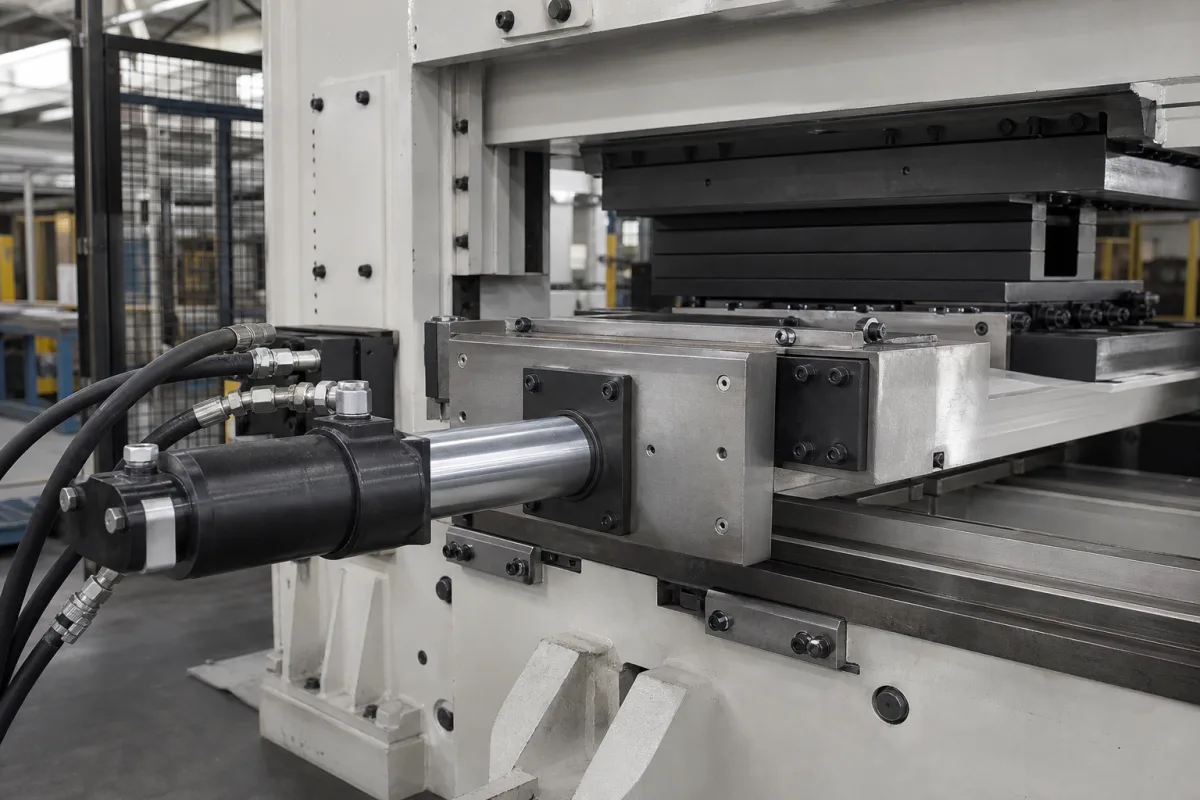
A canonical Hydraulic Ram / Mechanical Slide is characterized by the integration of Hydraulic Cylinder and Linear Guide Rails. In industrial production environments, manufacturers listed on CNFX commonly emphasize Hardened steel construction to support stable, high-cycle operation across diverse manufacturing scenarios.

A combined hydraulic actuation and precision linear motion component for applying controlled force in pressing operations.
Product Specifications

Technical details and manufacturing context for Hydraulic Ram / Mechanical Slide

Definition
A critical component of the Precision Pressing Station that integrates a hydraulic ram for force generation with a mechanical slide system for precise linear positioning. The hydraulic ram provides the pressing force through fluid pressure, while the mechanical slide ensures accurate, repeatable movement and alignment during pressing cycles.
Working Principle
Hydraulic fluid under pressure extends the ram to apply force, while precision mechanical guides (such as linear rails or dovetail slides) control the linear motion path. The system typically includes position sensors and pressure controls to coordinate force application with precise positioning.
Common Materials
Hardened steel, Bronze bushings, Sealing materials
Technical Parameters
  • Stroke length of the ram/slide assembly (mm) Standard Spec
Components / BOM
  • Hydraulic Cylinder
    Generates pressing force through hydraulic pressure
    Material: Hardened steel
  • Linear Guide Rails
    Provides precise linear motion guidance for the slide
    Material: Hardened steel with bronze bushings
  • Position Sensor
    Monitors and controls slide position during operation
    Material: Electronic components with stainless steel housing
Engineering Reasoning
50-210 bar hydraulic pressure, 0.01-0.5 m/s linear velocity, 0.005 mm positioning accuracy
Hydraulic pressure exceeding 250 bar causes seal extrusion, piston rod deflection exceeding 0.15 mm/m induces binding, fluid temperature above 65°C degrades viscosity below 32 cSt
Design Rationale: Seal failure occurs via extrusion when pressure differential exceeds seal material yield strength (EPDM: 12 MPa, Polyurethane: 25 MPa). Binding results from Euler buckling critical load threshold: P_critical = (π²EI)/(kL)² where E=210 GPa (steel), I=πd⁴/64, k=2 (fixed-free). Thermal failure follows Arrhenius equation: viscosity degradation rate doubles per 10°C above 60°C.
Risk Mitigation (FMEA)
Trigger Hydraulic fluid contamination exceeding ISO 4406 18/16/13 cleanliness level
Mode: Spool valve stiction causing pressure oscillations ±15% from setpoint
Strategy: Install 3 μm absolute beta₃≥200 filter with differential pressure monitoring at 0.7 bar threshold
Trigger Misalignment exceeding 0.02 mm/mm between slide ways and load axis
Mode: Asymmetric wear generating >50 N·m side load moment
Strategy: Laser alignment during installation with 0.01 mm/m tolerance and preloaded linear guides (C=15 kN, C0=22 kN)

Industry Taxonomies & Aliases

Commonly used trade names and technical identifiers for Hydraulic Ram / Mechanical Slide.

Applied To / Applications

This component is essential for the following industrial systems and equipment:

Industrial Ecosystem & Supply Chain DNA

Complementary Systems
Downstream Applications
Specialized Tooling

Application Fit & Sizing Matrix

Operational Limits
pressure: Up to 300 bar (4350 psi)
flow rate: 5-100 L/min (depending on cylinder size)
temperature: -20°C to 120°C
slurry concentration: Not recommended for slurry applications; max particulate size 25 μm in filtered hydraulic fluid
Media Compatibility
✓ Hydraulic oil (ISO VG 32-68) ✓ Water-glycol hydraulic fluids ✓ Synthetic ester-based fluids
Unsuitable: Abrasive slurry environments or corrosive chemical media
Sizing Data Required
  • Required force output (kN)
  • Stroke length (mm)
  • Operating cycle frequency (cycles/min)

Reliability & Engineering Risk Analysis

Failure Mode & Root Cause
Seal degradation and leakage
Cause: Contamination ingress (particles, moisture) or chemical incompatibility leading to seal hardening, cracking, or extrusion, resulting in hydraulic fluid loss and pressure drop.
Rod scoring and cylinder bore wear
Cause: Misalignment, side-loading, or inadequate lubrication causing abrasive contact between the rod/piston and cylinder wall, leading to increased friction, seal damage, and loss of precision.
Maintenance Indicators
  • Audible knocking or grinding during operation, indicating misalignment, bearing failure, or internal component contact.
  • Visible hydraulic fluid leakage around rod seals or cylinder connections, signaling seal failure or fitting issues.
Engineering Tips
  • Implement strict contamination control: Use high-quality filters, maintain proper fluid cleanliness (e.g., ISO 4406 standards), and ensure seals are compatible with the hydraulic fluid and operating environment.
  • Ensure precise alignment and mounting: Use alignment tools during installation, check for side-loads regularly, and apply appropriate lubrication to slide mechanisms to prevent uneven wear.

Compliance & Manufacturing Standards

Reference Standards
ISO 6020-2:2015 (Hydraulic fluid power - Mounting dimensions for single rod cylinders, 16 MPa series) ANSI/B93.5M-1985 (Hydraulic Fluid Power - Cylinders - Bore and Rod Diameter Metric Series) DIN 24334 (Hydraulic cylinders - Series 25 - Mounting dimensions)
Manufacturing Precision
  • Cylinder bore diameter: H8 tolerance (+0.022mm to +0.054mm for 50mm bore)
  • Slide way flatness: 0.05mm per 1000mm length
Quality Inspection
  • Pressure testing (1.5x maximum working pressure for 3 minutes)
  • Surface roughness measurement (Ra ≤ 0.8μm for sealing surfaces)

Factories Producing Hydraulic Ram / Mechanical Slide

Verified manufacturers with capability to produce this product in China

✓ 93% Supplier Capability Match Found

P Project Engineer from Germany Feb 22, 2026
★★★★★
"The technical documentation for this Hydraulic Ram / Mechanical Slide is very thorough, especially regarding technical reliability."
Technical Specifications Verified
S Sourcing Manager from Brazil Feb 19, 2026
★★★★★
"Reliable performance in harsh Machinery and Equipment Manufacturing environments. No issues with the Hydraulic Ram / Mechanical Slide so far."
Technical Specifications Verified
P Procurement Specialist from Canada Feb 16, 2026
★★★★★
"Testing the Hydraulic Ram / Mechanical Slide now; the technical reliability results are within 1% of the laboratory datasheet."
Technical Specifications Verified
Verification Protocol

“Feedback is collected from verified sourcing managers during RFQ (Request for Quote) and factory evaluation processes on CNFX. These reports represent historical performance data and technical audit summaries from our B2B manufacturing network.”

5 sourcing managers are analyzing this specification now. Last inquiry for Hydraulic Ram / Mechanical Slide from Turkey (1h ago).

Supply Chain Compatible Machinery & Devices

Heavy-Duty CNC Plasma Cutting Machine

Industrial machine for precision metal cutting using plasma arc technology

Explore Specs →
Automated Assembly Line System

Integrated production system for sequential component assembly operations

Explore Specs →
Automated Powder Coating System

Integrated industrial system for applying dry powder coatings to metal substrates.

Explore Specs →
Centrifugal Pump Impeller

Rotating component that transfers energy to fluid in centrifugal pumps.

Explore Specs →

Frequently Asked Questions

What are the main applications for this hydraulic ram with mechanical slide?

This component is designed for controlled force applications in pressing operations across machinery manufacturing, including metal forming, assembly pressing, and material compaction where precision linear motion is required.

What maintenance is required for the bronze bushings?

Bronze bushings require periodic lubrication and inspection for wear. Proper lubrication intervals depend on operating frequency and load conditions, typically every 500-1000 operating hours in standard industrial environments.

How does the position sensor improve operation?

The integrated position sensor provides real-time feedback on slide position, enabling precise control of stroke length, repeatable positioning accuracy, and integration with automated control systems for consistent pressing force application.

Can I contact factories directly on CNFX?

CNFX is an open directory, not a transaction platform. Each factory profile provides direct contact information and production details to help you initiate direct inquiries with Chinese suppliers.

Get Quote for Hydraulic Ram / Mechanical Slide

Request technical pricing, lead times, or customized specifications for Hydraulic Ram / Mechanical Slide directly from verified manufacturing units.

Your business information is encrypted and only shared with verified Hydraulic Ram / Mechanical Slide suppliers.

Thank you! Your message has been sent. We'll respond within 1–3 business days.

Need to Manufacture Hydraulic Ram / Mechanical Slide?

Connect with verified factories specializing in this product category

Add Your Factory Contact Us
Previous Product
Hydraulic Ram
Next Product
Hydraulic Ram Assembly