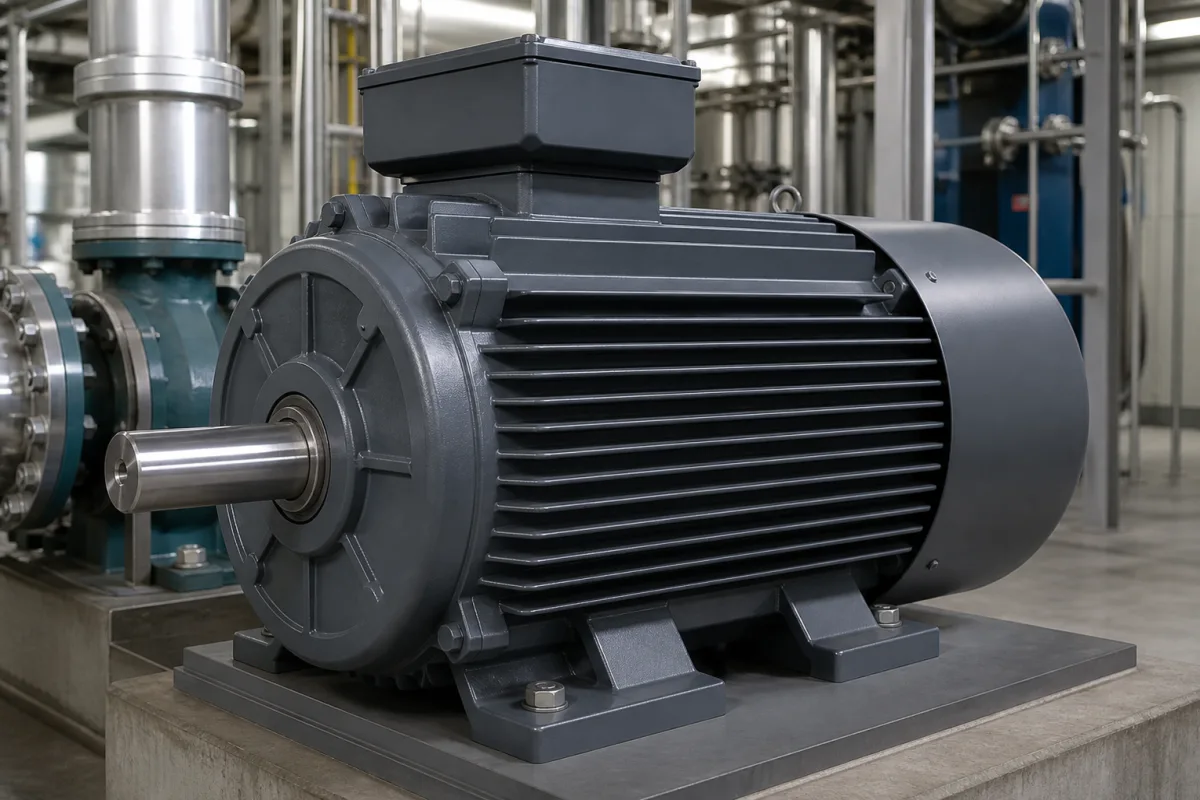
Cast-iron TEFC IEC-frame three-phase motor (IP 55, IC 411, foot-mounted)
Cast-iron IEC-frame motors · IP 55 and IC 411 enclosure codes, class F insulation with class B rise, foot mounting, bearings and frame-160 data
A cast-iron TEFC IEC-frame motor is a three-phase squirrel-cage motor whose stator housing, end shields and feet are cast iron, sealed to IP 55 and cooled by a shaft-mounted fan blowing over a finned frame (IC 411). Ask three things first: what the IP, IC and insulation codes on the nameplate promise, which mounting arrangement and fixing dimensions the frame size gives, and which bearings and thermal protection are fitted.
Totally enclosed fan-cooled three-phase squirrel-cage motors in cast-iron IEC frames, foot-mounted or foot-and-flange-mounted, specified by enclosure and cooling codes, insulation, mounting dimensions and bearings. Motor sizing, load measurement and efficiency-class rules for AC induction, permanent-magnet and DC motors are covered on the Electric motor page. Aluminium-frame motors, open drip-proof motors, servo, stepper and brushless DC motors, and motor controls are outside this page.
CNFX editorial research · Sources checked October 12, 2026 · 3 sources
ABB's general purpose motors catalogue (09-2003) explains the IP code by IEC 60034-5: the first digit 5 means dust-protected and the second digit 5 means protected against water jets. Cooling is designated by IEC 60034-6: in IC 411, the 4 means frame surface cooled and each 1 means self-circulation of the primary and secondary air. Its cast-iron motors in frame sizes 71 to 355 are listed as IP 55, IC 411 with class F insulation. [1]
ABB states that it uses class F insulation with class B temperature rise, giving a 25 °C safety margin that can be used to raise loading by up to 12% for limited periods, to run at higher ambient temperatures or altitudes, or to accept wider voltage and frequency tolerances. Its limits: class F allows a 105 K rise and class B an 80 K rise, both at 40 °C maximum ambient with a 10 K hot-spot margin; the insulation classes are B 130 °C, F 155 °C and H 180 °C. [1]
Editorial calculation: 40 °C ambient + 105 K + 10 K = 155 °C for class F, and 40 + 80 + 10 = 130 °C at class B rise, which is the 25 °C margin ABB quotes. [1] The WEG W22 15 kW listing reviewed states IP 55 TEFC IC 411, a 40 °C ambient rating and one thermistor per phase. [2]
Give the supplier the output, speed (poles), voltage, frequency and connection, the driven machine and whether a variable frequency drive will be used, the mounting arrangement (IM code) and frame size to match, IP and IC codes, ambient temperature and altitude, insulation class and rise, thermal protection, bearings and lubrication, terminal box position and cable entries, and the efficiency class required where the motor will be installed.
02
Check the frame, foot mounting and bearings
ABB's catalogue groups foot-mounted arrangements as IM B3, V5, V6, B6, B7 and B8, and foot-and-flange as IM B35 and B34 variants. For its cast-iron range it lists stator, end shields and terminal box in cast iron HT150 up to frame 250, a reinforced glass-fibre fan under a steel fan cover, paint of at least 60 µm, and D-end/N-end bearings of 6309/6209 at frame 160 and 6310/6210 at frame 180 (2-pole); winding protection is on request in the smaller frames, with 3 PTC thermistors at 150 °C listed as standard in the largest frames of the range. [1]
A distributor listing of WEG's W22 cast-iron IE3 motor, 15 kW 4-pole in frame 160L with B3 foot mounting, gives 1465 rpm and 97.8 Nm at 50 Hz, 27.9 A at 400 V delta, 92.3% efficiency, overall size 329 × 642 × 426 mm, foot holes of 14.5 mm on 254 × 254 mm centres 108 mm back from the shaft shoulder, a 42 × 110 mm shaft, 148 kg and bearings 6309 C3 (drive end) and 6209 Z C3 (non-drive end). [2]
Editorial calculation: 9,550 × 15 kW ÷ 1,465 rpm ≈ 97.8 Nm, matching the listed torque. ABB's 2003 cast-iron M2QA 160 L4A, also 15 kW 4-pole, lists 137 kg and 66 dB(A) sound pressure; the 11 kg gap to the W22's 148 kg shows why the weight and foundation drawing must come from the motor actually quoted. [2][1]
03
Compare a frame-160 motor from two catalogues
Two 15 kW, 4-pole, 400 V 50 Hz cast-iron motors in frame 160, as each source lists them.
The ABB figures come from a 2003 catalogue, before IE efficiency classes; the efficiency row is not a like-for-like efficiency-class comparison. [1]
Longbank's IEC series: IE2, IE3 and IE4 motors in cast-iron or aluminium frames
Of ten companies linked to this product, only Longbank's page shows an IEC motor range with ratings; the others list laminations, magnets, motor controls, BLDC or hub motors, or keyword pages without motor data.
The listing kept describes IE2, IE3 and IE4 asynchronous motors with cast-iron or aluminium bodies and IP 55 protection; ask for the frame-size data sheet, bearing list and test report for the motor quoted.
05
Inside a cast-iron TEFC motor: stator, die-cast rotor, bearings, shields and fan
Materials in this table follow ABB's cast-iron range: HT150 iron housing and end shields, die-cast aluminium rotor and a glass-fibre fan under a steel cover.
Part
Role
Fix in the order
Stator and frame
Copper winding in laminated core inside a finned cast-iron housing. [1]
Nameplate and drawing data to request for a cast-iron IEC motor
Frame size, mounting and weight values come from the frame-160 examples; for any other frame, ask for the dimension drawing and data sheet of the exact motor quoted.
Field
What it means and published values
Ask the supplier for
Rated Power (kW)
Longbank lists IE3 motors from 0.55 to 355 kW. [3]
Longbank lists IE2, IE3 and IE4 IEC low-voltage motors with cast-iron or aluminium bodies.
Longbank Motor
Manufacturing site to be confirmed for the order
Lists IEC series low-voltage motors: IE2, IE3 (0.55–355 kW) and IE4 (2.2–230 kW) asynchronous motors with cast-iron or aluminium bodies and IP 55 protection.
Explore company information and manufacturing capabilities, then discuss the scope of your project with a relevant supplier.
Share this page
Compiled and source-reviewed by the CNFX editorial team.
Each manufacturer above links to the page on that company's own website where the product is listed, with the date we checked it. How we source and review
· Page last updated 13 October 2026
Buyer questions
What does IP 55 IC 411 mean on a motor?
Per ABB's catalogue, IP 55 is dust-protected and protected against water jets; IC 411 is a frame-surface-cooled motor with self-circulating internal and external air. [1]
Why use class F insulation with class B rise?
ABB says it leaves a 25 °C margin that can absorb up to 12% overload for limited periods, higher ambient or altitude, or wider supply tolerances. [1]
What bearings does a frame-160 motor use?
Both ABB's cast-iron range and the WEG W22 160L listing give 6309 at the drive end and 6209 at the non-drive end. [1][2]
Sources and what still needs a direct check
Sources checked 2026-10-12. ABB's catalogue describes its own motors and the IEC coding they follow; the WEG data come from a distributor's listing of that motor; Longbank's page describes its own range.