Industrial Ethernet switches · Managed or unmanaged for I/O traffic, multicast and resiliency, temperature and EMC ratings, power and mounting
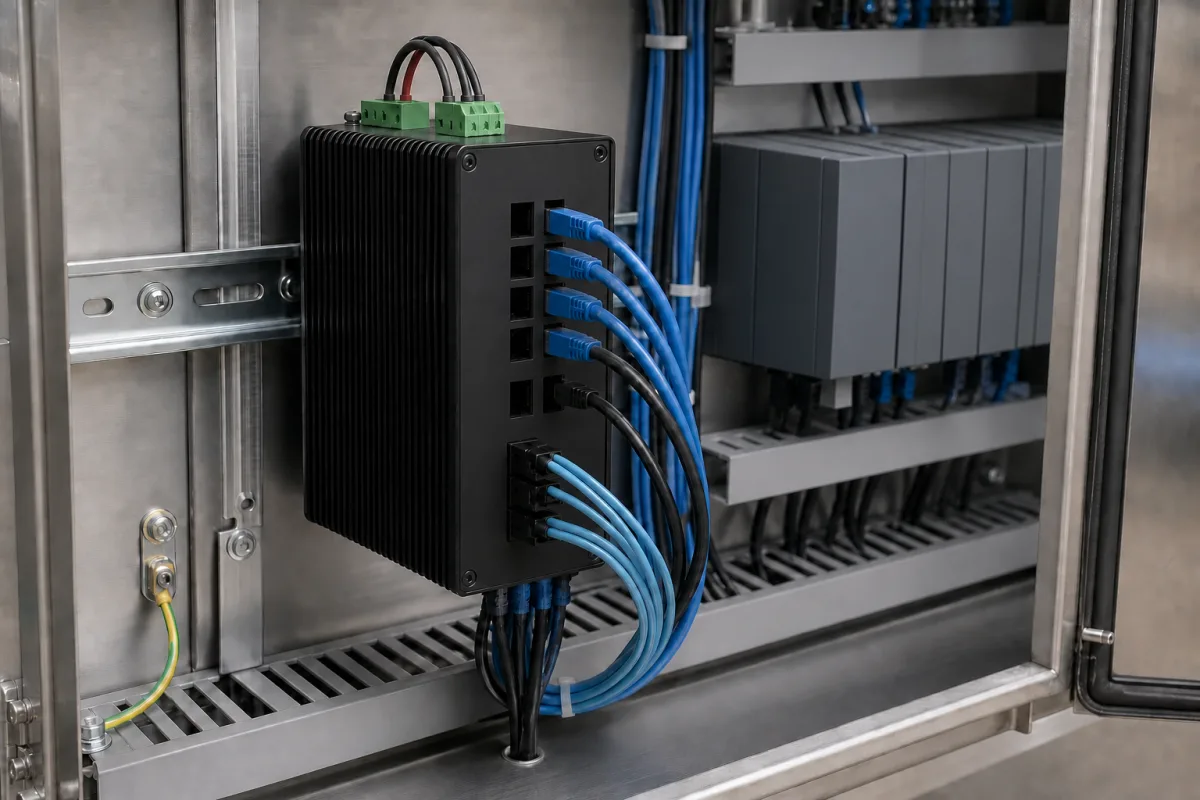
An industrial Ethernet switch connects controllers, I/O, drives and HMIs on a machine or plant network, built for DIN-rail mounting, wide temperatures and industrial interference, like the compact switch pictured in a control cabinet. Ask three things first: whether the network carries real-time I/O traffic that needs a managed switch, which temperature, EMC and hazardous-area ratings the location needs, and how the switch is powered and cooled in the enclosure.
DIN-rail and panel-mounted industrial Ethernet switches, managed and unmanaged, with copper and fibre ports, including PoE models. Office and data-centre switches, routers and firewalls on their own, media converters and wireless access points are outside this page.
CNFX editorial research · Sources checked October 12, 2026 · 4 sources
Rockwell Automation's Ethernet reference manual says unmanaged switches are inexpensive and simple to set up but provide no management, security or diagnostic information, so they are difficult to troubleshoot. It advises using them only where the application has no I/O traffic, or where it has I/O control and the network is not directly connected to the IT network, all nodes are its own devices and there is no potential to overload a device with traffic. Managed switches cost more and need configuration support, but can manage multicast traffic and provide diagnostics, security, segmentation and resiliency. [1]
The manual explains that IGMP snooping lets a switch forward multicast traffic only to ports with devices that requested it, and that unmanaged switches do not support STP, RSTP or any other resiliency protocol. It notes that network convergence after a fault must finish before connections time out; I/O connections time out at 4 × the requested packet interval (RPI), with a 100 ms minimum. [1]
Editorial calculation: with an RPI of 10 ms, 4 × RPI is 40 ms, so the 100 ms minimum applies; with an RPI of 50 ms the I/O connection times out at 200 ms. A redundant network has to recover within that window, which is why resiliency protocols and their recovery times matter on managed switches.
Give the supplier the number and type of ports (copper, fibre, speed, PoE), whether I/O or multicast traffic is carried, required management features (IGMP snooping, VLANs, redundancy protocol, diagnostics, security), operating temperature in the enclosure, EMC, hazardous-area and industry approvals, supply voltage and redundancy, mounting and available space.
02
Check temperature, EMC and power ratings
Rockwell Automation's technical data for its Stratix 2000 unmanaged switches lists two operating ranges, −10 to +60 °C for standard models and −40 to +75 °C for extended models, with −40 to +85 °C non-operating, 5–95% non-condensing humidity, 2 g vibration from 10 to 500 Hz, 15 g operating shock and an IP30 rating. EMC immunity includes 6 kV contact and 8 kV air ESD (IEC 61000-4-2), 10 V/m radiated RF and ±4 kV EFT on power ports, and certain models carry UL Class I Division 2, ATEX and IECEx Ex nA ratings when marked. [2]
The same data gives a 24 V power input accepting 12–48 V DC or 18–30 V AC (SELV), maximum power consumption from 3.4 W (5-port Fast Ethernet) to 10 W (10-port Gigabit with SFP slots), open-style enclosure rating, and minimum clearances of 51 mm top, bottom and sides and 64 mm in front to prevent overheating. Ports range from 5 to 18, with Fast Ethernet or Gigabit copper and fibre SFP modules (2 km multimode, 20 km singlemode for the preinstalled 100 Mbit modules). [2]
Editorial calculation: a 10 W switch on a 24 V DC supply draws about 0.42 A in steady state; size the supply and fuse for the stated maximum current and inrush rather than the nominal value, and add the heat to the cabinet's thermal budget.
03
Compare a second maker's unmanaged switch data
Pepperl+Fuchs' technical data for its ICRL2-U-5RJ45-DIN unmanaged switch describes five 10/100BASE-TX RJ45 ports with auto-MDI(-X) and autonegotiation in a rugged housing for harsh environments, suitable for PROFINET IO and EtherNet/IP, with an extended temperature range. [3]
Comparing it with the Rockwell Stratix figures above shows that ratings such as the temperature range, supply range, EMC standards and MTBF basis need to be read model by model rather than assumed from the product class. [3][2]
Editorial calculation: an MTBF of 67.9 years is about 595,000 hours; for a constant failure rate this is about 1.5% of units failing per year, so a plant with 100 such switches might expect one or two failures a year.
ICRL2-U-5RJ45-DIN (Pepperl+Fuchs)
Value
Ports
5 × RJ45, 10BASE-T/100BASE-TX, Category 5e or better
MAC table / jumbo frame
1K / 1,552 bytes; broadcast storm protection
Supply
12–48 V DC (24 V nominal), 3 W; overload and polarity protection
Ambient / storage temperature
−40 to +75 °C / −40 to +85 °C
Humidity / altitude
Up to 95% / 0–3,048 m
Protection
IP30
MTBF
67.9 years
EMC and safety
EN 55032, EN 55035, FCC Part 15 B; UL/CSA 61010-1, IEC 61010-2-201
Shock / vibration
EN 60068-2-27 / IEC 60068-2-6
State ambient temperature in the enclosure, supply voltage, required protocols and port count, and ask for the MTBF figure with its calculation method, EMC test standards and shock and vibration levels.
04
Read a managed switch's capacity and resilience data
Moxa's specification for its EDS-510E managed switch shows the figures an unmanaged sheet omits. It has 7 10/100BASE-T(X) RJ45 ports and 3 Gigabit combo ports (copper or SFP) for a redundant ring or uplink, supports Turbo Ring, Turbo Chain, RSTP/MSTP, IGMP v1/v2/v3 snooping and GMRP for multicast filtering, port-based and IEEE 802.1Q VLANs, and EtherNet/IP, PROFINET and Modbus TCP for device management, with RADIUS, TACACS+, SNMPv3, IEEE 802.1X, HTTPS and SSH for security. [4]
Editorial calculation: 0.68 A at 24 V DC is about 16.3 W, against a 10 W maximum for the largest Stratix 2000 unmanaged model, so budget the 24 V supply for management features as well as port count; and 725,532 h is about 83 years, a statistical failure rate rather than a service life. [4][2] Moxa's 8 kV contact and 15 kV air ESD levels are higher than the 6 kV and 8 kV Rockwell lists for the Stratix 2000, so compare EMC test levels number by number rather than by the standard's name. [4][2]
EDS-510E (Moxa)
Listed value
Switch properties
2,048 IGMP groups; 8 K MAC table; 64 VLANs (VID 1–4094); 1 Mbit packet buffer; 4 priority queues
Power
Redundant dual inputs, 12/24/48/−48 V DC (9.6–60 V DC operating); 0.68 A at 24 V DC; relay output 1 A at 24 V DC
Temperature
−10 to 60 °C (standard); −40 to 75 °C (-T model); storage −40 to 85 °C
EMC immunity
ESD 8 kV contact / 15 kV air; EFT 4 kV; surge 4 kV power and signal; 10 V/m radiated
Housing
Metal, IP30, 79.2 × 135 × 116 mm, 1,263 g, DIN-rail or wall mounting
Reliability
MTBF 725,532 h (Telcordia); 5-year warranty
05
Unmanaged, Gigabit DIN-rail and PoE switch listings
Listings include unmanaged and managed industrial Ethernet switches, Gigabit DIN-rail switches and industrial PoE switches. Ask each supplier for the full datasheet with temperature range, EMC test levels, approvals, power input and consumption, and the management features supported.
06
Ports, management, IGMP snooping and resiliency
IGMP snooping and a resiliency protocol are the two rows an unmanaged switch cannot fill, and both count once I/O traffic shares the network. [1]
Explore company information and manufacturing capabilities, then discuss the scope of your project with a relevant supplier.
Share this page
Compiled and source-reviewed by the CNFX editorial team.
Each manufacturer above links to the page on that company's own website where the product is listed, with the date we checked it. How we source and review
· Page last updated 13 October 2026
Buyer questions
Can I use an unmanaged switch for I/O traffic?
Rockwell Automation advises it only where the network is isolated from IT, all nodes are its own devices and no device can be overloaded with traffic. [1]
What temperature range do industrial switches cover?
Rockwell's Stratix 2000 switches come in −10 to 60 °C standard and −40 to 75 °C extended-temperature models. [2]
Why does IGMP snooping matter?
Rockwell explains that it forwards multicast traffic only to ports whose devices requested it, instead of flooding all ports. [1]
What temperature range do industrial unmanaged switches cover?
Pepperl+Fuchs' ICRL2-U-5RJ45-DIN, for example, is rated for −40 to +75 °C operation and −40 to +85 °C storage, with IP30 protection. [3]
What does a managed industrial switch add over an unmanaged one?
Moxa's EDS-510E, for example, lists IGMP snooping with 2,048 groups, 64 VLANs, ring redundancy (Turbo Ring, RSTP/MSTP), EtherNet/IP and PROFINET management and security functions such as IEEE 802.1X and SNMPv3. [4]
Sources and what still needs a direct check
Sources checked 2026-10-12. Rockwell Automation is an automation and switch maker; its reference manual gives design guidance for EtherNet/IP networks and its technical data gives values for its own switches. Pepperl+Fuchs and Moxa publish data for their own switches.