Industry-Verified Manufacturing Data (2026)

Insulated Tunnel Housing

Based on aggregated insights from multiple verified factory profiles within the CNFX directory, the standard Insulated Tunnel Housing used in the Machinery and Equipment Manufacturing sector typically supports operational capacities ranging from standard industrial configurations to heavy-duty production requirements.

Technical Definition & Core Assembly

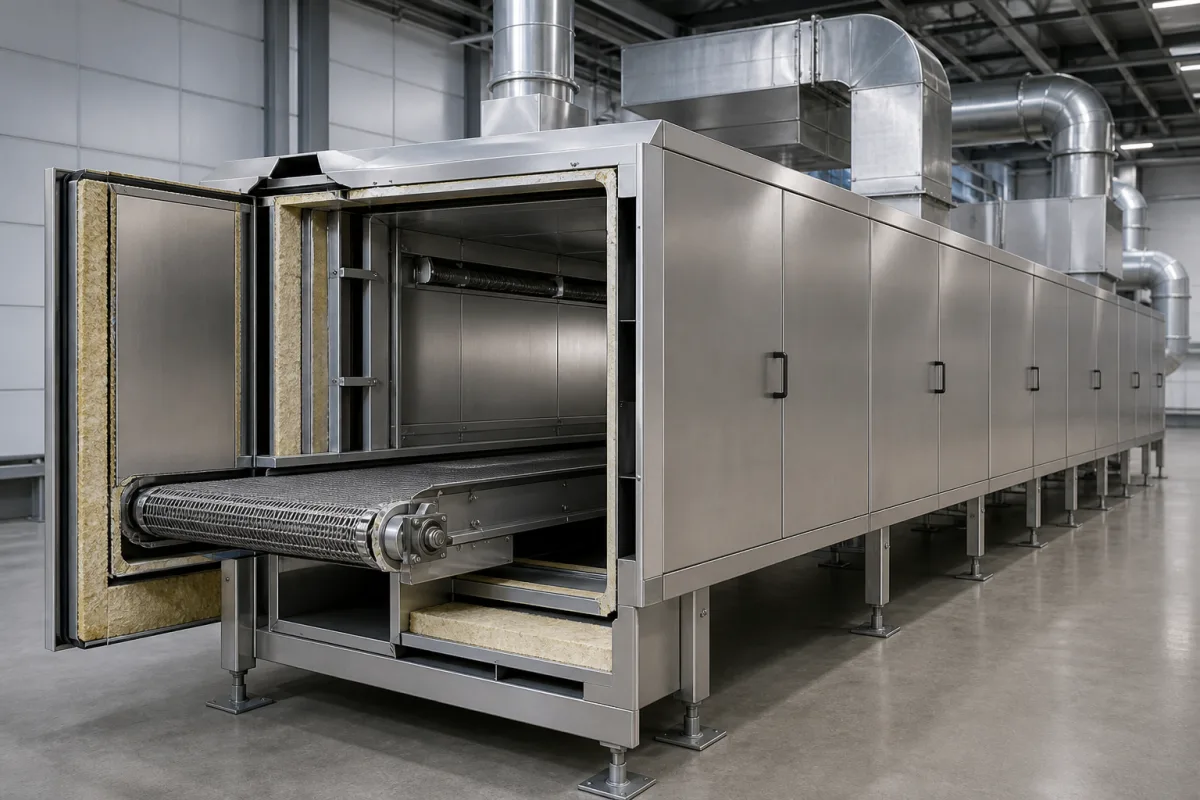
A canonical Insulated Tunnel Housing is characterized by the integration of Inner Liner and Insulation Core. In industrial production environments, manufacturers listed on CNFX commonly emphasize Insulated steel panels construction to support stable, high-cycle operation across diverse manufacturing scenarios.

The structural enclosure that provides thermal insulation for the cooling tunnel section.
Product Specifications

Technical details and manufacturing context for Insulated Tunnel Housing

Definition
A critical component of the Controlled Cooling Tunnel system, the Insulated Tunnel Housing serves as the protective outer shell that maintains consistent low temperatures within the tunnel by minimizing heat transfer from the external environment. It ensures energy efficiency and precise temperature control during product cooling processes.
Working Principle
The housing creates a sealed, insulated barrier around the cooling tunnel using materials with low thermal conductivity. This prevents ambient heat from entering the tunnel and maintains the controlled cooling environment required for consistent product processing.
Common Materials
Insulated steel panels, Polyurethane foam, Stainless steel cladding
Technical Parameters
  • Thickness of insulation material (mm) Standard Spec
Components / BOM
  • Inner Liner
    Provides smooth interior surface and protects insulation from moisture
    Material: Stainless steel
  • Insulation Core
    Reduces heat transfer between tunnel interior and external environment
    Material: Polyurethane foam
  • Outer Cladding
    Protects insulation from physical damage and environmental factors
    Material: Galvanized steel
  • Sealing Gaskets
    Ensures airtight connections between housing sections
    Material: Silicone rubber
Engineering Reasoning
Temperature differential: -40°C to +150°C across insulation barrier; Pressure differential: 0-2.5 kPa across housing walls
Thermal conductivity exceeds 0.035 W/m·K; Structural deformation exceeds 5 mm deflection under 3 kPa pressure; Moisture absorption exceeds 2% by weight
Design Rationale: Thermal bridging through insulation discontinuities (Fourier's Law: q = -k∇T); Polyurethane foam cell collapse under cyclic thermal stress (ΔT > 190°C); Water vapor diffusion through micro-cracks (Fick's Law: J = -D∇c)
Risk Mitigation (FMEA)
Trigger Polyurethane foam degradation at 180°C glass transition temperature
Mode: Insulation R-value reduction from 5.0 to 1.5 m²·K/W
Strategy: Ceramic fiber composite layer with 1200°C melting point
Trigger Condensate accumulation at dew point temperature differential > 15°C
Mode: Corrosion penetration rate > 0.5 mm/year on steel reinforcement
Strategy: Hydrophobic aerogel insulation with 0.016 W/m·K conductivity

Industry Taxonomies & Aliases

Commonly used trade names and technical identifiers for Insulated Tunnel Housing.

Applied To / Applications

This component is essential for the following industrial systems and equipment:

Industrial Ecosystem & Supply Chain DNA

Complementary Systems
Downstream Applications
Specialized Tooling

Application Fit & Sizing Matrix

Operational Limits
pressure: 0 to 2 bar (gauge)
flow rate: Up to 5 m/s fluid velocity
temperature: -40°C to +150°C
slurry concentration: Up to 40% solids by weight
Media Compatibility
✓ Food-grade cooling brines ✓ Process water with corrosion inhibitors ✓ Non-abrasive slurry mixtures
Unsuitable: Highly corrosive acidic solutions (pH < 2)
Sizing Data Required
  • Required cooling capacity (kW)
  • Tunnel cross-sectional area (m²)
  • Process fluid inlet temperature (°C)

Reliability & Engineering Risk Analysis

Failure Mode & Root Cause
Thermal insulation degradation
Cause: Moisture ingress compromising insulating materials, leading to reduced thermal efficiency and potential condensation issues.
Structural fatigue cracking
Cause: Cyclic thermal expansion and contraction stresses, combined with vibration from adjacent equipment, causing material fatigue at joints or supports.
Maintenance Indicators
  • Visible condensation or frost formation on external surfaces indicating insulation failure
  • Audible creaking or cracking noises during temperature transitions signaling structural stress
Engineering Tips
  • Implement regular infrared thermography surveys to detect early thermal anomalies and insulation breakdown before failure occurs
  • Install expansion joints and flexible connections at critical interfaces to accommodate thermal movement and prevent stress concentration

Compliance & Manufacturing Standards

Reference Standards
ISO 9001:2015 - Quality management systems ASTM C177 - Standard Test Method for Steady-State Heat Flux Measurements and Thermal Transmission Properties by Means of the Guarded-Hot-Plate Apparatus CE Marking - EU compliance for construction products (CPR 305/2011)
Manufacturing Precision
  • Overall dimensions: +/- 2mm per meter length
  • Insulation thickness: +/- 1.5mm
Quality Inspection
  • Thermal conductivity test (ASTM C177)
  • Dimensional verification with laser scanning

Factories Producing Insulated Tunnel Housing

Verified manufacturers with capability to produce this product in China

✓ 94% Supplier Capability Match Found

S Sourcing Manager from United Arab Emirates Feb 13, 2026
★★★★★
"The technical documentation for this Insulated Tunnel Housing is very thorough, especially regarding technical reliability."
Technical Specifications Verified
P Procurement Specialist from Australia Feb 10, 2026
★★★★☆
"Reliable performance in harsh Machinery and Equipment Manufacturing environments. No issues with the Insulated Tunnel Housing so far. (Delivery took slightly longer than expected, but technical support was excellent.)"
Technical Specifications Verified
T Technical Director from Singapore Feb 07, 2026
★★★★★
"Testing the Insulated Tunnel Housing now; the technical reliability results are within 1% of the laboratory datasheet."
Technical Specifications Verified
Verification Protocol

“Feedback is collected from verified sourcing managers during RFQ (Request for Quote) and factory evaluation processes on CNFX. These reports represent historical performance data and technical audit summaries from our B2B manufacturing network.”

9 sourcing managers are analyzing this specification now. Last inquiry for Insulated Tunnel Housing from Vietnam (1h ago).

Supply Chain Compatible Machinery & Devices

Heavy-Duty CNC Plasma Cutting Machine

Industrial machine for precision metal cutting using plasma arc technology

Explore Specs →
Automated Assembly Line System

Integrated production system for sequential component assembly operations

Explore Specs →
Automated Powder Coating System

Integrated industrial system for applying dry powder coatings to metal substrates.

Explore Specs →
Centrifugal Pump Impeller

Rotating component that transfers energy to fluid in centrifugal pumps.

Explore Specs →

Frequently Asked Questions

What materials are used in insulated tunnel housing construction?

Our insulated tunnel housing is constructed with insulated steel panels, polyurethane foam insulation core, and stainless steel outer cladding for durability and thermal efficiency.

How does insulated tunnel housing improve cooling tunnel performance?

The housing provides superior thermal insulation that maintains consistent temperatures in cooling tunnels, reduces energy consumption, and prevents condensation in machinery manufacturing processes.

What are the main components in the insulated tunnel housing BOM?

The bill of materials includes inner liner panels, polyurethane insulation core, stainless steel outer cladding, and sealing gaskets to ensure airtight thermal protection.

Can I contact factories directly on CNFX?

CNFX is an open directory, not a transaction platform. Each factory profile provides direct contact information and production details to help you initiate direct inquiries with Chinese suppliers.

Get Quote for Insulated Tunnel Housing

Request technical pricing, lead times, or customized specifications for Insulated Tunnel Housing directly from verified manufacturing units.

Your business information is encrypted and only shared with verified Insulated Tunnel Housing suppliers.

Thank you! Your message has been sent. We'll respond within 1–3 business days.

Need to Manufacture Insulated Tunnel Housing?

Connect with verified factories specializing in this product category

Add Your Factory Contact Us
Previous Product
Insulated Tunnel Casing
Next Product
Insulated Wall Panels